

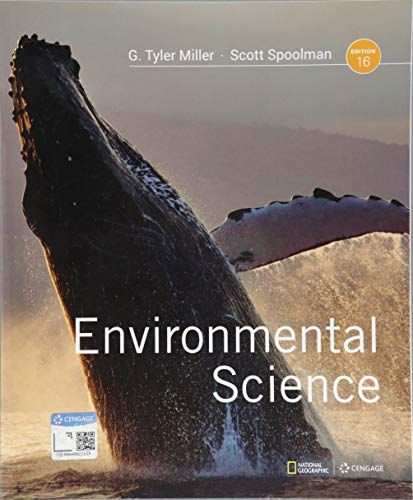
Environmental science
Introduction
Nova: Nearly three million students. Eight languages. Sixty-five editions. And one author who walked away from a tenured teaching career in 1975 because he believed the planet needed a textbook that could actually change how people think. Welcome to Aibrary. I'm Nova.
Atlas: And I'm Atlas. So Nova, are you telling me that an environmental science textbook — something most of us remember as a heavy doorstop from freshman year — has reached almost three million students worldwide?
Nova: That's exactly what I'm telling you. G. Tyler Miller's Environmental Science, now in its 17th edition with co-authors Scott Spoolman and Danielle Andrews-Brown, has been the most widely used environmental science textbook in the United States and around the world since 1975. We're talking about a book that has literally shaped how generations of students understand their relationship with the planet.
Atlas: But here's what gets me curious — what makes a textbook endure for fifty years? I mean, environmental science is one of those fields where the science keeps shifting, the data keeps updating, and the urgency keeps ratcheting up. How does a book stay relevant through all of that?
Nova: That's the perfect question to anchor today's episode. Miller's book isn't just a reference manual. It's built around a single, unifying idea — sustainability — and everything flows from that. He famously said, "If I had to pick a time to be alive, it would be the next 75 years." Not because things are going well, but because his generation and the ones after it have what he calls an unprecedented opportunity to learn how to live sustainably by working with nature instead of against it.
Atlas: Okay, that's a bold framing. Let's dig into what makes this book tick — the man behind it, the principles that structure it, and why it's still the gold standard in environmental education.
How G. Tyler Miller rewrote environmental education
The Accidental Textbook Revolutionary
Nova: Let's start with the author himself, because his story explains a lot about why this book reads differently. G. Tyler Miller has a PhD from the University of Virginia, and his professional background spans chemistry, physics, and ecology — which means he's genuinely interdisciplinary in a field that demands it.
Atlas: Right, because environmental science isn't just biology or just chemistry. It's where all the sciences collide with human behavior, economics, and politics.
Nova: Exactly. Miller taught college for 20 years and actually developed one of the nation's first environmental studies programs. But in 1975, he made a fascinating decision — he left teaching to write environmental science textbooks full time. He founded an organization called Earth Education and Research, devoted entirely to improving environmental education.
Atlas: Wait, so he walked away from the classroom to reach a bigger classroom. That's a gutsy move in 1975, when the modern environmental movement was barely a few years old.
Nova: It was visionary. Remember, the first Earth Day happened in 1970. The EPA was created that same year. Environmental science as a formal academic discipline was still in its infancy. Miller saw that students needed a coherent framework for understanding how Earth's systems work and how humans fit into them — not just a collection of scary facts.
Atlas: And the results speak for themselves. His books have been translated into eight languages, and he's received two honorary doctorates for his contributions to environmental education. The 17th edition, released in February 2024, now brings in Danielle Andrews-Brown to update the language and examples to reflect diverse cultural perspectives.
Nova: What I find remarkable is that Miller co-authored with Scott Spoolman for many editions, creating a partnership that kept the book current through massive scientific advances — from early climate modeling to today's sophisticated understanding of ecosystem services and tipping points. And through all those editions, one concept has anchored everything.
Solar energy, biodiversity, and chemical cycling
The Three Pillars of Life on Earth
Nova: Miller opens his book with a deceptively simple observation: Earth has been sustaining itself for about 3.5 billion years. So if we want to understand sustainability, we should look at how nature itself operates. From studying natural systems, he distills three scientific principles of sustainability.
Atlas: Alright, walk me through them.
Nova: First, reliance on solar energy. The sun warms the planet and powers photosynthesis. Plants are essentially bottling solar energy for use by every other organism. Without the sun, there's no food web. Period. Second, biodiversity — the variety of genes, species, ecosystems, and ecosystem processes. Biodiversity provides food, pollination, pest control, and resilience against disturbances.
Atlas: And the third?
Nova: Chemical cycling, also called nutrient cycling. There's a fixed amount of matter on Earth — elements like carbon, nitrogen, and phosphorus don't just disappear. They cycle from the environment to organisms and back again. Think about nitrogen fixation by bacteria, or the carbon cycle moving through atmosphere, plants, animals, and soil. Natural systems don't produce waste the way human systems do. Everything gets recycled.
Atlas: So Miller's argument is that human societies violate all three of these principles. We rely on fossil fuels instead of solar energy. We're destroying biodiversity at alarming rates. And our economic systems are linear — take, make, dispose — rather than cyclical like nature.
Nova: That's exactly the critique. And this framework gives students a lens for evaluating every environmental issue they encounter. Is an activity aligned with these three principles? If not, it's fundamentally unsustainable. The elegance of this framework is that it's scientifically grounded — it's not an opinion. It's derived from observing how Earth's life-support systems actually work.
The vocabulary of environmental accounting
Natural Capital and the Ecological Footprint
Nova: Once Miller establishes those three principles, he introduces two concepts that have become essential vocabulary in environmental discussions: natural capital and ecological footprint.
Atlas: Natural capital — that's the idea that nature provides assets and services that have real economic value, right?
Nova: Exactly. Natural capital is the sum of all natural resources — air, water, soil, minerals, biodiversity — plus the ecosystem services they provide. Think of a forest: it provides timber, which we can price. But it also provides flood control, carbon sequestration, air purification, and habitat. Those services are rarely priced but they're enormously valuable.
Atlas: And natural capital degradation is what happens when we use these resources faster than they can regenerate.
Nova: Right. Overfishing, deforestation, soil erosion, groundwater depletion — these are all forms of natural capital degradation. Miller emphasizes that we're spending down Earth's natural capital like a trust fund kid burning through an inheritance. Then he introduces the ecological footprint — the amount of land and water needed to supply a person or population with resources and absorb their waste.
Atlas: This is where it gets personal. I remember taking one of those ecological footprint quizzes and finding out it would take something like four Earths if everyone lived like me.
Nova: That's the wake-up call Miller intends. The United States runs an ecological deficit of about negative 5.1 — the highest of any country. We're living beyond our biological means. And globally, humanity's ecological footprint exceeded Earth's biocapacity sometime around 1970. We've been in overshoot ever since.
Atlas: So these aren't just academic concepts. Miller gives students tools to measure their own impact and understand the scale of the problem. But he doesn't stop at diagnosis — the book is structured around solutions too.
How the textbook walks students through interconnected crises
From Ecosystems to Climate: The Arc of the Book
Nova: The textbook's chapter structure is worth understanding because it reveals how Miller and his co-authors build knowledge systematically. The 16th edition, for instance, begins with foundational science — matter, energy, systems thinking — then moves to ecosystems and biodiversity.
Atlas: So it starts with how nature works before diving into how humans are disrupting it.
Nova: Precisely. Early chapters cover ecosystems, biodiversity, evolution, species interactions, and population dynamics. Then it pivots to human systems — population growth, urbanization, climate and biodiversity patterns — before taking on the big applied challenges: food production, water resources, energy, pollution, climate change, waste management, and finally environmental economics and politics.
Atlas: I notice the biodiversity chapters come in pairs — sustaining species and sustaining ecosystems. That seems deliberate.
Nova: It is. Miller makes clear that you can't save species without saving their habitats, and you can't save habitats without addressing the root causes of destruction. The book consistently connects dots — showing how food production affects water, how energy choices drive climate change, how climate change threatens biodiversity, and how all of these connect to human health and economic stability.
Atlas: And the 17th edition, released in 2024, brings new co-author Danielle Andrews-Brown into the mix. What does she add?
Nova: Her contribution includes updated language and examples that celebrate diverse cultural perspectives on environmental issues. She also integrates new imagery and interactive mapping through the MindTap digital platform. The partnership with National Geographic Learning brings stunning visuals, case studies of National Geographic explorers, and virtual field trips that let students explore places like Hawaiian volcanoes or Yellowstone without leaving their seats.
Atlas: So it's not just a textbook anymore — it's a multimedia learning ecosystem.
Nova: And that matters because the scale of the challenges Miller describes demands engagement, not passive reading. Each chapter includes "Core Case Studies" that ground abstract concepts in real places and real communities, plus "How Would You Vote?" questions that push students to think through trade-offs.
Why Miller's book is ultimately optimistic
Solutions, Trade-offs, and the Power of Individual Choice
Nova: Here's what separates Miller's textbook from a lot of environmental writing: it refuses to be merely apocalyptic. The book is built around five subthemes — natural capital, natural capital degradation, solutions, trade-offs, and the importance of individuals.
Atlas: Solutions and trade-offs — that pair is really interesting. Because environmental problems rarely have clean answers.
Nova: Exactly. Miller doesn't pretend otherwise. Take energy: solar and wind are clean but intermittent. Nuclear is low-carbon but carries waste and safety risks. Natural gas burns cleaner than coal but still emits carbon dioxide and requires fracking. Every solution involves trade-offs, and Miller forces students to grapple with that complexity rather than reach for simplistic answers.
Atlas: And the fifth subtheme — the importance of individuals — that could sound naive in the face of global systemic problems.
Nova: It could, but Miller grounds it in the concept of the "tragedy of the commons." If everyone thinks their individual contribution to pollution doesn't matter, the cumulative effect is catastrophic. The flip side is that individual choices, multiplied across millions of people, can drive meaningful change. He connects personal decisions — what you eat, how you travel, what you buy — to systemic outcomes.
Atlas: So the textbook is educating students not just as scientists but as citizens and consumers.
Nova: That's exactly right. Miller introduces the idea of environmental worldviews — the beliefs and values that shape how people relate to the environment. He contrasts the "planetary management" worldview, which sees humans as separate from and dominant over nature, with the "environmental wisdom" worldview, which sees humans as part of nature and dependent on its health.
Atlas: And that connects back to his famous quote about wanting to live in the next 75 years. He sees this moment not just as a crisis but as an opportunity for transformation.
Nova: He does. He believes that within our lifetimes, humanity can learn to live more sustainably by mimicking nature's own operating principles — what the book calls biomimicry. The textbook highlights examples like designing buildings that function like termite mounds for natural cooling, or developing materials that self-clean like lotus leaves. Nature has already solved many of the problems we're wrestling with.
Conclusion
Nova: So let's pull this together. G. Tyler Miller's Environmental Science has endured for half a century because it does something rare: it provides both a rigorous scientific framework and a moral vision. The three principles of sustainability — solar energy, biodiversity, and chemical cycling — give students an enduring lens for evaluating every environmental challenge they'll encounter. The concepts of natural capital and ecological footprint make the stakes concrete and measurable.
Atlas: And the book doesn't shy away from complexity. Through its five subthemes — natural capital, degradation, solutions, trade-offs, and individual action — it prepares students to think critically rather than react emotionally. It's built on the conviction that informed people, multiplied by millions, can bend the arc toward sustainability.
Nova: What strikes me most is Miller's perspective as someone who has been doing this work since the 1970s. He's watched environmental awareness grow dramatically. He's also watched emissions rise, forests fall, and species vanish. And yet his central message remains: look at how nature works. It's been sustaining itself for 3.5 billion years. The blueprint is right in front of us.
Atlas: The 17th edition, now with Danielle Andrews-Brown adding fresh perspectives, carries that message to a new generation of students — students who will face the consequences of decisions being made right now. It's not just a textbook. It's an invitation to participate in what Miller calls the most important project of our time.
Nova: Beautifully said. And whether you're a student picking up this book for the first time or someone who read an earlier edition decades ago, the core question remains the same: how do we learn to live on this planet without using it up?
Atlas: This is Aibrary. Congratulations on your growth!