Navigating the Achievement Trap in a Modern World
Golden Hook & Introduction
SECTION
Nova: Productivity has become the religion of our time, and the price of admission is our own exhaustion. We treat our lives like optimization problems, constantly patching the software of our daily routines, yet the hardware—our actual human brains—seems to be running hotter than ever.
Atlas: That hits home. I was staring at my calendar this morning, color-coding my tasks, and realized I felt like a contestant in a game show where the prize is just... more tasks. It is wild how we have turned our entire existence into a pursuit of output.
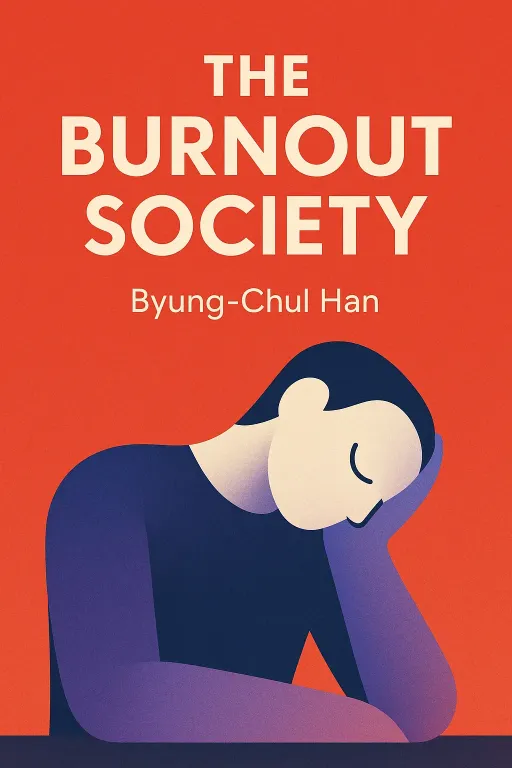
Nova: That is exactly the dynamic we are unpacking today. We are looking at a collision between two massive, conflicting ideas. On one side, we have Byung-Chul Han’s The Burnout Society, which argues that we have moved from a society of discipline to a society of achievement. In the old days, you had an external boss telling you what to do. Today, you are the boss, the employee, and the slave driver all in one.
Atlas: I can see that. I do not need a manager to tell me to check my email at 10 PM. I do that to myself because I feel like I am falling behind.
Nova: Precisely. And then, we have Steven Pinker’s Enlightenment Now. Pinker presents a mountain of data showing that, objectively, human life, health, safety, and prosperity are at their highest historical peak. We are safer, richer, and healthier than at any point in human history.
Atlas: That creates a massive tension. If the data says everything is objectively better, why does it feel like we are all sprinting on a treadmill that is set to a speed we cannot maintain?
Nova: That is the central question of our conversation. How do we reconcile the fact that we have built a paradise on paper, but we feel like we are living in a burnout factory?
The Achievement Trap
SECTION
Atlas: It feels like we are living in a paradox. I look at the numbers Pinker puts out, and I believe them. Yet, my own experience, and what I see in my friends, is that we are constantly tired. How does Han explain this? Why are we doing this to ourselves if we are supposedly living in the golden age?
Nova: Han’s insight is brilliant because he identifies the shift in the nature of power. In the past, society was defined by prohibition. You were told what you could not do. There were strict boundaries. But Han points out that our modern era is defined by the verb "can." We are constantly bombarded with the idea that we can achieve anything, that we can be anything, that we can optimize everything.
Atlas: Right. The "limitless potential" narrative. It sounds empowering until you realize it means there is never a finish line.
Nova: Exactly. The "I can" creates a tyranny of its own. When you believe you can do everything, you feel like a failure for not doing everything. You start exploiting yourself. You don't need a factory overseer with a whip when you have an internal voice telling you that you are not productive enough, not fit enough, not successful enough.
Atlas: I have definitely felt that voice. It is a subtle, constant hum in the background. It is not about someone else oppressing me; it is about me feeling like I am wasting my time if I am not maximizing every single hour.
Nova: That is the achievement subject. Han argues that this self-exploitation is actually more efficient than external exploitation because it is voluntary. You are the one driving the car, and you are the one pushing the pedal to the floor until the engine blows. You are not being forced to work; you are choosing to work because your self-worth is tied to your output.
Atlas: That is a tough pill to swallow. It means the solution isn't just to find a better boss or a better company culture. It means the work is internal. But wait, how does this relate to the idea of mastery? I know our listeners are driven by a hunger for mastery. Does Han suggest we should just give up on achievement?
Nova: Not necessarily. The problem isn't achievement itself; the problem is the of the achievement. Han talks about the difference between a life of deep, focused action and a life of constant, scattered activity. He suggests that we have lost the ability to be bored, to contemplate, to engage in deep, non-productive time. We view rest as a way to recharge so we can get back to work, rather than as an essential part of being human.
Atlas: That is a great distinction. I treat my weekend like a pit stop in a Formula One race. I sleep, I eat, I do a hobby, all so I can be faster on Monday. I am not resting; I am just preparing to work harder.
Nova: That is the trap. You are treating your life as a resource to be managed rather than an experience to be lived. When you view yourself as a machine that needs maintenance, you lose the ability to appreciate the present moment. You are always living in the future, in the next task, in the next achievement.
The Paradox of Prosperity
SECTION
Atlas: Okay, so we have established that we are driving ourselves into the ground because we feel like we are the CEOs of our own lives, and that is exhausting. But let's bring in Pinker. If I am sitting here, safe, fed, and with access to all the world's knowledge, why does the "I can" narrative feel so heavy? Why don't I feel the relief that comes with living in the most prosperous time in history?
Nova: That is the core of the paradox. Pinker’s Enlightenment Now is an incredible catalog of progress. He charts the decline of violence, the rise of literacy, the drop in extreme poverty, and the increase in life expectancy. He argues that we have made monumental strides because we used reason, science, and humanism to solve problems. But the reason we don't feel the relief is that our brains are not wired to perceive statistical progress.
Atlas: That makes sense. We are wired for survival, not for trend lines.
Nova: Exactly. We are wired to scan for threats. When you live in a world where extreme threats like plague, famine, and war are statistically lower than ever, your brain does not say, "Great, I can relax." Your brain says, "I have solved the big problems, so I must now worry about the small problems." We are hyper-sensitive to minor inconveniences because we have eliminated the major ones.
Atlas: It is the "first-world problem" phenomenon, but on a societal scale. We are optimizing our lives because we have the luxury to do so, but that luxury is creating a new kind of anxiety.
Nova: It is deeper than that. There is also the issue of comparison. In the past, you compared yourself to your neighbors. Now, you compare yourself to the entire world, filtered through the lens of social media. Pinker would argue that we are suffering from a disconnect between our objective reality and our subjective perception. We are living in a world of unprecedented opportunity, but we perceive it as a world of unprecedented competition.
Atlas: That is a perfect way to put it. I am not worried about a famine; I am worried about whether my career trajectory matches the person I saw on LinkedIn this morning. The stakes feel higher, even though they are actually lower.
Nova: And that is where the two authors meet. Han explains the of our exhaustion—the self-exploitation—and Pinker explains the of our anxiety—the fact that we are living in a world where everything is possible, which makes the pressure to succeed feel overwhelming.
Atlas: I am curious, though. If we accept Pinker’s view that we are living in a time of incredible progress, does that change how we should view our own productivity? Does realizing that we are objectively "winning" at life help us step off the treadmill?
Nova: It should. It provides a sense of perspective. When you realize that the baseline for human existence has risen so dramatically, you can stop viewing your life as a desperate struggle for survival. You can start viewing it as a project of self-actualization. The pressure to "achieve" shifts from a need to prove your worth to a desire to explore your potential.
Systems Thinking & Practical Application
SECTION
Atlas: That is a massive mental shift. Moving from "I must achieve to survive" to "I am achieving because I want to explore." But how does someone actually do that? I am a "Strategic Architect" type. I love efficiency. I want to build a system that works. How do I apply this without falling back into the trap of over-optimizing my life?
Nova: The key is to design systems that prioritize focus over volume. If you are an efficient learner, you don't need to read every book. You need to focus on the few ideas that actually change your trajectory. The "achievement trap" is about volume. The "mastery" path is about depth.
Atlas: So, instead of trying to clear my inbox, I should be asking, "What is the one thing that actually moves the needle on my legacy?"
Nova: Precisely. And you have to build in what Han calls "the time of no-time." You need to schedule periods where you are not being productive, where you are not optimizing, where you are simply existing. It feels counterintuitive to someone who values efficiency, but it is the most efficient thing you can do for your long-term cognitive health.
Atlas: That sounds like a radical act of rebellion. I can imagine our listeners thinking, "If I stop, I will fall behind."
Nova: That is the fear talking. But look at the data Pinker provides. The world is not going to fall apart if you take a walk without a podcast playing in your ears. The systems you have built, the career you have cultivated—they are more resilient than you think. You can afford to step back. In fact, you need to step back to maintain the perspective required to make high-quality decisions.
Atlas: I am thinking about the "Strategic Architect" persona we discussed earlier. They love to build systems. Maybe the system shouldn't be "How to do more," but "How to do less, but better."
Nova: That is the ultimate system. It is the art of subtraction. You identify the 20% of activities that provide 80% of your progress, and you ruthlessly eliminate the rest, not to create more time to work, but to create more time to.
Atlas: I like that. It turns the "achievement" mindset on its head. Achievement isn't about the quantity of boxes checked; it is about the quality of the life you are building.
Synthesis & Takeaways
SECTION
Nova: We have covered a lot of ground here. We started with the idea that we are exploiting ourselves in the name of achievement, and we balanced that with the reality that we are living in the most prosperous time in human history.
Atlas: It has been a fascinating tension to hold. On one hand, the internal drive to optimize everything is burning us out. On the other hand, we have the tools and the safety to actually pursue meaningful work if we choose to.
Nova: The takeaway is simple but challenging. You have to stop being the slave driver of your own life. You have to acknowledge the progress we have made as a species—which Pinker highlights—and use that as a foundation of security, not as a baseline for comparison. You don't need to compete with the whole world. You just need to compete with your own previous potential, and even then, do it with kindness.
Atlas: I think the most powerful thing I am taking away is that we need to be as intentional about our rest as we are about our work. If we don't design our systems to include space for contemplation, the "achievement trap" will fill that space with more noise.
Nova: That is the mark of a true Strategic Architect. You don't just build for output; you build for sustainability. You build for a legacy that includes both professional mastery and personal evolution.
Atlas: For our listeners today, here is the challenge: Commit to one 30-minute block daily where you do absolutely nothing "productive." No reading, no learning, no planning. Just think. Just be. See what happens when you stop the cycle of self-exploitation for just half an hour.
Nova: And remember, the goal is not to do more. The goal is to be more. You are not a machine to be optimized. You are a human being to be experienced.
Atlas: This has been such a great conversation, Nova. I feel like I have a much better framework for navigating this tension.
Nova: It is a lifelong practice, Atlas. But identifying the trap is the first step to escaping it. And to our listeners, thank you for joining us in this exploration. We hope you found the clarity you were looking for today.
Atlas: Keep building your legacy, and keep questioning the noise. This is Aibrary. Congratulations on your growth!
Closing
SECTION
Nova: We are signing off for now, but we will be back soon with more insights to help you navigate your world.
Atlas: Until next time.
Nova: This is Aibrary. Congratulations on your growth!