

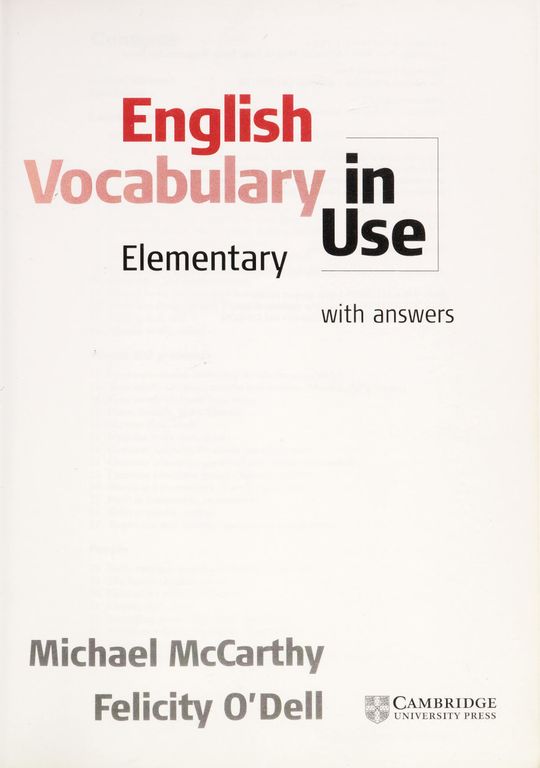
English vocabulary in use
Introduction
Nova: What if I told you that one vocabulary book series has sold millions of copies worldwide, been translated into multiple editions across four CEFR levels, and was built not on guesswork but on a massive computerized database of how English is actually spoken and written? That book series exists, and today we're diving deep into it: English Vocabulary in Use by Michael McCarthy and Felicity O'Dell.
Nova: That's exactly the question we're going to answer. These books weren't just slapped together. Michael McCarthy is an Emeritus Professor of Applied Linguistics at the University of Nottingham. He's spent over fifty years studying and teaching English, authored 58 books and more than 120 academic papers, and for the last thirty years, he's been analyzing enormous computerized corpora of real English texts to figure out which words people actually use and how they use them.
Nova: Precisely. And that's why this series has become, as Cambridge itself describes it, a best-selling vocabulary series that's been revised and updated across multiple editions since its first publication in 1994. Stick around, because we're going to unpack what's inside these books, why they work, and what even advanced learners might be surprised to discover.
Michael McCarthy and the Corpus Revolution
The Architect Behind the Books
Nova: Let's start with the man himself. Michael McCarthy is fascinating. He's Emeritus Professor of Applied Linguistics at Nottingham, a Fellow of the Royal Society of Arts, and he currently teaches English for Academic Purposes part-time at Cambridge University. But here's what really sets him apart: for three decades, he's been working with large, computerized corpora of English texts.
Nova: A corpus is basically a giant digital collection of real language. Think millions upon millions of words from newspapers, novels, conversations, academic papers, business meetings, radio broadcasts. McCarthy and his team feed these into software that reveals which words appear most frequently, which words tend to travel together, how grammar and vocabulary interact in authentic speech.
Nova: Exactly. The Cambridge International Corpus informs every level of English Vocabulary in Use. The vocabulary selection isn't based on tradition or intuition. It's based on frequency data. What words do people actually use right now? That's a radically different approach from older vocabulary books that might teach you perfectly correct words that nobody says anymore.
Nova: Yes, Felicity O'Dell. Together they built this series from the ground up. The first edition of English Vocabulary in Use, covering upper-intermediate and advanced, came out in 1994. Since then they've expanded it to four levels spanning A2 to C2 on the CEFR scale, plus an entire ecosystem of specialized spinoffs covering collocations, idioms, phrasal verbs, academic vocabulary, and business English.
Nova: McCarthy's research focused heavily on everyday spoken English. He noticed a gap between the English taught in traditional textbooks and the way people actually talk. His academic work, including the book Spoken Language and Applied Linguistics, argues that spoken English should be at the center of the syllabus, not treated as an afterthought. So the vocabulary in these books reflects real conversational patterns, not just formal written English.
Structure and Methodology
The Famous Two-Page Formula
Nova: Now let's get into the actual book structure, because this is where the magic happens. Every single unit in English Vocabulary in Use follows the same brilliant format: two facing pages. The left-hand page presents new vocabulary in context. The right-hand page provides exercises to practice it.
Nova: It sounds simple, but the execution is remarkably sophisticated. On the left page, vocabulary is never presented as a dry list. It's always embedded in authentic contexts: short articles, dialogues, labeled diagrams, or categorized tables. For example, in the upper-intermediate book, a unit on health might present vocabulary through a doctor-patient conversation or a magazine article about fitness.
Nova: Exactly. And the right-hand page exercises are varied. You'll find gap fills, matching tasks, error correction, word formation exercises, and questions that push you to use the vocabulary in your own sentences. The books also include a detailed answer key, which makes them genuinely usable for self-study.
Nova: The upper-intermediate book has 100 units, and the advanced book also has 100 units. The elementary level has 60 units. Each unit is designed to be completed in about 20 to 30 minutes. That means you could systematically work through a book in a few months with consistent daily practice.
Nova: Here's another smart design choice: the units are grouped thematically but you can do them in any order you like. The book explicitly tells learners this in the introduction. So if you're about to give a presentation at work, you can jump straight to the units on work and business vocabulary. If you're traveling, you can focus on the travel and tourism sections. It's modular.
Nova: And the thematic groupings are genuinely useful. Across the series you'll find units organized under topics like people, the world around us, daily life, work and study, leisure and entertainment, communication and technology, social concerns, and language concepts like word formation and collocation. Each unit covers roughly 20 to 25 new vocabulary items, which means the upper-intermediate book alone teaches about 2,500 words and phrases.
Real-World Impact and Reviews
What Learners Actually Say
Nova: So the theory sounds great, but what do actual learners say? I dug into reviews across Goodreads, Reddit, Amazon, and language learning forums, and the consensus is overwhelmingly positive. On Goodreads, the elementary level holds a 4.18 rating from over 330 ratings, the upper-intermediate and advanced combined edition has a 4.14 from over 300 ratings, and the advanced standalone has a 4.40 from nearly 250 ratings.
Nova: One Reddit user put it bluntly: "It is excellent. It helped me a lot years ago." Another described their method: "Study the left pages and do the exercises on the right pages. Do the exercises both out loud and in writing. Rewrite and repeat the corrected mistakes a few times."
Nova: Exactly. Some learners copy vocabulary into notebooks and transfer it to apps like Anki or Quizlet. Others treat the books as their primary curriculum. One learner wrote that they preferred writing words and examples in a notebook and then adding them to spaced repetition software. The two-page format makes it easy to extract whatever you need.
Nova: The most common limitation mentioned is that the books focus heavily on receptive vocabulary, meaning you'll get great at recognizing words when you read or hear them, but building productive vocabulary, actually using those words in speech and writing, requires additional effort. The exercises help, but they can't fully replicate real conversation. Some learners also note that the British English focus can be a bit jarring for those accustomed to American English, though Cambridge has released American English editions for some levels.
Nova: And that's a fair point. The book itself acknowledges this. The introduction to the advanced level says learners will ideally need between 6,000 and 8,000 words for comfortable advanced communication. The book provides the raw material, but McCarthy and O'Dell are clear that the books work best when combined with real-world practice: reading, listening, speaking, and writing in English.
Collocations, Idioms, Phrasal Verbs, and More
Beyond Vocabulary: The 'In Use' Ecosystem
Nova: One of the most impressive things about English Vocabulary in Use is that it spawned an entire ecosystem. Once McCarthy and O'Dell proved the demand was there, they expanded into specialized areas that most vocabulary books completely ignore.
Nova: There's English Collocations in Use, which has a 4.30 rating on Goodreads from over 160 ratings. Collocations are word partnerships that native speakers use naturally. We say "heavy rain," not "strong rain." We say "make a decision," not "do a decision." These pairings are notoriously difficult for learners because there's often no logical rule.
Nova: That's exactly it. Then there's English Phrasal Verbs in Use, rated 4.25. Phrasal verbs like "put up with," "come across," "get by" are famously challenging. This book organizes them by topic and particle, so you're learning patterns rather than memorizing random lists. And English Idioms in Use, which covers over 1,000 idioms and has a 3.99 rating.
Nova: Yes. The Academic Vocabulary in Use book is especially valuable because academic English has its own vocabulary conventions. Words like "hypothesize," "constitute," "notwithstanding" appear far more frequently in academic writing than in everyday speech. McCarthy brought his experience teaching English for Academic Purposes at Cambridge directly into that book.
Nova: And that's exactly what the CEFR alignment achieves. The elementary book maps to A2, the pre-intermediate and intermediate to B1, upper-intermediate to B2, and advanced to C1 and C2. In total across the series, learners master more than 7,000 words and phrases. The latest editions also include enhanced ebooks with audio, so you can hear the pronunciation and do interactive exercises on a tablet or computer. It's a complete system.
The Hidden Design Principles
What Makes This Series Different
Nova: Let's zoom out and talk about what really separates English Vocabulary in Use from the thousands of other vocabulary books on the market. I think there are three big differentiators.
Nova: First, the corpus foundation. McCarthy didn't sit in an office deciding which words were important. He analyzed millions of words of real English usage through the Cambridge International Corpus. This means the vocabulary is not just correct, it's current and frequent. The books teach words you'll actually encounter, not words that appear in dusty nineteenth-century literature.
Nova: Second, the books explicitly teach vocabulary learning strategies. Several units at the beginning of each book are dedicated to how to learn vocabulary effectively: using dictionaries, keeping vocabulary notebooks, understanding word formation with prefixes and suffixes, recognizing collocations, and using context to guess meaning. These are metacognitive skills that benefit learners long after they've finished the book.
Nova: Third, and this is subtle but powerful, the books treat vocabulary not as isolated items but as part of a network. Words are presented in semantic families, with attention to register, connotation, and usage restrictions. You're not just learning that "skinny" and "thin" both describe body size. You're learning that "skinny" has a negative connotation, "slim" has a positive one, and "thin" is neutral. These distinctions are what separate intermediate from advanced speakers.
Nova: Right. And the books also pay close attention to word grammar. Many units cover which prepositions follow certain words, whether a word is typically used in active or passive voice, and what grammatical patterns a word appears in. For example, the upper-intermediate book has units on dependent prepositions: we say "interested in," "good at," "afraid of." These small grammatical details are what make vocabulary usable in real sentences.
Nova: That's a great way to put it. The line between vocabulary and grammar is blurrier than most people think, and McCarthy's research has always emphasized that connection.
Conclusion
Nova: So after diving deep into English Vocabulary in Use, what's the big takeaway? I think it's this: the series succeeded because it combined rigorous academic research with a brilliantly simple user experience. Michael McCarthy and Felicity O'Dell didn't just write another vocabulary book. They built a data-informed, strategically structured, modular learning system that respects the learner's autonomy.
Nova: The key insights for anyone considering these books: the two-page unit structure makes learning manageable and trackable. The corpus-informed vocabulary ensures you're learning words that actually matter. The thematic organization lets you prioritize what's relevant to you. And the ecosystem of specialized books means you can go deep into collocations, idioms, phrasal verbs, or academic vocabulary when you're ready.
Nova: Absolutely. Think of English Vocabulary in Use as your vocabulary infrastructure. It gives you the building blocks. But you still need to go out and build things with them. The books work best when paired with extensive reading, listening to authentic English content, and, most importantly, speaking with real people.
Nova: It's applied linguistics in the truest sense. Research that leaves the ivory tower and lands on a learner's desk in Seoul or São Paulo or Stockholm. And given that the series now includes enhanced ebooks with audio, interactive exercises, and cross-platform compatibility, it continues to evolve with how people actually learn today.
Nova: This is Aibrary. Congratulations on your growth!