

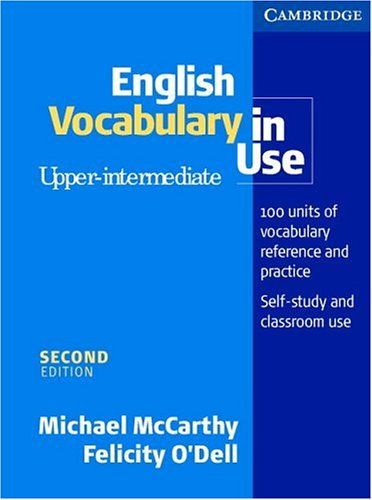
English Vocabulary in Use Upper-Intermediate
Introduction
Nova: Picture this. You're in the middle of a conversation in English and you know exactly what you want to say, but the word just isn't there. It's on the tip of your tongue, but your vocabulary has hit a wall. Sound familiar? That frustrating moment between knowing enough English to get by and actually feeling confident and expressive — that's the upper-intermediate plateau. And today, we're diving into the book that has helped millions of learners break through it: English Vocabulary in Use Upper-Intermediate by Michael McCarthy and Felicity O'Dell.
Nova: I love that skepticism, Sage, because that's exactly what I wondered too. But here's the thing: this book has sold millions of copies worldwide, is now in its fourth edition, and has been a cornerstone of Cambridge University Press's catalog for decades. Michael McCarthy isn't just any textbook author — he's an emeritus professor of applied linguistics who has spent over 52 years studying and teaching English, and he literally helped pioneer the use of computerized corpora to understand how English is actually used in the real world.
Nova: Exactly. So instead of teaching vocabulary based on what someone thinks people should say, McCarthy and O'Dell built this book around what millions of English speakers actually do say. And that's just the beginning of what makes this book worth talking about. So stick around, because we're going to unpack the methodology, the structure, and the surprising wisdom inside English Vocabulary in Use Upper-Intermediate.
How the Book's Design Changes Everything
The Two-Page Revolution
Nova: Let's start with the most obvious thing about this book, Sage. You open it up, and what do you notice right away?
Nova: That's precisely the point. That two-page format isn't just convenient — it's a deliberate pedagogical choice. Each unit presents about 25 to 30 new vocabulary items on the left-hand page using clear explanations, example sentences, and often illustrations or diagrams. Then the right-hand page gives you immediate practice. You learn it, you use it, all within one sitting.
Nova: Exactly. And here's the brilliance: that makes it incredibly flexible. You can do one unit a day as a disciplined self-study routine, or you can dip in and out based on what you need. The book doesn't demand that you go in order from unit 1 to unit 101. You can skip ahead to the unit on business vocabulary if you have a meeting coming up, or jump to the unit on crime and justice if you're binge-watching a legal drama.
Nova: It is. And the authors know that. The units constantly reference related vocabulary in other sections. So while studying emotions and moods in unit 49, you might get pointed toward the unit on idioms describing people, because real language doesn't stay in neat little boxes. Also worth noting: the fourth edition added an enhanced eBook with audio, so you can actually hear the pronunciation of every word on the left-hand page. That's huge for learners who are primarily self-studying.
What It Really Means to Know a Word
Beyond Definitions
Nova: Sage, here's a question for you. What does it actually mean to know a word?
Nova: That's what most people think. But McCarthy and O'Dell dedicate the very first unit of this book to dismantling that assumption. Unit 1, called Learning Vocabulary, argues that knowing a word involves at least four distinct things. First, you need to know which words it usually appears with — these are called collocations. You don't just know the word opinion, you know that people express an opinion or hold a strong opinion — not say an opinion or make an opinion.
Nova: Perfect example. Second, you need to know its grammatical characteristics. Is it countable or uncountable? Is it an irregular verb? Does it take a particular preposition? Third, pronunciation. And fourth, register — is this word formal, informal, or neutral? Would you use it in a job interview or only with close friends?
Nova: Exactly. And this is where McCarthy's corpus linguistics background really shines. The book doesn't teach English based on what sounds right to the authors. It draws from the Cambridge International Corpus — a multimillion-word database of real spoken and written English. So when the book tells you that particular collocations are common, that's not a guess. That's data. Native speakers really do say rich vocabulary and common sense — and they really don't say dense vocabulary or usual sense.
Nova: And here's a striking statistic from the book itself: there are over half a million words in English, but the average native speaker only uses about 5,000 in everyday speech. So the goal isn't to learn every word. It's to learn the right 3,000 words — and learn them deeply.
How the Book Organizes the English Language
The Architecture of 101 Units
Nova: Let's talk about how the book is actually organized, Sage, because it's not just a random collection of vocabulary topics. There's a real architecture here.
Nova: Right. The book opens with four units on what they call Effective Vocabulary Learning. This is the meta-section — it teaches you how to learn vocabulary. How to organize a vocabulary notebook, how to use a dictionary effectively, how to guess meaning from context. It's like giving you the tools before sending you into the workshop.
Nova: Precisely. Then you get into the big topic-based section — units 5 through 41. This is where you'll find vocabulary organized by real-world themes: countries and nationalities, the weather, describing people's appearance and personality, relationships, food, health and medicine, work, business, sport, art and literature, music, the environment, crime, money, education. It's basically a tour of human experience through vocabulary.
Nova: Exactly. But then the book shifts gears. After the topic units, you get sections on feelings and actions, basic concepts like numbers and time, connecting and linking words, word formation — that's prefixes, suffixes, roots, compound adjectives, compound nouns. Then there's a fascinating section on words and pronunciation, including commonly mispronounced words and homophones. And then sections on phrasal verbs and expressions, and finally a section on varieties and styles — formal versus informal words, similes, proverbs, US English versus UK English.
Nova: Unit 101. And it matters. Think about elevator versus lift, apartment versus flat, sidewalk versus pavement. For an upper-intermediate learner who might be consuming media from both sides of the Atlantic, understanding these differences is genuinely useful. The book recognizes that English isn't one monolithic thing.
Why Data-Driven Vocabulary Beats Intuition
The Corpus Revolution in Your Hands
Nova: Let's dig deeper into the corpus linguistics angle, Sage, because this is what really separates McCarthy's work from traditional vocabulary books.
Nova: Because human intuition about language is surprisingly unreliable. Research has shown that even experienced language teachers often can't accurately predict which words are most frequent or which collocations are most common. We tend to notice unusual words and overlook the everyday ones. A corpus — which is essentially a giant searchable database of real English usage — tells you what people actually say and write, not what we think they say.
Nova: Great question. Take the word nice. Many traditional textbooks might avoid it as too simple or too vague for upper-intermediate learners. But corpus data shows that nice is one of the most frequently used adjectives in spoken English, appearing in a wide range of collocations: nice weather, nice people, nice meal, nice to meet you, have a nice day. So rather than ignoring it, the book would teach learners how to use it naturally and appropriately.
Nova: Exactly. McCarthy has written extensively about how corpora reveal the phraseological nature of English — the fact that much of our language consists of prefabricated chunks rather than words we assemble from scratch each time. Think about expressions like by the way, at the end of the day, if you see what I mean. These aren't generated word by word — they're stored and retrieved as whole units. And this book teaches these chunks, not just individual words.
Nova: Unit 77 on binomials and unit 79 on multi-word expressions. Yes. And it's also why the book has a whole section on phrasal verbs and verb-based expressions — units on expressions with do and make, bring and take, get, set and put, come and go. These are some of the hardest things for learners to master because they often can't be translated word for word. But they're everywhere in real English. Corpus data confirms it, so the book prioritizes them.
Why This Book Works for Independent Learners
The Self-Study Sweet Spot
Nova: Sage, one of the things that keeps coming up in reviews of this book is how well it works for self-study. And that's not an accident — it was designed for it.
Nova: Several things. First, the answer key is comprehensive and included in the back of the book — not sold separately, not hidden online. Every exercise has answers. Second, the explanations are written to be understood without a teacher mediating them. They use clear examples and avoid jargon. Third, the enhanced eBook included with the fourth edition gives you audio for all the left-hand pages, so you're not guessing at pronunciation.
Nova: And that's exactly why unit 80 is dedicated to words commonly mispronounced. The book confronts the hardest parts of English head-on. But there's another self-study feature that's subtler: the units are designed to be self-contained enough that you feel a sense of completion after each one. You sit down, you work through a two-page unit, you check your answers, and you feel like you've accomplished something concrete. That momentum is psychologically important for independent learners who don't have a teacher or classmates cheering them on.
Nova: Yes. And the book also teaches you how to continue learning beyond its pages. Unit 2 is all about organizing a vocabulary notebook — not just writing down words with translations, but creating bubble networks, grouping words by topic or root, noting collocations, recording example sentences. It's teaching you to become an autonomous learner. The book is a springboard, not a cage.
Nova: McCarthy and O'Dell are explicit about this in the introduction. They say the book covers approximately 3,000 new words and phrases, but they encourage learners to read widely, listen to podcasts, watch films, change their phone language to English — all the things that build vocabulary beyond the classroom. The book gives you the foundation; real-world exposure builds the house.
Conclusion
Nova: So Sage, after all this, what stands out to you most about English Vocabulary in Use Upper-Intermediate?
Nova: It really is. The book respects both the complexity of language and the reality of learners' lives. It doesn't pretend that vocabulary acquisition is easy or fast, but it also doesn't make it harder than it needs to be. The left-page-right-page format, the modular structure, the corpus-informed content, the focus on collocations and chunks rather than isolated words — all of these design choices work together to create something that has genuinely stood the test of time.
Nova: Here's my takeaway for listeners: if you're at that upper-intermediate plateau — you can communicate, but you feel limited, repetitive, like you're using the same 500 words over and over — this book offers a path forward. Start with the four units on effective vocabulary learning. Then explore the topic units that matter most to your life. Do one unit a day. Keep a vocabulary notebook. Listen to the audio. And most importantly, use what you learn — in conversation, in writing, in thinking. Vocabulary doesn't live on the page. It lives in your mouth and in your mind.
Nova: Michael McCarthy once wrote that vocabulary is not a finite list to be memorized but a network of meanings and associations to be explored. This book is the map for that exploration. Happy learning, everyone.