

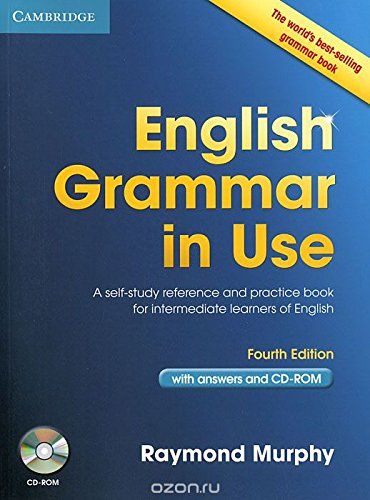
English Grammar in Use
Introduction
Nova: Picture this: It's 1985. A former English teacher in Oxford, frustrated that no grammar book actually helped his students, self-publishes a collection of worksheets. Two publishers reject it. The third takes a chance. Fast forward 40 years, and that book has sold over 30 million copies and reached an estimated 100 million learners worldwide. Today we're diving into "English Grammar in Use" by Raymond Murphy — the blue book that conquered the world.
Nova: That is exactly the question. And the answer reveals something fascinating about how we actually learn languages, what students really need, and why clarity beats cleverness every single time.
Nova: I'm Nova. And today on Aibrary, we're cracking open the world's best-selling grammar book.
How a teacher's frustration became a global phenomenon
The Accidental Bestseller
Nova: So the origin story of English Grammar in Use is genuinely charming. Raymond Murphy was teaching English as a foreign language — first in Germany starting in 1971, then at the Swan School of English in Oxford. He was facing a classic teacher's problem: his students kept asking grammar questions he couldn't cover in class. Multilingual classrooms with students from completely different language backgrounds, all with different gaps.
Nova: Exactly. So Murphy started writing his own worksheets. Simple explanations on one page, practice exercises on the other. He put them in the school library as a self-access resource. Students would look up a card index, find the worksheet they needed, work through it, and check their answers. And here's the key: these worksheets were so popular that Murphy thought, maybe this could be a book.
Nova: Two publishers flat out rejected it. Only Cambridge University Press saw potential. And even then, Murphy has said his main fear was that nobody would buy it anywhere. He was genuinely relieved when a few thousand copies sold in that first year. Some early adopters were in Italy in 1986, then it spread through Europe. A Korean translation appeared around 1990, and the rest is history.
Nova: And Murphy himself seems almost bemused by the whole thing. He received an honorary MA from Cambridge University in 2012, 27 years after the book was published. The Guardian called it a grammar "bible" — and the funny thing is, Murphy has admitted he's not even particularly interested in grammar as an academic subject.
Nova: His words! He said he's interested in presenting grammar — making it clear and simple — not in grammar itself. He once joked he might have been good at writing instruction manuals for washing machines. It's about clarity, not about being the world's greatest linguist.
Why the book's format changed everything
The Two-Page Revolution
Nova: Let's talk about the actual structure of the book, because this is where the genius lies. English Grammar in Use has 145 units. Every single unit is exactly two facing pages. Left page: grammar explanation with example sentences. Right page: exercises to practice that grammar point. That's it.
Nova: Think about what most grammar books do. They'll give you a long chapter of explanations — pages and pages of rules — and then at the end, some exercises. By the time you reach the exercises, you've forgotten half the rules. Murphy's format creates an immediate cycle: read, then do. No flipping back and forth. No cognitive overload.
Nova: Exactly. And Murphy was very deliberate about this. He didn't organize the units progressively — Unit 1 isn't necessarily easier than Unit 58. Instead, the units are grouped thematically: verbs at the front, then articles, nouns, adjectives, prepositions, and so on. The book has a study guide at the back that helps you diagnose your weak spots and directs you to the specific units you need.
Nova: And it reflects Murphy's core belief about how grammar learning should work. He famously described it using a "lay-by" analogy. Imagine you're driving on the main road of real language learning — speaking, listening, communicating. Occasionally, you pull into a lay-by, a rest stop, to check the map. That's what grammar study should be: a quick reference stop, not the whole journey.
Nova: Right. He's said he doesn't believe anyone has ever truly learned a language just through formal study. The natural learning — exposure, practice, real communication — that's the real thing. The grammar book is just a helpful companion on the side.
Nova: And that was the original vision — it was built for self-access before that was even a term in education. The answer key is included, the explanations use simple language, and the examples are drawn from everyday situations, not academic abstractions.
How one grammar reference conquered every continent
The Blue Book Goes Global
Nova: Now let's talk about the sheer scale of this thing. Over 30 million print copies since 1985. An estimated 100 million users when you factor in libraries, classrooms, and shared copies. Sixteen million copies sold just since 2010 alone.
Nova: That's the fascinating part. You'd think free online resources would kill a paid grammar book. But teachers and learners consistently say the opposite — free content is often unreliable or contradictory. With English Grammar in Use, there's trust. Cambridge University Press has maintained rigorous quality control. Every example has been tested. Every explanation has been refined through five editions.
Nova: Exactly. There's Essential Grammar in Use for elementary learners, covering A1 to B1 on the European framework. Then the classic English Grammar in Use — the "blue Murphy" — for intermediate learners at B1 to B2. And Advanced Grammar in Use for C1 to C2. Plus American English editions, and bilingual editions translated into Japanese, Korean, French, Spanish, and Italian.
Nova: Yes. The intermediate blue book is the top global seller, especially in Europe — Germany, Italy, the UK. But in Japan and South Korea, Basic Grammar in Use is actually the favorite. The series has adapted to regional needs while keeping the core format intact.
Nova: Cambridge University Press held a celebration at Downing College, Cambridge. About 100 members of the English language teaching community gathered. Raymond Murphy himself attended. The marketing director, Ian Cook, said the secret to the book's success is its ability to clearly explain English grammar in context and in simple language, with lots of opportunities to practice. He noted that the communicative approach that influenced Murphy back in the 1970s remains just as relevant now as it was 40 years ago.
The surprising case for structured grammar learning in the digital age
Why Grammar Books Still Matter
Nova: Let's address the elephant in the room. In 2025, with AI chatbots, language apps, and infinite free content — does anyone still need a printed grammar book?
Nova: And you'd probably get a decent answer. But here's what Murphy's book offers that a chatbot doesn't: a coherent, curated, pedagogically sound framework. Every unit builds understanding through carefully selected examples that show not just form, but meaning and use in context. Murphy described his process: when approaching something like "had better," he'd think about what the student's actual problem is. What does it mean? How does it overlap with "should"? Then he'd present examples that make those distinctions visible.
Nova: Not at all. The exercises are designed to help you internalize patterns, not just regurgitate facts. And because the examples use everyday language — "It's late, we'd better go" — they feel natural, not like textbook sentences.
Nova: Yes! And that philosophy runs through the whole book. The explanations use minimal technical jargon. The focus is always on understanding and using the language, not on classifying it. That makes it accessible to self-study learners who might not have a teacher to decode academic grammar terminology.
Nova: That's exactly it. And that humility shows in other ways too. When asked if his books should be used as classroom texts, he said it's totally up to the user — once a book is published, it's out of the author's hands. He genuinely believes learners should use the material however works best for them.
Nova: And that philosophy has now been validated by 40 years of global success. It turns out that when you solve a real problem with clarity and respect for the learner, you don't need marketing gimmicks or trendy methodology. You just need to be genuinely useful.
Conclusion
Nova: So here's what I take away from the story of English Grammar in Use. First, great educational resources often come from practitioners, not theorists. Raymond Murphy was a working teacher who built something because his students needed it. Second, clarity is a superpower. The two-page format, the simple language, the everyday examples — none of it is flashy, but all of it works. And third, there will always be a place for trustworthy, well-crafted resources, even in an age of free content.
Nova: It's also worth noting that Murphy sees grammar study as a supplement, not the main event. The lay-by, not the highway. So if you're an English learner, use the blue book — but don't live in it. Read it, do the exercises, then get back on the road: speak, listen, make mistakes, communicate.
Nova: Forty years, five editions, 30 million copies, 100 million users, and one teacher in Oxford who just wanted to help his students. Raymond Murphy didn't set out to change the world of English language teaching. He just wrote clear explanations and good exercises. And the world responded.