

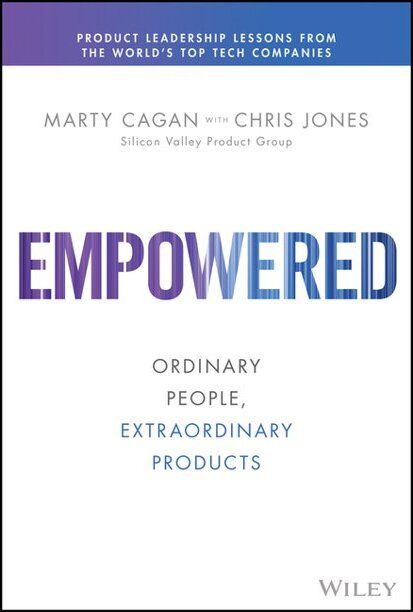
Empowered
Ordinary People, Extraordinary Products
Introduction
Nova: Imagine you are working at a massive tech company. You have some of the smartest engineers and designers in the world on your team. But every single day, you are told exactly what to build, down to the last button. You are essentially a high-priced order taker. This is what Marty Cagan calls the feature factory, and it is exactly what his book Empowered is trying to dismantle.
Nova: It happens because many organizations confuse management with leadership. They think that to be successful, they need to control every output. Marty Cagan, who is a legend in the product world, argues that the most successful companies—the Googles and the Netflixes of the world—do the exact opposite. They do not give their teams lists of features to build. They give them problems to solve.
Nova: Exactly. But it is not just a feel-good book about autonomy. It is a rigorous framework for how leaders can transform their organizations from a collection of mercenaries into a team of missionaries. Today, we are going to break down how to actually make that shift and why ordinary people can produce extraordinary products when they are given the right environment.
Key Insight 1
Mercenaries versus Missionaries
Nova: One of the most famous quotes from the book is that we need teams of missionaries, not teams of mercenaries. It is a distinction that Cagan borrows from John Doerr, but he really dives deep into what it looks like in practice.
Nova: A missionary is a team that is actually bought into the vision. They are not just building a login page because it was on the roadmap for Q3. They are building it because they understand that reducing friction at the entry point helps more users find value in the product. They feel responsible for the outcome, not just the output.
Nova: That is the mercenary trap. In a feature team, success is measured by the date. Did you ship the feature by Friday? In an empowered product team, success is measured by the business result. Did the feature actually solve the customer's problem? Did it increase retention or reduce churn?
Nova: It is much harder, which is why most companies take the easy way out and stay as feature factories. Cagan points out that in feature teams, the product manager is really just a project manager. They are just moving tickets across a board. In an empowered team, the product manager has to deeply understand the customer, the data, and the business constraints.
Nova: Absolutely. Cagan says that at least half of our ideas are not going to work. Either the customers won't use it, or they can't figure out how to use it, or it turns out it is too expensive to build. Mercenaries build all those bad ideas anyway because they were told to. Missionaries kill the bad ideas early so they can focus on the ones that actually move the needle.
Key Insight 2
The Holy Trinity of Product Teams
Nova: To make this missionary mindset work, Cagan talks about a very specific team structure. He calls it the product trio, or the empowered product team. It is usually made up of a product manager, a product designer, and at least two or three engineers.
Nova: They are still involved, but they are not part of the core discovery process. The magic happens within that trio. And here is the kicker: the engineers are involved from the very beginning. They aren't just handed a design and told to code it.
Nova: That is the biggest mistake a company can make. Cagan argues that the most important source of innovation is actually the engineers. They are the ones who know what is possible with the technology. If you only bring them in at the end to implement a design, you've missed out on the most valuable insights they can offer.
Nova: Exactly. That is what he calls feasibility. In an empowered team, the trio works together to address four big risks before they ever write a line of production code. Those risks are value, usability, feasibility, and business viability.
Nova: Business viability is the one that often gets ignored. It means, does this solution work for our specific business? Does it comply with legal requirements? Can our sales team actually sell it? Does it fit our brand? A product manager's job is to ensure the solution works for all those stakeholders without them having to micromanage the team.
Nova: Yes, and Cagan is very clear that the product manager role is the hardest one on the team. They have to have the same level of business understanding as the CEO, but without the authority of the CEO. They have to lead through influence and data, not through rank.
Key Insight 3
The Leadership Shift: Coaching and Staffing
Nova: If the teams are empowered, you might wonder, what do the managers actually do all day? If they aren't telling people what to build, are they just sitting around drinking coffee?
Nova: Cagan argues the opposite. In an empowered organization, the role of a leader—like a VP of Product or a CTO—actually becomes much more demanding. Their number one responsibility shifts from project management to coaching.
Nova: It means spending at least fifty percent of your time developing your people. If a product manager isn't performing well, a traditional manager might just take over their work or micromanage them. An empowered leader identifies the specific skill gap and works with them every single week to bridge it.
Nova: Beautifully put. Cagan says that you can't have empowered teams without competent people. If you empower a team that doesn't know what they are doing, you just get chaos. So, the leader's job is staffing and coaching. They have to hire the right people and then coach them until they are capable of making those high-stakes decisions.
Nova: It is faster in the short term, but it doesn't scale. If you are the only one making decisions, you become the bottleneck for the entire company. Empowered leaders focus on the strategic context. They provide the vision and the strategy so the teams can make their own decisions.
Nova: Precisely. If the team knows the vision—the future we are trying to create—and the strategy—how we plan to win in the market—they don't need to ask permission for every small feature. They already know the boundaries of the playground.
Key Insight 4
Vision, Strategy, and Team Topology
Nova: To give that compass to the teams, leadership has to do the hard work of defining a clear product vision. Cagan describes the vision as the North Star. It should be emotional and inspiring, usually looking three to five years into the future.
Nova: Yes, but not a plan of features. A product strategy is about focus. It is about identifying the most important problems to solve right now. Cagan points out that most companies fail because they try to do everything at once. A good strategy says, for the next six months, we are focusing exclusively on reducing the time it takes for a new user to find their first friend on the platform.
Nova: Exactly. He calls them team objectives. You give the team the objective, and they figure out the best way to achieve it. But there is another piece to this: team topology. This is how you actually organize those teams so they can be autonomous.
Nova: It is related to the org chart, but it is more about how teams are aligned with the product. You want to minimize dependencies between teams. If Team A has to wait for Team B to finish a piece of code before they can ship anything, they aren't really empowered. They are stuck.
Nova: That is the death of speed. Cagan advocates for organizing teams so they have as much end-to-end control as possible. Whether that is by customer journey, like a checkout team, or by a specific platform. The goal is to let teams run as fast as they can without tripping over each other.
Case Study and Challenges
The Struggle of Transformation
Nova: You're right, this transformation is incredibly difficult. Cagan even wrote a follow-up book recently called Transformed because so many people struggled with the ideas in Empowered. One of the biggest hurdles is trust.
Nova: Yes, but also trust between the product organization and the rest of the company. If the CEO doesn't trust the product teams to solve the business problems, they will revert to giving them lists of features. Cagan tells stories of companies where the stakeholders—like the head of sales—have a shadow roadmap of things they've promised to customers.
Nova: That is the ultimate empowerment killer. When that happens, the team is no longer solving for the whole market; they are solving for one specific customer. Cagan's solution to this is not to ignore the stakeholders, but to bring them into the process early.
Nova: You show them the data. You show them the discovery process. Instead of saying no to a feature request, an empowered product manager says, that is an interesting idea, let's look at how it helps us reach our current strategic objective. When you move the conversation from opinions to data and objectives, the power dynamics shift.
Nova: It does. That is why Cagan emphasizes that you need strong product leaders at the top who can protect the teams and maintain that culture of empowerment. He often points to companies like Amazon, where the culture is built on these principles of high-velocity decision-making and customer obsession. It is not a coincidence that they are so successful; they have built an environment where ordinary people are enabled to do extraordinary things.
Conclusion
Nova: We have covered a lot today, from the difference between mercenaries and missionaries to the four big risks of product discovery and the critical role of coaching. The big takeaway from Empowered is that the secret to great products isn't some genius founder with a magic vision. It is about creating an environment where smart, diverse teams are given the context and the trust to solve real problems.
Nova: That is the ultimate test. And for any leader listening, the challenge is clear: are you willing to stop being the one with all the answers and start being the one who asks the right questions? It is a journey that starts with coaching and ends with innovation.
Nova: If you are interested in transforming your team, I highly recommend picking up Marty Cagan's book for the full deep dive. There is so much more there about team objectives and the nuances of the product role.
Nova: This is Aibrary. Congratulations on your growth!