

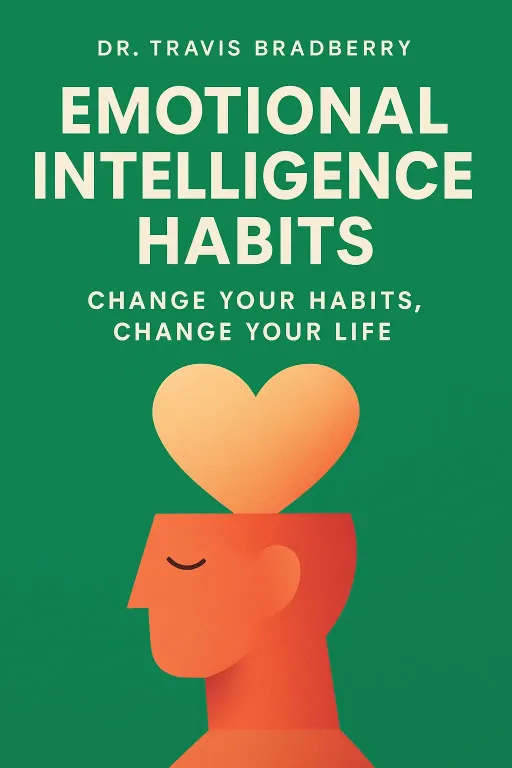
** **The EQ Habit: Mastering Your Emotions from Customer Support to the C-Suite**
Golden Hook & Introduction
SECTION
Nova: Have you ever finished a conversation, maybe with a difficult customer or a demanding boss, and just felt... completely drained? You know you handled it professionally, but inside, you're running on empty.
Dav: All the time. It's like you're holding your breath for the entire interaction, and when it's over, you finally exhale and realize how much energy it took just to stay composed.
Nova: Exactly. And it turns out, managing those moments isn't just about willpower. It's a skill, and according to Dr. Travis Bradberry's book 'Emotional Intelligence Habits,' it's a skill anyone can learn. Welcome to the show, everyone. Today, we're joined by Dav, who works on the front lines of these interactions every day in government customer support.
Dav: Thanks for having me, Nova. I'm really curious to get into this. The idea that this is a learnable skill, not just something you're born with, is really appealing.
Nova: It's a total paradigm shift! And that's what we're going to explore. Today, we're going to tackle this from two different angles. First, we'll explore the shocking neuroscience behind why our feelings so often overpower our logic. Then, we'll break down the practical, four-part toolkit anyone can use to master their emotional world.
Deep Dive into Core Topic 1: The Gage Paradox: Why Emotion Rules Reason
SECTION
Nova: So, to understand how to manage those feelings, Dav, we first have to understand where they come from. And the book starts with one of the most bizarre and illuminating stories in medical history: the case of Phineas Gage.
Dav: I’m intrigued. This sounds like more than just a self-help book.
Nova: Oh, it is. Picture this: it's 1848. Phineas Gage is a foreman for a railroad, known for being calm, capable, and well-liked. One day, there's an accident. A tamping iron—basically a three-and-a-half-foot-long metal rod, over an inch thick—is shot through his head by a blasting explosion. It enters under his cheekbone and exits through the top of his skull.
Dav: And he survived? That seems impossible.
Nova: Not only did he survive, he was walking and talking within minutes. His physical wounds healed. But the man who returned was not Phineas Gage. His doctor, J. M. Harlow, described the new Gage as, and I'm quoting from the book, "fitful, irreverent, manifesting but little deference for his fellows, impatient of restraint or advice when it conflicts with his desires." He lost his job, his friends, his entire personality was different.
Dav: So what happened in his brain?
Nova: That's the million-dollar question the book answers. The iron rod had destroyed most of his brain's prefrontal cortex. This is the rational, decision-making part of our brain. But it left the limbic system, the emotional center, largely untouched. Essentially, his emotional brain was left without a driver. All our sensory information—everything we see, hear, and feel—travels through the emotional limbic system it gets to our rational prefrontal cortex.
Dav: Wow. So that physical separation in his brain is a perfect metaphor for what it feels like sometimes. That initial flash of anger or frustration with a difficult person—it's like the emotional brain is reacting on its own before the 'manager' part of the brain can step in. The book says sensory info hits the emotional centers?
Nova: Exactly! That's the key. It's a biological pathway, not a character flaw. And this is where the book's definition of Emotional Intelligence, or EQ, becomes so powerful. It's, and I'll quote again, "your ability to recognize and understand emotions in yourself and others, and your ability to use this awareness to manage your behavior and relationships." It’s about strengthening the connection that Phineas Gage lost.
Dav: That's a game-changer. It reframes it from a personal failing—'Why did I get so upset?'—to a biological process we can learn to work with. It's not about feeling the anger, it's about what you with it once you feel it.
Nova: Precisely. And the data backs this up. The book mentions that EQ is responsible for 58% of performance in all types of jobs, and 90% of top performers are high in EQ. It’s not a soft skill; it's a fundamental driver of success.
Dav: That makes complete sense. In my job, the best outcomes happen not when I ignore a customer's frustration, but when I acknowledge it and then guide the conversation somewhere productive. I'm managing my emotions and theirs. I just never had a name for it.
Deep Dive into Core Topic 2: The Four-Skill Toolkit for Navigating Any Situation
SECTION
Nova: Exactly. And working it is where the practical side comes in. The book breaks EQ down into a fantastic four-part toolkit. It’s divided into two main competencies: Personal Competence—which is about you—and Social Competence—which is about how you interact with others.
Dav: Okay, a framework. As an analytical person, I love a good framework.
Nova: You'll love this one. Under Personal Competence, we have Self-Awareness and Self-Management. Under Social Competence, we have Social Awareness and Relationship Management. To make this real, let's use a story from the book about a marketing specialist named Sarah who had a terrible boss, a Mr. Thompson.
Dav: I think we've all had a Mr. Thompson at some point.
Nova: Right? So, Mr. Thompson was erratic, critical, and would publicly call Sarah's work 'unimaginative' and 'a waste of time.' He'd change deadlines at the last minute, creating a hugely stressful environment.
Dav: That sounds incredibly demoralizing.
Nova: It was. And here's how she used the toolkit. The first skill is. The book says this is your ability to accurately perceive your own emotions. Sarah didn't just ignore her feelings. She recognized that her anxiety was spiking and her job satisfaction was plummeting.
Dav: Right, she didn't just say 'this is a tough job.' She identified her specific emotional response. She named the feeling. That's the first, and sometimes hardest, step.
Nova: It is. And that awareness unlocked the second skill:. This is what you do with that awareness. Instead of lashing out or quitting in a huff, what did she do? She started documenting everything. Dates, times, specific quotes. She channeled her frustration into methodical data collection.
Dav: That's so smart. It's a proactive step that gives you a sense of control. In customer support, that could be documenting a recurring system issue a customer is complaining about, instead of just getting frustrated with the customer. It turns the emotion into a solvable problem.
Nova: That is a perfect example. It's about directing your behavior positively. Now for the other side of the coin: Social Competence. The third skill is, which is about accurately picking up on emotions in other people and understanding what's really going on. Sarah sought advice from a mentor and eventually decided to go to HR. She was aware of the social dynamics and the proper channels to use.
Dav: She was reading the room, essentially. Understanding the organizational landscape, who to talk to, and how they might react. That's a critical skill.
Nova: Absolutely. And it all culminates in the fourth and final skill:. This is using your awareness of your own emotions and others' to manage interactions successfully. When Sarah finally met with HR, the book says she 'calmly and professionally' presented her documented case. She didn't go in angry and accusatory. She managed that high-stakes interaction for a positive outcome.
Dav: Which is the hardest part. It brings all the other skills together. You can be self-aware and manage your own feelings, but if you can't communicate it effectively, it doesn't land. That's the core of de-escalation in my job, too. You have to be calm to create calm.
Nova: And it worked. HR launched an investigation, other employees came forward, and the boss was required to get management training. His behavior improved, and Sarah felt empowered and eventually got a promotion. She used all four skills to turn a toxic situation into a victory.
Dav: That's an amazing story because it shows that EQ isn't passive. It's not just about 'feeling your feelings.' It's an active, strategic process for creating better outcomes.
Synthesis & Takeaways
SECTION
Nova: I love how you put that. It’s a strategic process. So, we have this biological reality, thanks to Phineas Gage, that our emotions are powerful and fast. But we also have this practical, four-part toolkit to work with them. It's not about suppressing emotion, but channeling it.
Dav: Exactly. It's about being the intelligent manager of your own emotional world. Recognizing the signal, and then choosing the response, rather than just letting the automatic reaction take over.
Nova: And the book is filled with dozens of habits to build these skills. But for today, I want to leave our listeners with one that's so simple and so powerful for self-management. It's about gratitude.
Dav: I'm always a little skeptical of the 'just be grateful' advice, but I'm curious about the science.
Nova: I get that, but this is backed by hard data. Research from the University of California, Davis, found that taking time to contemplate what you're grateful for reduces the stress hormone cortisol by 23%.
Dav: Twenty-three percent? That's a tangible number. After a day of dealing with complaints and problems, that sounds like a necessary reset button.
Nova: It is! It physically calms your body down. So the challenge for us, and for everyone listening, is this: tonight, before you go to bed, just take 60 seconds. Think of one specific thing from your day you're genuinely grateful for. It could be a kind word from a colleague, a problem you finally solved, the taste of your morning coffee. Anything.
Dav: That feels doable. It’s not about pretending the bad parts of the day didn't happen, but about consciously giving weight to the good parts, too.
Nova: Precisely. It’s a small habit, but as the book's title says, "Change Your Habits, Change Your Life." Dav, thank you so much for bringing your front-line perspective to this. It's been fantastic.
Dav: This was so insightful. Thank you, Nova. I'm already thinking about my four-part toolkit for tomorrow.









