

The Resilient Blueprint: Building Your Leadership with Emotional Agility
Golden Hook & Introduction
SECTION
Atlas: There’s a great story, an old naval legend. Picture a massive British battleship, the HMS Defiant, cutting through the sea at dusk. The captain is on the bridge, proud, commanding. A lookout shouts, "Light, dead ahead!" The captain, annoyed, grabs his signal lamp and flashes a message: "Change course 10 degrees south." A message flashes back almost immediately: "You change course 10 degrees north."
Avi: Ah, a battle of wills already.
Atlas: Exactly. The captain is furious. He signals back, "I am a captain. Change course 10 degrees south." The reply is instant: "I am a seaman, second class. You change course 10 degrees north." Now the captain is apoplectic. He sends his final, thunderous message: "I am the HMS Defiant, a 35,000-ton battleship of Her Majesty's Imperial Navy. I am not changing course for anything. Change your course. Now." There's a short pause, and then the final, simple message flashes back: "We are a lighthouse, sir."
Avi: That’s brilliant. And painfully familiar.
Atlas: Right? Avi, as a real estate developer, you must see 'lighthouses' all the time—unmovable market realities, zoning commissions, geological surveys. You can't command them to move.
Avi: Absolutely. You can have the most beautiful architectural plans, the most perfect financial model, but if the city council says no, or the market shifts, that's the lighthouse. Your ego and your initial plan don't matter. You either change course, or you run aground. That story perfectly captures the danger of being too rigid.
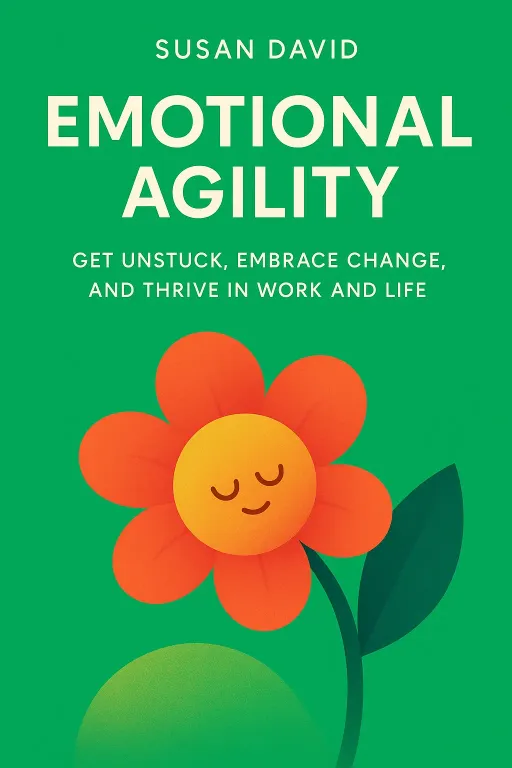
Atlas: And that's exactly what we're exploring today, through the lens of Susan David's incredible book, "Emotional Agility." It’s about the choice between being the rigid captain, headed for disaster, or the agile navigator who thrives. Today we'll dive deep into this from two perspectives. First, we'll explore the Rigidity Trap and how leaders get 'hooked' by their own emotions. Then, we'll shift to the Agility Blueprint, focusing on how to build resilience by 'walking your why' with tiny, deliberate tweaks.
Deep Dive into Core Topic 1: The Rigidity Trap
SECTION
Atlas: That battleship captain was 'hooked' on his own authority, his own story of being the most powerful thing on the water. In her book, Susan David argues that we all get hooked like this. Our thoughts, feelings, and old stories can trap us, making us act in ways that are completely counterproductive.
Avi: So it's not just about external facts, like the lighthouse. It's about our internal landscape getting in the way.
Atlas: Precisely. David shares a very personal story. A few years ago, a colleague left her a voicemail saying he was going to use her core concept as the title for his new book, without even asking. She was, understandably, furious. She immediately called her husband, Anthony, to vent. But he answered the phone and said, "Suzy, I'm in the operating room, a patient needs an emergency procedure, I can't talk." And he hung up.
Avi: Okay, a perfectly legitimate reason.
Atlas: A completely legitimate reason. But in her anger, her brain didn't process it that way. The story she told herself wasn't, "My husband is a doctor saving a life." The story became, "He's never there for me when I need him!" She got hooked on that narrative. And for two days, she gave him the silent treatment, wasting all that energy on a conflict that had nothing to do with the real problem—her colleague.
Avi: That’s such a powerful example of emotional misdirection. In real estate, you see this constantly. A deal gets delayed because of a financing snag, which is frustrating but impersonal. The leader then goes into a team meeting and becomes overly critical about a minor detail on a presentation slide. They're not angry about the slide; they're hooked on the frustration from the financing deal, and they're aiming it at the nearest, safest target.
Atlas: Exactly. David identifies four common hooks, but one that’s so relevant for leaders is what she calls "wrongheaded righteousness." It's that feeling of being so certain you're right that you refuse to see any other perspective. It's the battleship captain. It’s the developer who falls in love with their own project plan and ignores the market data—the lighthouse—telling them to pivot.
Avi: Or they get hooked on "old, outgrown ideas." A strategy that worked for a development project ten years ago, in a different economic climate, might be a recipe for failure today. But because it's a familiar story—"this is how we've always done it"—the leader gets hooked on it, even as the evidence mounts that it's not working. It's a kind of cognitive inertia.
Atlas: That's the perfect term for it. And what's dangerous is that these hooks operate automatically. They are our System 1, fast-thinking brain taking over. We don't even realize we're caught until we've already given our spouse the silent treatment or alienated our team. The first step to agility is just noticing the hook. Acknowledging, "Ah, I'm feeling that righteous anger again," or "I'm falling back on that old, comfortable strategy."
Avi: So awareness is the starting point. It’s about creating that tiny space that Viktor Frankl talked about—the space between stimulus and response. In that space lies our power to choose. For a leader, that space is everything. It's the difference between a reactive decision that causes damage and a considered response that moves the project forward.
Deep Dive into Core Topic 2: The Agility Blueprint
SECTION
Atlas: Exactly. So if getting hooked is the trap, how do we build the escape route? The book argues it starts with the third movement of emotional agility: 'Walking Your Why.' This is about getting crystal clear on your core values. Not your goals, like 'close three deals this year,' but your values—the principles that guide your actions, like 'integrity,' 'community,' or 'creativity.'
Avi: This feels like the foundation of building an organization's culture. It's the 'why' behind the 'what.' We're not just building a block of condos; we're 'creating a vibrant community.' We're not just maximizing profit; we're 'building with sustainable integrity.' That 'why' is the compass.
Atlas: It is the compass. And it protects you from getting hooked on external validation. The book tells the story of Jeff Kinney, the author of the mega-successful 'Diary of a Wimpy Kid' series. He had all the money and fame he could want, but he realized his 'why' wasn't just about selling more books. He felt unfulfilled. So, he took a risk and opened a local bookstore in his hometown. He said if that bookstore changed just one kid's life, it would be worth it. He reconnected with his deeper 'why'—fostering community and a love of reading.
Avi: That's a fantastic story. It's about defining your own scorecard. In development, it's easy to get caught up in the industry's scorecard: biggest building, highest price per square foot. But 'walking your why' might mean choosing a project that's more complex and less profitable but has a greater positive impact on a neighborhood. It's a long-term view of success.
Atlas: And here’s where it gets really practical and, I think, really powerful for a builder like you, Avi. The fourth movement is 'Moving On,' and the key principle here is making 'Tiny Tweaks.' You don't build a strong culture or become an agile leader overnight with some grand gesture. You do it through small, consistent, value-driven actions.
Avi: It’s architectural. You build a skyscraper one steel beam, one rivet at a time.
Atlas: Exactly! And the most compelling evidence for this is the 'Love Lab' study by psychologist John Gottman. He brought married couples into a lab apartment, watched them for 24 hours, and could predict with over 90% accuracy who would still be married years later.
Avi: How on earth could he do that?
Atlas: He wasn't looking at the big things, like whether they fought about money. He was looking at the tiny moments. He called them 'bids for emotional connection.' A bid could be as small as one partner saying, "Wow, look at that boat outside." The other partner has three choices. They can 'turn toward' the bid, 'turn away', or 'turn against'. The couples who consistently 'turned toward' each other's tiny bids were the ones who thrived. The health of their entire relationship was built on the foundation of these micro-interactions.
Avi: That is… profound. And completely translatable to leadership. It’s not about the big holiday party or the annual bonus. It's about the daily bids. A junior team member stays late to finish a report and says, "Phew, glad that's done." That's a bid. As a leader, do you turn toward it and say, "I really appreciate you putting in the extra time on this, thank you"? Or do you turn away and just walk past? That single, tiny moment can either build a culture of recognition and trust or a culture of disengagement.
Atlas: You've nailed it. That's the tiny tweak. It's a small, deliberate action infused with your values. If your 'why' is to build a collaborative team, then turning toward those bids is a non-negotiable tiny tweak. It's how you architect the culture you want, one small choice at a time.
Synthesis & Takeaways
SECTION
Atlas: So, it's a really clear and powerful blueprint. We start with the rigid battleship captain, convinced of his own power, heading for a crash. He's hooked. We've seen how leaders can get hooked on their own righteousness or old ideas, misdirecting their frustration and making poor decisions.
Avi: And then we have the path out. It's not about suppressing those emotions, but about noticing them. And then, instead of letting them drive the ship, you consult your compass—your 'why,' your core values. You ask, "What does the leader I want to be do in this moment?"
Atlas: And you execute that with tiny, deliberate tweaks. You build the resilient organization not with a single grand design, but through a thousand small, value-driven actions—like turning toward your team's bids for connection. From rigid to agile, from hooked to intentional.
Avi: It really reframes leadership from a series of big, heroic decisions to a consistent practice of small, mindful choices. It feels much more sustainable and, frankly, more human.
Atlas: So, to leave our listeners with a final thought, let's bring it back to that idea of a tiny tweak. The book challenges us to move from intention to action. So, the question for everyone listening is this: What is one tiny tweak you can make this week—in a meeting, in an email, in a conversation—that is aligned with the leader you truly want to be?
Avi: That’s the perfect question. For me, thinking about this now, it might be as simple as starting our weekly project update meeting by asking what the team is most proud of from the past week, before we dive into what's on fire. It's a tiny shift in focus from problems to progress. It's a bid to connect with their sense of accomplishment. A small tweak, but it could reframe the entire tone of our work.
Atlas: Courage is fear walking. And agility, it seems, is values walking, one tiny step at a time. Avi, thank you. This was fantastic.
Avi: Thank you, Atlas. A lot to think about.









