

Leading Through Emotional Complexity
Opening
SECTION
Nova: Content format.
Nova: English.
Nova: "Oh, a pop quiz!", "Right?", "That's intriguing.", "Oh man, I know that feeling.", "So it's like saying...", "That makes me wonder...", "Hold on...", "So, my recent win...", "That’s going to resonate...", "So, if Emotional Agility is...", "Beautifully put.", "That’s incredibly insightful.", "For leaders who are driven by impact...", "So, your 15 minutes...").
Golden Hook & Introduction
SECTION
Nova: Atlas, I've got a challenge for you today. In exactly five words, how would you review the concept of leading through emotional complexity? Go!
Atlas: Oh, a pop quiz! Hmm. "Feel it, label it, then lead."
Nova: "Feel it, label it, then lead." I love that! It's concise, it's actionable, and it perfectly encapsulates the nuanced dance we're exploring today. Because for too long, leadership advice has often been about suppressing emotion, or worse, pretending it doesn't exist.
Atlas: Right? It's like the old adage, "Leave your feelings at the door." Which, let's be honest, is about as effective as telling a tidal wave to go home. Emotions are powerful currents, especially in high-stakes environments.
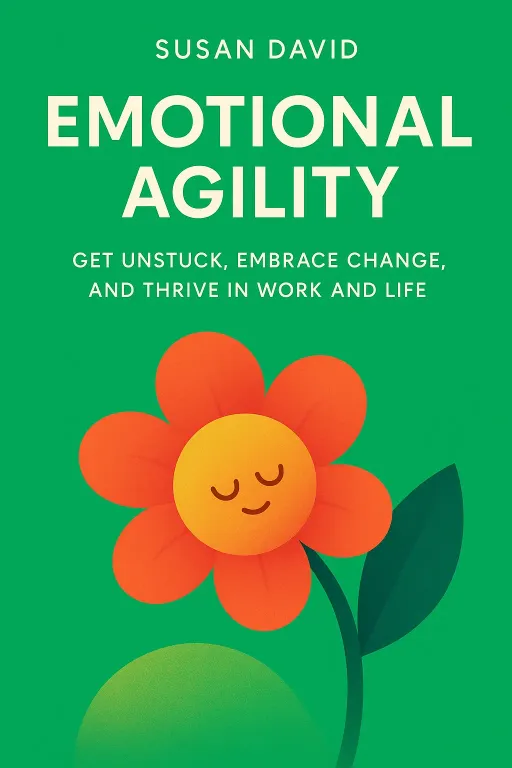
Nova: Absolutely. And that's why we're diving into some truly illuminating work today, pulling insights from two remarkable sources. First, we'll unpack Susan David's groundbreaking book, "Emotional Agility," which champions a radical idea: treating our emotions not as directives, but as data.
Atlas: Data. That's intriguing. I imagine a lot of our listeners, who are constantly analyzing spreadsheets and market trends, might find that a compelling way to reframe their inner world.
Nova: Precisely. And Susan David, who developed this framework, has a deeply personal understanding of emotional resilience. Her own life was profoundly shaped by grappling with grief and illness as a teenager, which led her to truly understand how we process and respond to difficult feelings. It’s not just theory for her; it’s lived experience.
Atlas: That adds such a powerful layer of credibility. It makes you wonder, what if we approached our own internal states with the same analytical rigor we apply to external problems?
Nova: Exactly. And building on that, we'll then pivot to David Noble and Carol Kauffman's "Real-Time Leadership," specifically their powerful MOVE framework. Noble and Kauffman come from extensive experience coaching top executives and navigating complex organizational changes, so their insights are grounded in the messy reality of corporate leadership. Their work emphasizes the critical need to validate your own vantage point before executing any strategy.
Atlas: So, if Susan David helps us understand the of our emotions, Noble and Kauffman help us understand the those emotions, and our own biases, shape our strategic actions?
Nova: You've hit the nail on the head, Atlas. It's about understanding both the raw material of emotion and the lens through which we perceive the world. Because in those crucial, high-stakes conflicts, the question isn't just "What am I feeling?" but "Is this emotion a signal of a core value being challenged, or just noise from the situation, filtered through my own unique perspective?"
Emotional Agility: Emotions as Data, Not Directives
SECTION
Nova: Let's start with Susan David's core premise in "Emotional Agility": the idea of 'unhooking' from difficult emotions. She argues that we often treat our emotions as literal commands. If we feel angry, we lash out. If we feel anxious, we avoid. But what if those emotions are simply messengers?
Atlas: That's a huge shift in perspective. For leaders, especially, there's often an expectation to be unflappable, to suppress any sign of weakness. But if you're telling me anger is just data, what kind of data is it providing?
Nova: It's phenomenal, right? Imagine this scenario: You're a strategic leader, you've just received some incredibly critical feedback on a project you poured your heart into. The initial reaction? A surge of anger, maybe defensiveness, a feeling of being undervalued. Your gut instinct screams, "Push back! Defend your work!"
Atlas: Oh man, I know that feeling. That initial gut punch can feel like a directive. It's hard to separate the emotion from the message.
Nova: And that's the trap. Instead of immediately reacting, David suggests a three-step process. First, the emotion. Don't push it away. "I am feeling anger right now." Second, it precisely. Don't just say "I'm upset." Is it frustration? Disappointment? Resentment? The more specific you are, the more you disarm its power.
Atlas: So it's like saying, "I'm not, I'm experiencing about the perceived lack of recognition for my team's efforts." That distinction feels subtle but incredibly powerful. It gives you a tiny bit of distance.
Nova: Exactly! That distance is the 'unhooking.' Once you’ve labeled it, the third step is to it as data. Ask yourself: "What is this frustration trying to tell me? Is it pointing to a genuine misalignment of values – perhaps my value of thoroughness isn't being met? Or is it simply noise, a knee-jerk reaction to a perceived threat that isn't actually there?"
Atlas: That makes me wonder, if I'm a strategic leader and I feel a surge of anxiety about a new market trend, is that anxiety 'noise' or a signal of a core value, like perhaps my team's security or the long-term viability of our strategy?
Nova: That's the million-dollar question, and it's where emotional agility becomes a superpower. If that anxiety is consistently triggered by genuine threats to your team's stability or a clear flaw in your strategic foresight, it's a signal. It’s data telling you to re-evaluate, to plan, to protect. But if it's a generalized, constant hum of worry that paralyzes you from making any decision, it might be noise. It’s your brain over-processing, perhaps, or reacting to shadows rather than substance.
Atlas: So, the goal isn't to be emotionless, but to become an expert interpreter of your own internal signals.
Nova: Precisely. You become a scientist of your own experience. You’re not trying to stop the feeling, but to understand its message, and decide if you want to follow its advice.
Real-Time Leadership: Validating Your Vantage Point
SECTION
Nova: This idea of discerning signal from noise perfectly sets us up for Noble and Kauffman's work in "Real-Time Leadership," particularly their MOVE framework. While Emotional Agility helps us understand the of our emotions, MOVE helps us understand the —our personal biases and filters—through which that data is being processed, especially before executing strategy.
Atlas: Okay, so MOVE. What does that stand for, and how does it connect to validating your vantage point?
Nova: MOVE is an acronym for how leaders can operate effectively in complex, ambiguous environments. It stands for Mindset, Options, Vantage Point, and Execution. Today, we're zeroing in on the 'V' – Validate your Vantage Point. This is about understanding your own perspective, your biases, your assumptions, and even your current emotional and physical state, before you make a critical decision or engage in a high-stakes conflict.
Atlas: Hold on, for our listeners who are constantly making high-stakes decisions, how do you 'validate' your vantage point without falling into analysis paralysis? Especially when you're driven by impact, you want to.
Nova: That's a crucial point, Atlas. It's not about endless navel-gazing. It's about a quick, critical self-assessment. Imagine you're in a heated negotiation. You feel confident, perhaps even a little aggressive, because you just closed a massive deal. That feeling of confidence is data. But your vantage point—your current state of mind, your recent success—might be making you overconfident, blinding you to subtle cues from the other party.
Atlas: So, my recent win, which feels great, could actually be a bias that skews my perception of the current negotiation? I'm seeing the situation through the lens of "I can do no wrong."
Nova: Exactly. Validating your vantage point means taking a moment to ask: "What are my current assumptions about this situation? What biases might I be bringing to the table right now? Am I overestimating my position because of a recent success, or underestimating it due to a past failure?" It means recognizing that your perspective is just perspective, and it's shaped by unique history, emotions, and beliefs.
Atlas: That’s going to resonate with anyone who struggles with imposter syndrome, or conversely, with overconfidence after a string of wins. So, what’s the practical step here? How do I validate it?
Nova: It starts with self-awareness, much like emotional agility. But it extends to actively seeking out diverse perspectives. Talk to someone who sees the situation differently. Ask your team, "What am I missing here?" or "How might someone else interpret this?" It's about deliberately challenging your own narrative before you commit to action. It’s a way to road-test your strategic thinking.
Atlas: So, if Emotional Agility is about understanding you're feeling, is 'Validating Your Vantage Point' about understanding you're feeling it, and how your history or current state is coloring your view, especially in the context of your actions?
Nova: Beautifully put. Emotional Agility helps you identify the raw emotional data: "I'm feeling anxious about this new product launch." Validating your vantage point then asks: "Why am I feeling this anxiety? Is it because I had a failed launch two years ago and I'm projecting that fear? Is it because I haven't gathered enough market data, and my fear is actually a signal of insufficient preparation? Or is it a genuine concern about a competitor's move that I need to address?"
Atlas: It’s the difference between blindly trusting your gut and intelligently questioning your gut.
Nova: Precisely. It’s not about ignoring your intuition, but refining it, making it more accurate and less susceptible to past baggage or momentary mood swings. This process allows leaders to move, not just react, but to move with clarity and purpose.
Synthesis & Takeaways
SECTION
Nova: So, bringing these two powerful ideas together, we see a clear path for leaders. It's about a two-stage process for navigating emotional complexity in high-stakes situations. First, you unhook from the raw emotion by labeling it as data. Then, you critically assess – your vantage point – before you even consider taking action.
Atlas: That’s incredibly insightful. So, when faced with that high-stakes conflict, the real question isn't just "What am I feeling?" but "Why am I feeling it, and how is my history or current state influencing how I see this entire situation?" It's about being honest with yourself about your own internal operating system.
Nova: Exactly. It's about understanding that your emotions are not just random occurrences; they are often signals. But the critical skill is to understand what kind of signal it is, and then to filter that signal through a validated, self-aware perspective. This approach transforms leaders from reactive decision-makers into deliberate, emotionally intelligent strategists.
Atlas: For leaders who are driven by impact, who seek to cultivate both prosperity and well-being, this isn't just about managing emotions; it's about optimizing their entire strategic approach. It's about ensuring that your internal state doesn't inadvertently sabotage your external goals.
Nova: Absolutely. It's the ultimate integration of personal growth and financial acumen. It's how you inspire teams with wisdom, because you've first cultivated wisdom within yourself.
Atlas: So, your 15 minutes of reflection today could be spent simply asking: "What emotion am I feeling right now, and is it a directive, or just data filtered through my current lens?" That's a powerful and practical step.
Nova: It really is. That small pause, that moment of self-inquiry, can be the difference between a knee-jerk reaction and a truly strategic, impactful decision. It's about embracing the journey of self-awareness as your greatest asset.
Atlas: What a fantastic deep dive into truly strategic self-leadership.
Nova: Thank you, Atlas. And to all our listeners, thank you for joining us on this journey.
Nova: This is Aibrary. Congratulations on your growth!









