

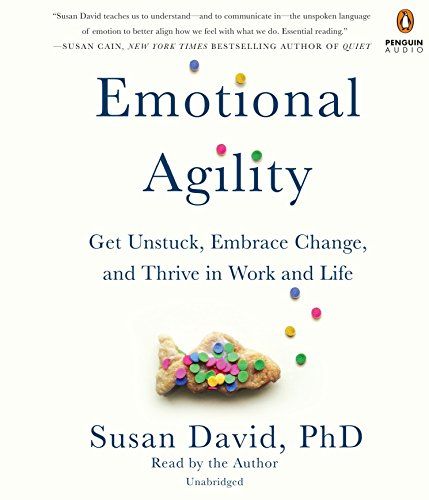
Emotional Agility
Introduction: Beyond Toxic Positivity
Introduction: Beyond Toxic Positivity
Nova: Welcome back to the show! Today, we are diving into a concept that is fundamentally changing how high-performers handle stress, conflict, and change: Emotional Agility. We’ve all heard of Emotional Intelligence, or EQ, but what if that’s only half the battle?
Nova: : That’s what I was thinking, Nova. For years, the mantra was 'manage your emotions' or 'stay positive.' But Susan David, the Harvard psychologist behind the book, suggests that trying to suppress or force positivity is actually a recipe for emotional rigidity. It sounds like she’s giving us permission to feel the messy stuff.
Nova: Exactly. Her core premise is that the quality of our lives isn't determined by tough emotions we experience, but by. She argues that trying to force happiness or bottle up anxiety is toxic. Instead, we need agility—the ability to be open to our full range of experiences, both good and bad, and still move forward aligned with our values.
Nova: : That’s a powerful distinction. So, we aren't aiming for emotional emptiness; we're aiming for emotional flexibility. If I’m feeling crippling self-doubt before a big presentation, EQ might tell me to calm down. What does Emotional Agility tell me to do?
Nova: It tells you to notice the self-doubt, acknowledge it as a visitor, and then ask, 'What is this feeling trying to tell me, and does it align with my goal of delivering a great presentation?' It’s about creating space between the feeling and the reaction. This book, "Emotional Agility: Get Unstuck, Embrace Change, and Thrive in Work and Life," is essentially a four-step roadmap to building that space.
Nova: : A roadmap sounds practical. I’m ready to get unstuck. Let’s break down this framework, Nova. Where does Susan David tell us to start this journey away from rigidity and toward agility?
Nova: We start by understanding the landscape. Let's set the stage by comparing this new concept to the old guard: Emotional Intelligence. This is where the conversation gets really interesting.
Why Managing Emotions Isn't Enough
The Next Frontier: Agility vs. Intelligence
Nova: Let’s tackle the elephant in the room: Emotional Intelligence, or EQ. We know EQ is vital. Research suggests that for many careers, EQ is more predictive of success than IQ. Some studies even show that 58% of job performance is influenced by EQ.
Nova: : That statistic is huge. EQ is about recognizing, understanding, and managing our own emotions, and influencing others. It’s a crucial skill set. But David suggests that EQ, when applied rigidly, can lead us to try and our emotions too tightly, right?
Nova: Precisely. Think of EQ as learning the rules of the road. You know where the brake is, you know where the accelerator is. Emotional Agility, however, is about driving in a sudden blizzard. You still know where the controls are, but the conditions demand flexibility, adaptation, and a willingness to acknowledge the slipperiness of the road itself.
Nova: : That’s a great analogy. If I’m highly emotionally intelligent, I might recognize my anger during a negotiation, and then consciously suppress it to maintain a professional demeanor. That’s management. How does Agility differ?
Nova: Agility says, 'I see the anger. I acknowledge it's here. It’s a hot, heavy feeling in my chest. That’s interesting.' Then, instead of suppressing it, you look at what value—say, integrity or fairness—that anger might be pointing toward. You don't let the anger, but you listen to its message before you choose your next move. David emphasizes that EA is about internal flexibility and growth, not just control.
Nova: : So, if EQ is about your internal landscape, EA is about it without getting lost in the terrain. Is there a danger in focusing too much on EQ? Does it encourage a kind of emotional performance?
Nova: Absolutely. David calls this the trap of 'false positivity.' If the goal is always to appear calm, happy, or in control, we end up performing an emotional script rather than showing up authentically. This performance is exhausting and ultimately brittle. When real crisis hits, the suppressed emotions explode or lead to burnout. The search results highlighted that EA is about the absence of pretense and performance—it’s about being real.
Nova: : Being real sounds liberating, but also terrifying. If I show my true fear, won't people see me as weak? I remember reading that David links courage to emotion, saying courage is 'fear walking.' Can you elaborate on that concept? It sounds like a direct challenge to the stoic ideal.
Nova: It is. Courage isn't the absence of fear; it’s feeling the fear—the 'hook'—and choosing to take a values-connected action anyway. If your value is being a dedicated parent, and you feel exhausted and resentful after a long day, EQ might push you to mask it. EA encourages you to acknowledge the exhaustion, perhaps take five minutes to reset, and engage with your child, rather than snapping or withdrawing completely. You walk forward the feeling, not in spite of it.
Nova: : So, the difference is subtle but profound. EQ helps us regulate; EA helps us relate to our inner experience in a way that frees us up to act. It sounds like EA is the operating system upgrade for EQ. If we accept that EA is the necessary next step, what are the mechanics? Let’s move into the four steps that form the core of her methodology.
Nova: Let's dive into the four pillars. These are the actionable steps that transform theory into daily practice. They are: Showing Up, Stepping Out, Walking Your Why, and Moving On. These steps are designed to break the cycle of emotional rigidity we just discussed.
Showing Up, Stepping Out, Walking Your Why, Moving On
The Four Pillars: A Roadmap to Flexibility
Nova: Let’s start with Step One: Showing Up. This is the foundation. Showing Up means turning toward your inner experience—your thoughts, your emotions, your memories—with curiosity and compassion. It’s about dropping the pretense.
Nova: : So, if I’m dreading a difficult conversation, Showing Up isn't about rehearsing my script perfectly. It’s about noticing, 'Wow, my stomach is tight, and I’m having the thought, 'I’m going to fail at this.''
Nova: Exactly. You are noticing the physical sensation and the narrative. David stresses that we must allow these feelings to be present without judgment. This is where many people get stuck; they judge the feeling itself. 'I shouldn't be anxious about this promotion.' That judgment is the first layer of rigidity.
Nova: : Okay, I’ve noticed the tightness and the negative self-talk. What’s Step Two: Stepping Out? This sounds like creating distance.
Nova: Stepping Out is where cognitive defusion comes in. It’s about creating space between and your thoughts. You stop saying, 'I am a failure,' and start saying, 'I am having the thought that I am a failure.' It’s a subtle linguistic shift, but it’s massive. It recognizes that thoughts are just mental events, not necessarily objective reality.
Nova: : That’s the 'Hook' and 'Hold' concept I saw referenced in some summaries. The thought 'hooks' you, and Stepping Out is the 'holding' loosely. If I can see the thought as just words floating by, it loses its power to control my behavior, correct?
Nova: Precisely. You are no longer fused with the story. You can observe the anxiety without becoming the anxiety. This step is crucial because if you skip it, you’ll try to act on your values while still being completely controlled by the fear or doubt—which is impossible.
Nova: : Right. So, we’ve shown up to the feeling, and we’ve stepped out from being fused with the thought. Now we get to the action part, Step Three: Walking Your Why. This must be about values, right?
Nova: It is the heart of agility. Walking Your Why means intentionally choosing an action that aligns with your core values, the difficult emotion is still present. For example, if your value is 'connection,' but you feel social anxiety, Walking Your Why means going to the networking event anyway, not because you aren't anxious, but because connection matters more than the anxiety right now.
Nova: : That requires immense courage. It’s the moment you decide that your future self, living according to your principles, is more important than the temporary comfort of avoidance. What if I try to Walk My Why, and I mess up? What if I go to the event and freeze up?
Nova: That brings us perfectly to Step Four: Moving On. This is the grace note of the entire framework. Moving On means accepting that you are human, you will stumble, and you will not be perfectly agile every single time. It’s about learning from the experience without spiraling into self-criticism.
Nova: : So, if I froze up at the event, Moving On isn't about saying, 'See, I told you I was a failure, I should have stayed home.' It’s about reflecting: 'I showed up, I felt the anxiety, I tried to connect, and I froze. Next time, maybe I’ll focus on just one conversation.' It’s iterative learning.
Nova: Exactly. It’s a continuous loop, not a destination. David notes that rigidity is trying to control the outcome or eliminate the feeling. Agility is accepting the internal chaos while maintaining forward momentum toward what matters. It’s about being present for the whole messy experience—the fear, the attempt, the stumble, and the adjustment—without letting any single part derail you. This entire process is what allows us to thrive in uncertain worlds, which, let’s be honest, is every world we live in today.
Nova: : I’m seeing how this is more robust than just 'positive thinking.' It’s a full-body, full-mind engagement with reality. It sounds like the real work happens in the transition between Stepping Out and Walking Your Why. That space between observation and action is where the magic—or the rigidity—happens.
Why Labeling Emotions is a Superpower
The Science of Defusion and Values Alignment
Nova: Let’s zoom in on the science behind Step One and Two—Showing Up and Stepping Out. David leans heavily on cognitive science, particularly the concept of cognitive defusion. This is where the power of labeling comes in. When you label an emotion, you are essentially engaging the prefrontal cortex, which helps dial down the emotional reactivity of the amygdala.
Nova: : So, when I say, 'I feel anxious,' I’m moving from being the emotion to the emotion. It’s like putting the feeling under a microscope instead of being trapped inside the microscope. Are there specific ways she suggests labeling to maximize this effect?
Nova: Yes. She advocates for descriptive, non-judgmental labeling. Instead of 'I’m angry,' which fuses you with the state, try 'I notice a surge of heat and tension in my chest, which I label as anger.' Or even better, use the 'I am having the thought that...' structure we mentioned. This linguistic trick is incredibly effective at creating that necessary psychological distance.
Nova: : I’ve heard this concept before in Acceptance and Commitment Therapy, or ACT. Is David’s framework heavily influenced by that school of thought? It feels very aligned with psychological flexibility.
Nova: It is deeply aligned. David’s work is a practical application of these principles for a broader audience. The research confirms that this defusion technique is powerful. If you are hooked by a negative self-story—say, 'I’m not smart enough for this job'—that story triggers stress hormones, narrows your focus, and makes you perform poorly, creating a self-fulfilling prophecy. Defusion breaks that loop.
Nova: : And this leads directly into the 'Walking Your Why' step. If we are defused from the negative story, how do we ensure we choose the action? How do we define our 'Why'?
Nova: Defining your 'Why' is about identifying your core values. These are not goals; goals are destinations, like 'Get promoted.' Values are directions, like 'Be an influential mentor' or 'Lead with integrity.' You can always move toward integrity; you can’t always achieve the promotion tomorrow.
Nova: : That’s a critical distinction. Goals are finite; values are infinite. So, if my value is 'being an influential mentor,' and I feel overwhelmed by administrative tasks, the rigid response is to ignore the mentorship tasks because I’m too busy. The agile response is to find a small, values-connected action the administrative load.
Nova: Exactly. Maybe the agile action is sending one thoughtful email to a junior colleague, or spending ten minutes preparing a mentorship framework, even if it means staying five minutes later to finish the admin. The key is that the action is based on your deep commitment, not to based on your immediate discomfort. This is where David’s work really separates itself from simple stress management techniques.
Nova: : It sounds like the entire system is designed to combat what you called emotional rigidity. What does that rigidity look like in a high-stakes environment, like leadership? I saw a reference to validating an Emotional Agility Scale for leaders.
Nova: In leadership, rigidity manifests as micromanagement when anxious, or complete avoidance when facing conflict. A leader who is hooked by the fear of disappointing their team might avoid giving necessary critical feedback. They are prioritizing the temporary comfort of avoiding the difficult conversation over the long-term value of developing their team. An agile leader acknowledges the fear of confrontation but proceeds because developing people is their core value. They deliver the feedback with compassion, but they deliver it.
Nova: : That makes perfect sense. It’s about choosing the harder, more meaningful path over the easier, avoidance-based path. It requires constant self-monitoring, though. How often do we stop to check if we are hooked or if we are walking our why?
Nova: That’s the challenge, and it’s why the practice needs to be daily. It’s not a one-time fix. It’s about building the habit of pausing. If you find yourself procrastinating on a hard task, or snapping at a loved one, that’s your cue to pause and run a quick internal audit: Am I Showing Up to this feeling? Am I Stepping Out of the story? Am I Walking My Why?
Conclusion: Embracing the Beautiful Mess
Conclusion: Embracing the Beautiful Mess
Nova: We’ve covered a lot of ground today, moving from the limitations of pure Emotional Intelligence to the dynamic flexibility of Emotional Agility. The core takeaway is that our inner world—our thoughts and feelings—is not something to be conquered or eliminated, but something to be engaged with openly.
Nova: : It’s a fundamental shift in perspective. We learned that the four steps—Showing Up, Stepping Out, Walking Your Why, and Moving On—provide a practical framework for this engagement. Showing Up means acknowledging the internal weather, Stepping Out means creating distance from the stories our minds tell us, Walking Your Why means choosing action based on deep values, and Moving On means granting ourselves grace when we inevitably stumble.
Nova: And that grace is so important. Susan David’s message is ultimately one of radical self-acceptance. She reminds us that life’s beauty is inseparable from its fragility. Trying to eliminate all the difficult emotions—the fear, the doubt, the sadness—is like trying to enjoy a sunset while blocking out the dark sky that makes the colors visible.
Nova: : It’s about embracing the whole picture. For our listeners who feel stuck, perhaps overwhelmed by self-criticism or avoidance patterns, what is the single most actionable takeaway they can implement today?
Nova: I’d suggest focusing solely on Step One and the linguistic trick from Step Two. Today, when you feel a strong negative emotion—stress, frustration, worry—don't try to fix it. Just pause for ten seconds and label it neutrally. Say to yourself, 'I notice I am experiencing frustration.' Or, 'I am having the thought that this meeting is pointless.' That small act of labeling is the first crack in the wall of rigidity.
Nova: : That’s achievable. It requires no major life overhaul, just a moment of honest observation. It’s about owning our emotions instead of letting them own us. It’s a powerful way to start building resilience in an uncertain world.
Nova: Indeed. Emotional Agility isn't about being fearless; it’s about being brave enough to feel everything and still choose the direction you want your life to go. It’s about choosing meaning over comfort, moment by moment.
Nova: : A truly insightful deep dive into Susan David’s work. Thank you for guiding us through this essential skill set, Nova.
Nova: My pleasure. Keep practicing that pause, keep walking your why, and remember to be kind to yourself when you stumble.
Nova: This is Aibrary. Congratulations on your growth!