Reclaiming Cognitive Space and Creative Agency
Golden Hook & Introduction
SECTION
Nova: If you feel like your brain is a browser with fifty tabs open, and forty-five of them are frozen, you are not alone. We are living in an era where our attention is the most valuable commodity on the planet, and yet, we are giving it away for free, one scroll at a time.
Atlas: That is the perfect way to frame it. I look at my screen time report at the end of the week, and I honestly get a little embarrassed. It is not even that I am doing work; it is just endless passive consumption. I feel like I am constantly busy, but I am not actually producing anything of value. It is exhausting.
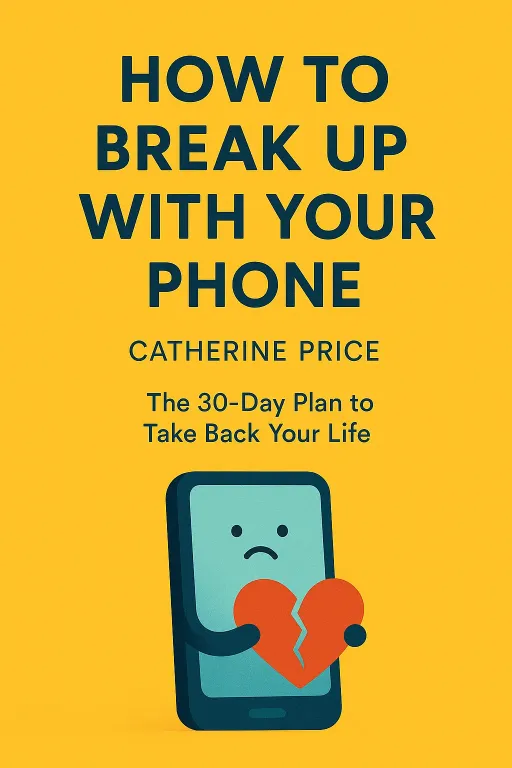
Nova: That exhaustion is exactly what we are dissecting today. We are looking at how to reclaim your cognitive space and your creative agency. We are pulling from two brilliant minds today. First, we are looking at How to Break Up with Your Phone by Catherine Price. She is a science journalist who essentially decoded how our devices are engineered to hijack our focus.
Atlas: I have heard of her work. She frames it less as a moral failing and more as a design problem, right?
Nova: Exactly. And to pair with that, we are bringing in Embrace Your Weird by Felicia Day. She is a legend in digital culture, and she provides this fantastic toolkit for conquering creative anxiety. The goal for this episode is simple: how do we build a system that protects our deep work while giving us the confidence to actually create things that matter?
The Mechanics of Digital Hijacking
SECTION
Atlas: Let us start with the phone issue. I think a lot of people, myself included, treat this as a willpower problem. I tell myself, I will just check this one email, and then thirty minutes later, I am down a rabbit hole of news articles or social media feeds. Is Catherine Price saying we should just get rid of our phones entirely?
Nova: Not at all. That is an unrealistic expectation for anyone in a modern career. Price is very pragmatic. She points out that these devices are scientifically designed to exploit our brain's reward loops. Think of it like a slot machine in your pocket. Every time you pull down to refresh your feed, your brain is getting a tiny hit of dopamine, just like a gambler waiting to see if they won.
Atlas: That makes perfect sense. It explains why I feel that phantom vibration in my pocket even when my phone is on the table. It is a biological response to a digital prompt. But how do we actually counter that? I have tried the grayscale mode, I have tried turning off notifications, but I always end up reverting.
Nova: The breakthrough in Price’s approach is shifting from restriction to intentionality. She talks about creating what she calls a screen-life balance. It is about identifying what you actually want to do with your phone versus what the phone wants you to do. The phone wants you to stay in the app. You want to use the phone as a tool for communication or specific, high-value tasks.
Atlas: So, it is about setting a boundary between the tool and the distraction. I imagine this resonates with anyone who struggles with the constant ping of notifications. If I am an architect or an engineer trying to do deep, complex work, that interruption is not just a nuisance; it is a total reset of my cognitive load.
Nova: Precisely. Price highlights that deep cognitive work requires what she calls a state of flow. When you are interrupted, it takes, on average, over twenty minutes to return to that same level of focus. If you are checking your phone every fifteen minutes, you are effectively operating in a state of perpetual distraction. You are never actually hitting your stride.
Atlas: That is a staggering realization. I think of my day in terms of hours, but I should be thinking about it in terms of focus blocks. If I check my email or a news feed, I am not just losing the minute it takes to check; I am losing the twenty minutes of ramp-up time required to get back into the zone.
Nova: Exactly. And that is where the mental fatigue comes from. It is not the work itself that is burning you out; it is the constant context switching. Your brain is essentially running a high-speed processor that is being forced to reboot every time you check a notification.
Reclaiming Creative Agency
SECTION
Atlas: Okay, so let us say I successfully create those boundaries. I have blocked off my time, I have silenced the notifications, and I have regained that cognitive space. Now I have this quiet. And honestly, for a lot of people, that quiet is terrifying. This is where Felicia Day’s work comes in, right?
Nova: It is. Once you clear the digital clutter, you are left with yourself. And that is often where the second problem arises: creative anxiety. Felicia Day, in Embrace Your Weird, argues that we spend so much time consuming other people's curated lives that we lose touch with our own unique quirks. We start to censor ourselves before we even begin to create.
Atlas: I see that all the time. People hold back on sharing their ideas or starting a project because they are worried it is not perfect, or they are worried about how it will look compared to what they see on social media. It is like we are all trying to fit into a standardized box of what success looks like.
Nova: Day’s core argument is that your quirks are not bugs; they are features. She talks about how she used her own weirdness, her niche interests, and her specific way of looking at the world to build a career that didn't exist before. She views creative anxiety as a signal. It means you are doing something that matters to you.
Atlas: I love that reframe. Instead of avoiding the anxiety, you use it as a compass. If I am nervous about a project, it is because I actually care about the outcome. If I didn't care, I wouldn't feel anything.
Nova: Exactly. And Day offers a toolkit for this. She encourages people to stop waiting for permission to be weird. She suggests creating things just for the sake of creating, without the pressure of an audience or a professional outcome. It is about reconnecting with the joy of making.
Atlas: That is a tough pill to swallow for someone who is results-oriented. If I am an architect or a strategic lead, I want everything I do to have a clear ROI. How do I justify "creating for the sake of creating" when I have deadlines and KPIs?
Nova: That is the secret, though. The most innovative ideas rarely come from staring at a spreadsheet and trying to force efficiency. They come from the lateral thinking you develop when you explore hobbies, weird interests, or side projects that have nothing to do with your main job. That creative muscle you build by embracing your weirdness in your personal time directly strengthens your professional problem-solving abilities.
Atlas: So, it is like cross-training for the brain. I spend my day building high-impact systems, but if I spend my evening exploring something completely different, I am actually keeping my mind flexible and adaptable.
Nova: Precisely. You are preventing cognitive rigidity. When you are too focused on one outcome, you miss the peripheral vision. Day’s work is about ensuring you keep that peripheral vision sharp.
Synthesis & Actionable Systems
SECTION
Atlas: This brings us back to the user profile we are talking to today. The Efficient Architect. Someone who wants high-impact knowledge and sustainable progress. If we combine Catherine Price’s digital boundaries with Felicia Day’s creative confidence, what does the daily system look like?
Nova: It starts with the twenty-minute daily framework. If you dedicate twenty minutes of your day to one actionable, high-value task, you need to protect that time. That is where Price’s digital boundaries come in. That twenty-minute block is a sacred space. No phone, no notifications, no external input.
Atlas: And then, during that block, you apply Day’s philosophy. You don't just do the mundane work; you use that time to tackle the project that you have been anxious about, the one that feels a bit too "weird" or "different" for the standard office environment.
Nova: That is the perfect synthesis. You use the boundaries to protect your focus, and you use the creative agency to push the boundaries of your work. You are not just being efficient; you are being effective. You are not just doing more; you are doing work that is uniquely yours.
Atlas: I really like that. It turns the phone into a tool you control, rather than a master you serve. And it turns the creative anxiety into fuel for innovation. It makes the work feel less like a grind and more like a craft.
Nova: And that is the shift that leads to sustainable growth. You stop measuring your success by how many tasks you cleared off your list and start measuring it by the quality of the intellectual and creative value you are producing.
Atlas: It is a profound shift. It moves us from passive consumers of information to active architects of our own output. I think the challenge for our listeners is to start small. Don't try to overhaul your entire life today. Just protect one twenty-minute block tomorrow. Use it to do the thing you have been putting off because you are afraid it won't be perfect.
Nova: Exactly. Start there. Protect the space, embrace the weirdness, and see what happens. The results will surprise you.
Atlas: This has been a fantastic exploration of how to regain control of our mental environment. If you are listening to this, I challenge you to take that first step today. Protect your focus.
Nova: We are rooting for you. This is Aibrary. Congratulations on your growth!