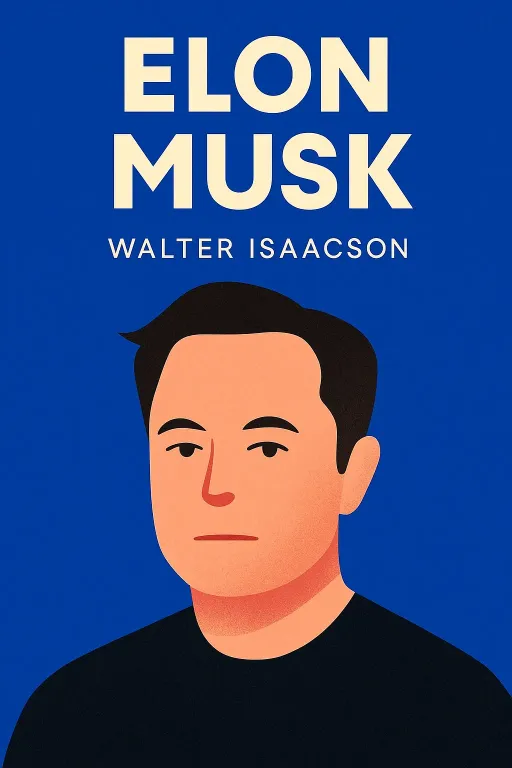
The Innovator's Scars: How Elon Musk's Past Forged the Future
Golden Hook & Introduction
SECTION
Socrates: What if the key to building a multi-billion dollar empire isn't a brilliant idea, but an unusually high tolerance for pain? We celebrate innovators like Elon Musk for their vision, but Walter Isaacson's new biography forces us to ask a darker, more complex question: What if his relentless drive is fueled by deep childhood trauma? As an entrepreneur, lago, you know the pressure of taking risks, but Musk’s story suggests a different calculus entirely, one forged in a crucible of violence and emotional neglect.
lago: That's a powerful framing, Socrates. In the startup world, we glorify 'grit' and 'resilience,' but we rarely dissect where it comes from. The idea that it could be rooted in something as dark as trauma, rather than just ambition, is both fascinating and unsettling. It reframes the entire narrative of the 'visionary founder.'
Socrates: It really does. And Isaacson’s book gives us a front-row seat to the formation of that mindset. So today we'll dive deep into this from two powerful perspectives. First, we'll explore the brutal forge of his childhood and how it created an armor of pain tolerance.
lago: And then, I assume, the consequences of wearing that armor.
Socrates: Exactly. Then, we'll discuss the innovator's dilemma: the trade-off between his famous 'demon mode' and human empathy. This isn't just about Musk; it's about the psychology of extreme achievement, and it has lessons for any leader.
Deep Dive into Core Topic 1: The Forge of Adversity
SECTION
Socrates: So let's start at the beginning. To understand Musk's pain tolerance, Isaacson takes us to a place called 'veldskool' in South Africa. Picture this: a paramilitary survival camp in the wilderness. The kids are given minimal food and water, and the monitors actively encourage them to fight over it. Bullying isn't just tolerated; it's considered a virtue.
lago: It sounds like a real-life Lord of the Flies. A social experiment designed to find the most ruthless.
Socrates: That's a perfect way to put it. And a young, small, socially awkward Elon Musk is thrown right into this. He's not a natural survivor in this environment. The book says he was beaten up twice and lost five kilograms in one session. To make it worse, the monitors would tell stories of boys who had died in previous years as a warning.
lago: That's brutal. It's like a perverse form of A/B testing for human cruelty. What's the takeaway he has from that? Does it break him, or does it build something?
Socrates: It builds something. The book says the second time he went, when he was almost 16, he was bigger and had learned some judo. He had a realization. He learned that if someone bothered him, a hard, swift punch to the nose was the most effective solution. They would just leave him alone. This lesson—that direct, overwhelming force solves the problem—becomes a recurring pattern.
lago: I can see that. It's a direct, almost algorithmic response. Problem -> Apply Force -> Resolution. You can see that logic in how he runs his companies. When facing a production problem at Tesla, he doesn't just tweak the system; he builds a whole new, gigantic factory line. He applies overwhelming force. He treats engineering problems like a bully in the schoolyard.
Socrates: And that schoolyard was just as brutal. It wasn't just at camp. Isaacson details a horrific school bullying incident. One morning, a boy attacks him, and during recess, the boy and his friends corner Elon. They kick him in the head, knock him down a flight of concrete stairs, and just keep beating and kicking his head until he's unrecognizable. He was hospitalized for a week.
lago: Unbelievable. But the physical pain is only half the story, right? What was the support system?
Socrates: That's the most chilling part. There was none. When his father, Errol, came to the hospital, he didn't offer comfort. He sided with the bullies. He told Elon it was his own fault for being annoying. There was no safe harbor. The lesson was absolute.
lago: So there's no emotional support system. The lesson is: you are entirely on your own, and you can only rely on your own resilience. For an entrepreneur, that's a familiar feeling, but this is an extreme, foundational version of it. It explains the 'bet the company' risks he takes with SpaceX and Tesla. If you've already survived the absolute worst with no safety net, what's the fear of bankruptcy? It's just another problem to solve.
Socrates: Exactly. It recalibrates your definition of 'failure.' As Musk himself says in the book, reflecting on all this, "A adversidade me moldou. Minha resistência à dor é bem alta." "Adversity shaped me. My pain tolerance is very high."
lago: It’s the source code for his operating system. Everything else is built on top of that foundation.
Deep Dive into Core Topic 2: 'Demon Mode' vs. Empathy
SECTION
Socrates: And that high pain tolerance, that ability to operate without a safety net, leads us directly to the second, more complex idea: the psychological cost of that armor. It’s one thing to endure pain yourself, but what happens when you start expecting it from others?
lago: You start inflicting it.
Socrates: Precisely. His first wife, Justine, offers this incredible insight in the book. She says, and I'm quoting here, "He learned to shut down fear. If you shut down fear, maybe you have to shut down other things too, like joy and empathy." This is the origin of what his team at SpaceX and Tesla calls 'demon mode.'
lago: I've heard that term. It's when he goes into a state of manic focus, right?
Socrates: Yes, a state of almost inhuman focus where he pushes people relentlessly, completely devoid of social niceties, and is 100% mission-oriented. The human cost becomes secondary to solving the engineering problem.
lago: That's the innovator's dilemma right there. As a leader, you need to be obsessed with the mission. But 'demon mode' sounds like it burns out the very people you need to execute that mission. I've seen founders who operate on a similar, though less intense, wavelength. They're brilliant, but they leave a trail of burnt-out, albeit highly compensated, talent.
Socrates: Isaacson gives many examples. Pushing engineers to sleep on the factory floor during the Model 3 production hell, firing people in sudden bursts of anger. Yet, it often produces results that everyone thought were impossible. His former partner, the musician Grimes, adds another layer to this. She says, "I don't think he knows how to enjoy success... I think he learned in childhood that life is pain."
lago: Wow. That's a profound distinction. So the drive isn't for the joy of winning, but to escape a baseline state of turmoil. In motivational theory, it's not 'pull' motivation, being pulled toward a beautiful future. It's 'push' motivation, being pushed away from a painful past.
Socrates: That's a fantastic way to put it.
lago: And from a systems perspective, a 'push' system is inherently unstable. It requires constant crisis. If there's no crisis, he might subconsciously create one, just to feel normal. We see this in his management style—the constant sense of urgency, the 'wartime CEO' mentality even in peacetime. It's a system that requires a dragon to slay. If one isn't available, he'll find one.
Socrates: The book uses a quote from Andrew Jackson to describe him, which feels eerily perfect: "I was born for a storm, and a calm does not suit me." It seems he thrives in chaos because it's the environment he was programmed to survive in. It’s his native state.
lago: It's a powerful cautionary tale for leadership. You might admire the results of 'demon mode,' but trying to replicate it without the underlying psychological wiring is not only inauthentic, it's just plain destructive. It's not a 'leadership style' you can learn in a seminar. It's a survival mechanism that’s been repurposed for business.
Synthesis & Takeaways
SECTION
Socrates: So, to bring it all together, Isaacson draws this direct, almost brutal line: a traumatic childhood forges an armor of high pain tolerance. That armor allows for incredible, world-changing risk-taking. But it comes at the cost of emotional connection, creating a 'demon mode' leadership style that is both incredibly effective and deeply problematic.
lago: Exactly. And for any entrepreneur or leader listening, the key takeaway isn't to try and emulate Musk's trauma. That's absurd. It's to be introspective. To ask: What is fueling drive? Is it a healthy passion for the mission, or am I running from something? Is my 'grit' productive, or is it just a manifestation of my own inability to process failure?
Socrates: That’s a question that requires a lot of honesty.
lago: It does. The challenge for the next generation of innovators is to cultivate that relentless focus and resilience Musk has, but to do it consciously. To build a culture that supports people and thrives on ambition, rather than seeing them as disposable resources in your personal war against your own demons. The ultimate innovation, perhaps, is to achieve great things without paying that same human cost. It's about harnessing the storm, without becoming it.
Socrates: A powerful thought to end on. Harnessing the storm without becoming it. lago, thank you.
lago: Thank you, Socrates. This was fascinating.