

The Quiet Strategist: Taming Ego in Marketing and Leadership
Golden Hook & Introduction
SECTION
Orion: In a world that screams 'fake it till you make it,' what if the single biggest obstacle to 'making it' is the 'faking it' part? We're told to project confidence, to build a personal brand, to hustle. But what if that very drive, when it curdles into ego, becomes the enemy of our own success? This isn't just a philosophical question; for anyone in a competitive field like finance or marketing, it's a daily battle.
Mehak Imran: It really is, Orion. That tension is something I feel every day. You have to project certainty to get buy-in for a new marketing strategy, but you also have to be humble enough to know that the market might tell you you're completely wrong tomorrow.
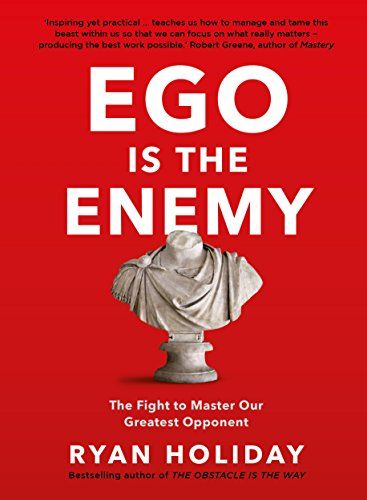
Orion: And that's the tightrope walk we're exploring today, through the lens of Ryan Holiday's fantastic book,. I'm Orion, and I'm thrilled to have Mehak Imran with us. She's a Marketing Manager in the finance industry, an analytical thinker, and a fan of philosophy, which makes her the perfect person to discuss this with. Mehak, welcome.
Mehak Imran: Thanks for having me. I'm excited. This book hits close to home. As someone who identifies as a 'Protector' type, my instinct is to focus on the work and the team, but the corporate world often rewards the loudest voice, not necessarily the most thoughtful one.
Orion: A brilliant point. And Holiday gives us a framework to navigate that. Today, we're going to dive deep into this from two critical perspectives. First, we'll explore the battle with ego during our 'aspiring' phase—when we're trying to make our mark. Then, we'll discuss the arguably more dangerous trap: the ego that emerges in 'success,' and how to navigate it without crashing.
Deep Dive into Core Topic 1: The Student vs. The Star
SECTION
Orion: So, let's start at the beginning, with aspiration. This is the phase where we're hungry, we're trying to prove ourselves. Holiday argues that the primary danger here is an ego that whispers to us that we're special, that we're better than we are, and that we can skip the hard work. It encourages us to talk more than we do.
Mehak Imran: It’s the desire to be seen as a genius from day one, right? Before you’ve actually done the work to earn it.
Orion: Precisely. And to illustrate the antidote, Holiday tells a story that I just love for how counterintuitive it is. I want you to imagine this: you are Kirk Hammett, the lead guitarist for Metallica. It's the late 80s, early 90s. You are, without exaggeration, in one of the biggest rock bands on the entire planet. You've sold tens of millions of albums. You are playing to sold-out stadiums of 80,000 people every night. You are a rock god. So, what do you do?
Mehak Imran: I would imagine you'd... I don't know, enjoy it? Maybe buy a private island?
Orion: You could! But what Kirk Hammett did was he picked up the phone and called Joe Satriani, another legendary guitarist, and asked for lessons. At the absolute peak of his fame and success, he felt he had hit a creative plateau and needed to learn more. He chose to be a student, not a star. His ego didn't tell him, 'You're Kirk Hammett, you're already great.' His ambition told him, 'You could be better.'
Mehak Imran: Wow. That's a powerful story because it's so opposite to the culture in many professional settings. In marketing, especially within a demanding industry like finance, you're hired to be the expert. There's this immense, unspoken pressure to have all the answers immediately.
Orion: Exactly. So how do you reconcile that? How do you be the 'student' Kirk Hammett was, when your boss, your clients, your team, they all expect you to be the 'star'?
Mehak Imran: You know, hearing that story, I think it's about reframing what 'expertise' really means. Maybe true expertise isn't about knowing everything from the start. Maybe it's about having the best, most humble process for the right answer.
Orion: I like that. Unpack that a bit. What does that look like in your world?
Mehak Imran: Well, for us, it means being a student of the data, and a student of the customer. Let's say we launch a new digital ad campaign and it's not performing. The ego-driven response is to defend it, to say 'The creative is brilliant, the audience just doesn't get it.' It’s about protecting my idea.
Orion: Protecting your ego.
Mehak Imran: Right. But the 'student' response, the Kirk Hammett response, is to say, 'Okay, the data is our teacher here. What is it telling us we're doing wrong? Is the copy off? Is the targeting wrong?' It's a fundamental mindset shift from 'I am right' to 'Let's find what is right, together.'
Orion: That's a brilliant connection. You're essentially moving the ego from your personal identity and attaching it to the integrity of the process itself.
Mehak Imran: Exactly. And as an ISFJ, that really resonates. The 'Protector' in me wants to protect the project's success and the well-being of the team, not my own personal ego. Making the process the hero, instead of myself, actually makes that job easier and less stressful. It allows you to be confident in your method, even when you're uncertain about the outcome.
Deep Dive into Core Topic 2: The Success Trap
SECTION
Orion: And that mindset you just described, Mehak, becomes absolutely critical when you move from aspiration to the next stage Holiday outlines: success. Because as he warns, success is where ego lays its most insidious and dangerous trap. It's one thing to be humble when you're hungry, but what happens when you're full?
Mehak Imran: It's so much harder. When you have external validation, the ego has evidence to back up its claims.
Orion: It has receipts! And this is where Holiday brings in a truly cautionary tale: the story of Howard Hughes. Here was a man who was a legitimate genius in his youth. He inherited a tool company fortune, but then went on to become a groundbreaking aviator, a brilliant engineer, and a powerful Hollywood film producer. He achieved staggering, almost mythical, success before he was 30.
Mehak Imran: He was the definition of success.
Orion: The absolute definition. But then... what happened? He stopped listening. He achieved so much, so young, that he began to believe he was infallible. He surrounded himself with 'yes-men' who never challenged him. His ego became so inflated that it built a fortress around him, and he became a prisoner inside it. He went from innovating in aviation and film to obsessing over the most trivial details, like the seams on a costume in one of his movies.
Mehak Imran: He lost all perspective.
Orion: Completely. He became so convinced of his own myth, his own legend, that he couldn't take any outside input. His world shrank and shrank until he was living as a recluse in a hotel penthouse, crippled by paranoia, terrified of germs and human contact. His early success didn't lead to more success; it led directly to isolation and delusion. His ego consumed him.
Mehak Imran: That's a terrifying story. And it's so relevant because it's like he started believing his own marketing, his own press releases. In my world, that is a huge, huge danger. You launch a campaign, it exceeds all the KPIs, the revenue numbers are fantastic, and everyone is celebrating.
Orion: The victory lap. It feels good.
Mehak Imran: It feels amazing! And the ego says, 'I'm a genius. I have the magic formula.' The danger is that you then try to apply that exact same formula to the next problem, which might be in a different market, with a different audience, and you're completely baffled when it fails. Success, if you're not careful, makes you lazy and arrogant.
Orion: Holiday calls the necessary antidote 'the sobriety of success.' It's an active, conscious effort. So, how do you stay 'sober,' in a marketing context, after a huge win?
Mehak Imran: It's a two-pronged approach, I think. First, analytically, you have to perform a post-mortem on your successes just as rigorously as you do on your failures. You have to ask the hard questions. Was it just luck? Was it market timing? Was it one specific channel that did all the heavy lifting while the others failed? You have to break it down and stay a student of the success itself, not just bask in it.
Orion: So you're analyzing the victory to find the real lesson, not just confirming your own genius.
Mehak Imran: Exactly. And the second part is more of that 'Protector' instinct. It's about immediately turning the spotlight from yourself onto the team. The moment a win is confirmed, the job is to say, 'This is an incredible team effort. Great job, everyone. Now, what's next? How can we get 1% better?' It diffuses that personal ego-inflation and channels the positive energy back into forward momentum. It keeps everyone, including yourself, hungry.
Synthesis & Takeaways
SECTION
Orion: So when we put these two stories side-by-side—Kirk Hammett the student and Howard Hughes the prisoner of success—what we're really seeing are two sides of the same coin. In aspiration, ego tells us we don't need to learn. In success, ego tells us we have nothing left to learn.
Mehak Imran: And in both cases, it stops our growth dead in its tracks. The antidote, as we've discussed, seems to be that conscious, continuous choice to remain a student. It's a constant practice, not a one-time decision.
Orion: I think that's the core message of the book. It's not about destroying your ego, which is probably impossible. It’s about having something bigger than your ego to serve.
Mehak Imran: Absolutely. It’s about subordinating it to a higher purpose. For Kirk Hammett, that purpose was the music. For a good marketing manager, that purpose has to be the customer, the integrity of the brand, the success of the team. The goal isn't to get rid of ego, but to harness it so it serves the work, not the other way around. When your ego is tied to how good you look, you're fragile. When it's tied to the quality of your work, you're resilient.
Orion: A perfect summary. So for everyone listening, especially those of you navigating your own careers, here's the challenge from today's discussion, taken straight from the pages of: This week, find one meeting, one project, one conversation where you can consciously choose to be the student instead of the master.
Mehak Imran: That’s a great, practical step.
Orion: Ask a question you think you should already know the answer to. Genuinely listen to a perspective that contradicts your own. See what happens when you let go of the need to right, and instead, focus all your energy on right. It might just be the most powerful move you make. Mehak, thank you so much for this insightful conversation.
Mehak Imran: Thank you, Orion. It was a pleasure.