

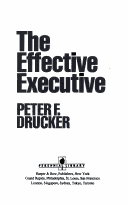
Effective Executive
How to Acquire the Effectiveness Habit
Introduction
Nova: Have you ever noticed that some of the smartest, most hardworking people you know seem to get absolutely nothing done? They are constantly busy, their calendars are packed, they are brilliant in meetings, but at the end of the year, the needle hasn't actually moved.
Atlas: I feel like you are describing my entire professional life right now. It is that feeling of running on a treadmill at top speed but staying in the exact same spot in the gym.
Nova: Exactly. And that is the problem Peter Drucker set out to solve back in 1966 with his absolute classic, The Effective Executive. Drucker is often called the father of modern management, and this book is basically the bible for anyone who wants to stop being busy and start being effective.
Atlas: I have heard the name Drucker a thousand times, but 1966? That feels like a lifetime ago. Is a book written in the era of rotary phones and carbon paper really going to help me manage a flooded Slack channel and back-to-back Zoom calls?
Nova: It is actually more relevant now than it was then. Drucker’s big insight was that we were moving from an economy of manual workers to an economy of knowledge workers. In a factory, you measure efficiency by how many widgets you make per hour. But for a knowledge worker, efficiency doesn't matter if you are making the wrong things. Effectiveness is about doing the right things.
Atlas: So it is the difference between climbing a ladder really fast and making sure the ladder is leaning against the right wall.
Nova: Precisely. And the most empowering thing Drucker says is that effectiveness is not a talent. You aren't born with it. It is a habit, or rather a complex of habits, that can be learned. Today, we are going to break down those habits and see how they apply to the chaos of the modern workplace.
Key Insight 1
The Knowledge Worker Revolution
Nova: Before we get into the habits, we have to talk about who Drucker is actually writing for. When people hear the word executive, they usually think of a CEO in a corner office. But Drucker defines an executive as any knowledge worker who, by virtue of their position or knowledge, is responsible for a contribution that affects the capacity of the organization to perform.
Atlas: That is a pretty broad net. So you are saying even a junior analyst or a software engineer is an executive in Drucker's eyes?
Nova: If their decisions affect the results of the company, yes. In the old days, a manual worker just did what they were told. The effectiveness was built into the process by the manager. But a knowledge worker has to manage themselves. You have to decide what to work on, how to do it, and what the goals are. You are your own CEO.
Atlas: That sounds like a lot of pressure. It means I can't just blame my boss if I spend all day doing low-value tasks.
Nova: That is exactly the point. Drucker argues that the organization actually works against the executive. There are four major realities that keep us from being effective. First, your time belongs to everyone else. Anyone can walk into your office or send you an email and steal your attention.
Atlas: Tell me about it. My calendar looks like a game of Tetris played by someone who hates me.
Nova: Second, executives are often forced to keep operating unless they take positive action to change the direction. You get caught in the flow of events. Third, you are within an organization, which means you only see the internal world. But results only happen on the outside, with customers or clients.
Atlas: Right, you can have the most efficient internal meeting in history, but if the customer doesn't buy the product, it was all for nothing.
Nova: And fourth, you are inside a bubble of information. The higher up you go, the more the information is filtered. You lose touch with reality. Drucker says the only way to overcome these four pressures is to consciously practice the habits of effectiveness. It is a survival guide for the modern brain.
Key Insight 2
Know Thy Time
Nova: The first habit is the most famous one: Know Thy Time. Drucker says that effective executives do not start with their tasks. They start with their time. They don't start by planning; they start by finding out where their time actually goes.
Atlas: I feel like I know where my time goes. It goes to meetings, emails, and putting out fires. Do I really need to track it?
Nova: Drucker would say you are probably wrong. He tells a story about a CEO who was certain he spent his time on three things: personal chores, busy work, and then actual business. When he actually kept a log for three weeks, he found he spent almost no time on business. It was all social stuff and things his subordinates should have been doing.
Atlas: So it is like a food diary but for your workday. That sounds incredibly tedious.
Nova: It is, but it is the only way to see the truth. Drucker suggests a three-step process: Record time, Manage time, and Consolidate time. You have to record it in real-time, not from memory at the end of the day. Then, you look at that log and ask: What would happen if this were not done at all? If the answer is nothing, stop doing it.
Atlas: I can think of about five meetings right now that fit that description.
Nova: Then you ask: Which of these activities could be done by someone else just as well, if not better? That is delegation. But the most important part is the third step: Consolidating time. Drucker argues that knowledge work requires large chunks of time. You can't write a complex report or solve a hard engineering problem in fifteen-minute increments between meetings.
Atlas: This is the deep work concept before deep work was a thing. But how do you actually get those chunks? My day is fragmented by design.
Nova: Drucker suggests being ruthless. Maybe you work from home one day a week. Maybe you block off every morning until noon for no-meeting time. He says that even a quarter of a day, if it is in one solid piece, is usually enough to be effective. But if you have small drips of time throughout the day, even if they add up to four hours, they are essentially useless for high-level thinking.
Key Insight 3
Focus on Contribution and Strengths
Nova: The second habit is focusing on outward contribution. Most people ask, what do I do? Or what am I supposed to do? The effective executive asks, what can I contribute that significantly affects the performance and the results of the institution I serve?
Atlas: That sounds like a subtle shift, but I see the difference. It moves the focus from the effort to the result. It is not about how hard I worked; it is about what actually changed because I was there.
Nova: Exactly. It forces you to look at your role from the perspective of the customer or the company's goals. This leads directly into the third habit: Making strengths productive. Drucker is very firm on this. You cannot build performance on weaknesses. You have to build on what people can do, not what they can't do.
Atlas: That goes against a lot of modern performance reviews where the whole focus is on your areas for improvement. You know, the things you are bad at.
Nova: Drucker thinks that is a total waste of time. He says that to achieve results, you have to use all the available strengths: the strengths of your associates, the strengths of your superior, and your own strengths. If you spend all your time trying to turn a C-minus skill into a C-plus, you are ignoring the A-plus skill that could actually change the company.
Atlas: So if I have a brilliant programmer who is terrible at public speaking, I shouldn't force them into a public speaking class?
Nova: Not unless their job is literally being a public speaker. You should find a way to let them program more. Drucker points out that effective executives don't look for people who have no weaknesses. They look for people who are great at one thing. He uses the example of General Grant during the Civil War. People complained to Lincoln that Grant drank too much. Lincoln supposedly said, find out what brand he drinks so I can send a case to my other generals. Lincoln cared about the results Grant produced, not his personal flaws.
Atlas: That is a bold way to manage. It requires accepting that people are going to be messy and imperfect as long as they are brilliant in the ways that matter.
Nova: It is about maximizing the impact of the strength and making the weakness irrelevant. If you staff for lack of weakness, you will end up with a mediocre team. If you staff for strength, you get excellence.
Key Insight 4
Concentration and Decision Making
Nova: The fourth habit is concentration. Drucker’s rule is simple: First things first, and second things not at all. He says the secret of people who do so many things is that they do only one thing at a time. As a result, they need much less time than the rest of us.
Atlas: This is the hardest one for me. Everything feels like a priority. How do you decide what is actually first?
Nova: You have to be courageous. Drucker says you should choose the future over the past, choose opportunity over problems, and choose your own direction rather than jumping on the bandwagon. But here is the most radical part: he suggests periodic abandonment. You should look at every activity and ask, if we weren't already doing this, would we start it today?
Atlas: Oh, that is painful. We keep so many projects alive just because we have already spent money on them. The sunk cost fallacy is real.
Nova: Drucker calls it sloughing off the past. If you don't clear out the old, dead wood, you have no room for new growth. And that leads us to the final habit: Effective Decision Making. Drucker says effective executives don't make many decisions. They make a few important ones.
Atlas: Only a few? I feel like I make a hundred decisions a day.
Nova: You might be making small choices, but are you making decisions? Drucker says an effective decision is a systematic process. First, you have to ask: Is this a generic situation or a unique event? Most problems are generic. They are just symptoms of an underlying issue. If you treat a generic problem as a unique event, you are just putting a bandage on a wound that needs surgery.
Atlas: So you create a rule or a policy for the generic stuff so you don't have to keep deciding it over and over again.
Nova: Exactly. And here is the part that surprises people: Drucker says you shouldn't start with facts. You should start with opinions. Everyone has a bias anyway. The goal is to bring those opinions out and then test them against reality. He actually encourages disagreement. If everyone agrees immediately, he says the decision isn't ready. You need the friction of different viewpoints to see the whole picture.
Atlas: That is the opposite of seeking consensus. It is seeking the truth through debate.
Nova: Right. Consensus is often just the lowest common denominator. An effective executive wants the right decision, not the most popular one. And finally, a decision isn't a decision until it has been turned into work. You have to assign responsibility, a deadline, and a way to measure the result. Otherwise, it is just a good intention.
Conclusion
Nova: We have covered a lot of ground today. From the realization that we are all executives in the knowledge economy to the five habits: managing time, focusing on contribution, building on strengths, concentrating on priorities, and making effective decisions.
Atlas: It is a lot to take in, but it feels surprisingly practical. It is not about being a genius; it is about being disciplined with your habits. I think the biggest takeaway for me is the time audit. I am genuinely curious to see where my hours are leaking away.
Nova: That is the best place to start. Drucker’s legacy isn't just about business; it is about personal responsibility. He believed that effectiveness is the only way for a modern society to remain free and productive. If we can't manage ourselves, we can't manage anything else.
Atlas: It is a call to step up and take ownership of our work and our impact. Even if the book is over fifty years old, the human brain hasn't changed that much. We still struggle with focus, we still get distracted by the trivial, and we still need to be reminded to do the right things.
Nova: Well said. Effectiveness is a journey, not a destination. It is something you practice every single day. Start by recording your time, focus on what you can contribute, and remember that your strengths are your greatest assets.
Atlas: I am ready to stop being busy and start being effective. Thanks for walking me through this, Nova.
Nova: My pleasure. This is Aibrary. Congratulations on your growth!