

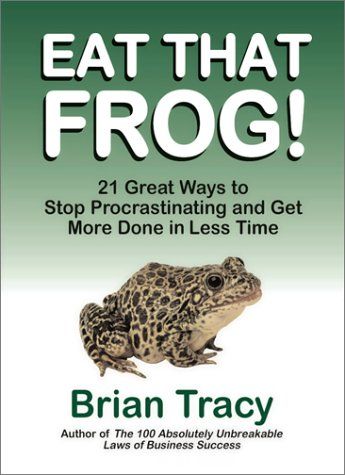
Eat That Frog! 21 Great Ways to Stop Procrastinating and Get More Done in Less Time
Introduction
Nova: Imagine waking up every single morning and the very first thing you have to do is eat a giant, slimy, live frog. It sounds absolutely horrifying, right?
Nova: Because according to Mark Twain, if you do that first thing in the morning, you can go through the rest of the day with the satisfaction of knowing that it is probably the worst thing that is going to happen to you all day. And that is the core premise of Brian Tracy's legendary productivity book, Eat That Frog! 21 Great Ways to Stop Procrastinating and Get More Done in Less Time.
Nova: Exactly. Procrastination is the great equalizer. It does not matter if you are a CEO or a student; we all have those frogs. Brian Tracy argues that the secret to high levels of performance and productivity is to develop the lifelong habit of tackling your major task first thing every morning. In this episode, we are going to dive into the 21 methods he outlines to help you stop stalling and start doing.
Nova: It really is a survival guide for the modern, over-scheduled human. Tracy’s approach is not about doing more things; it is about doing the right things. So, let’s break down how to find your frog and, more importantly, how to actually swallow it.
Key Insight 1
Finding Your Ugliest Frog
Nova: The first rule of frog eating is this: if you have to eat two frogs, eat the ugliest one first. In work terms, if you have two important tasks before you, start with the biggest, hardest, and most important task first.
Nova: Tracy would call that a trap. He says that doing the easy things first actually drains your mental energy and gives you a false sense of accomplishment. By the time you get to the big task—the ugly frog—you are tired, and you are more likely to push it to tomorrow. Again.
Nova: Exactly. It is about the 80/20 rule, or the Pareto Principle. You have probably heard of it, but Tracy applies it specifically to our task lists. He says that 20 percent of your activities will account for 80 percent of your results. Your frog is always in that 20 percent.
Nova: He has a great rule for that: The Rule of Three. If you could only do one thing on your list all day, which one would have the biggest impact on your career or your life? Then, if you could do only two? Usually, there are three key tasks that contribute about 90 percent of the value you bring to your work. Those are your frogs.
Nova: That is where the second rule comes in: if you have to eat a live frog at all, it does not pay to sit and look at it for very long. The longer you stare at the task, the more daunting it becomes. You have to develop the habit of diving in without overthinking it. Tracy calls it a sense of urgency.
Nova: That is a perfect analogy. And Tracy emphasizes that you need to single-handle the task. Once you start that big task, you stay with it until it is 100 percent complete. No jumping back and forth. No checking your phone. Just you and the frog until the frog is gone.
Key Insight 2
The ABCDE of Prioritization
Nova: To help you stay organized, Tracy introduces something called the ABCDE Method. It is a simple way to look at your to-do list and immediately see the hierarchy of importance.
Nova: Sort of. You put a letter next to every item on your list. An A task is something that is very important. Something you must do. If you do not do it, there will be serious consequences. This is your frog.
Nova: You nailed it. A-1 is the ugliest frog of them all. Then you have B tasks. These are things you should do, but they only have mild consequences. Like returning a non-urgent phone call. Tracy’s rule is: never do a B task when an A task is left undone.
Nova: C tasks are nice to do, but have no consequences at all. Like grabbing coffee with a coworker. D stands for delegate. You should delegate everything you possibly can to free up more time for the A tasks. And E?
Nova: You got it! E tasks are things you should just stop doing altogether. Maybe they were important once, but they do not serve your goals anymore. Tracy says that the mark of a great leader is the ability to say no to the low-value tasks.
Nova: That is a huge insight. Tracy talks about the Law of Forced Efficiency. There is never enough time to do everything, but there is always enough time to do the most important thing. By focusing on the consequences, you clarify what actually matters.
Nova: That is the 10/90 rule. Spending just 10 percent of your time planning and organizing your work before you begin will save you as much as 90 percent of the time in getting the job done. He suggests planning your day the night before. That way, your subconscious mind can work on your frogs while you sleep.
Key Insight 3
Salami Slicing and Swiss Cheese
Nova: Now, sometimes the frog is so big and so ugly that you cannot possibly eat it in one bite. It is just overwhelming. Tracy has two great techniques for this: Salami Slicing and the Swiss Cheese method.
Nova: The Salami Slices method is about breaking a huge task down into tiny, bite-sized pieces. You do not try to eat the whole salami at once; you just commit to eating one thin slice. In work terms, you do not try to write the whole book; you just write one page. Or even one paragraph.
Nova: Exactly. Once you start, you often find that you have the momentum to keep going. The Swiss Cheese method is similar but a little different. Instead of slicing the task, you poke a hole in it. You decide to work on a large task for a specific period of time—say, fifteen minutes—and then stop.
Nova: Precisely. It turns a daunting mountain into a series of small, manageable hills. He also mentions the One Oil Barrel at a Time method. He tells a story about crossing the Sahara Desert. The only way people could find their way was by following oil barrels placed every few miles. You can only see the next barrel, but if you keep reaching the next one, you eventually cross the entire desert.
Nova: Another way he suggests overcoming resistance is by upgrading your key skills. He argues that we often procrastinate because we feel inadequate or unskilled in a certain area. If a task feels hard because you do not know how to do it well, you will naturally avoid it.
Nova: That is a classic example. Continuous learning is actually a productivity strategy. The better you are at your key tasks, the more motivated you are to start them because you know you can do them efficiently. You become a master frog-eater.
Key Insight 4
The Inner Game of Productivity
Nova: We have talked a lot about the tactics, but Tracy also spends a lot of time on the psychology of productivity. He believes you have to be your own cheerleader. You have to put the pressure on yourself.
Nova: Well, he points out that the top 2 percent of people in every field work as if they have no supervisor. They set their own deadlines and hold themselves to a higher standard than anyone else could. It is about taking total ownership. If you wait for someone else to push you, you will always be a follower.
Nova: In a way, yes! He suggests setting imaginary deadlines. If you have a project due on Friday, tell yourself it is due on Tuesday. See if you can beat your own clock.
Nova: Yes, this is a huge one. In every task or goal, there is one bottleneck—one factor that determines how fast you achieve it. He asks the question: what is the one thing that is holding you back? Is it a person? A resource? A lack of a specific skill?
Nova: Tracy says that about 80 percent of the constraints are internal. They are within you. Your habits, your lack of discipline, or your fears. Only 20 percent are external factors like the economy or your company's structure.
Nova: Exactly. If you can identify and break that one constraint, your productivity will skyrocket. It is like clearing a logjam in a river. Once that one big log is gone, everything else starts flowing again.
Nova: He actually has a chapter on technological quicksand. He warns against being a slave to your devices. He suggests that we should treat technology as a tool, not a master. Turn off the notifications. Create large chunks of time where you are completely offline and focused on your A-1 frog.
Conclusion
Nova: We have covered a lot today, from the 80/20 rule and the ABCDE method to slicing up your tasks like salami and identifying your inner bottlenecks. Brian Tracy’s Eat That Frog! is really about one thing: developing the habit of action.
Nova: That is a great way to put it. The most successful people are not the ones who work the most hours; they are the ones who work on the most important things. They have the discipline to choose the frog over the distraction every single morning.
Nova: That is the perfect first step. Remember the Six-P Formula: Proper Prior Preparation Prevents Poor Performance. If you can master that, you can master anything.
Nova: That feeling of accomplishment is the best fuel for more success. Go out there, find your ugliest frog, and take that first bite. Your future self will thank you for it.
Nova: This is Aibrary. Congratulations on your growth!