

Empowering Your Team: Autonomy and Motivation
Golden Hook & Introduction
SECTION
Nova: You know, for centuries, we've been taught that leadership is all about giving orders and expecting obedience. It's the general, the CEO, the captain at the top, dictating every move.
Atlas: Right? It’s deeply ingrained in our collective consciousness, this idea of the singular, all-knowing leader. You see it in movies, hear it in corporate anecdotes. It feels almost like the natural order of things.
Nova: But what if that entire premise is fundamentally flawed, and actually your team's potential, stifling their growth and strategic impact? What if the very act of leading conventionally is holding you back from developing the next generation of leaders?
Atlas: Whoa, that's a bold claim right out of the gate. Undermining potential? That certainly resonates with anyone who's ever felt the weight of trying to empower a team while still feeling the need to control.
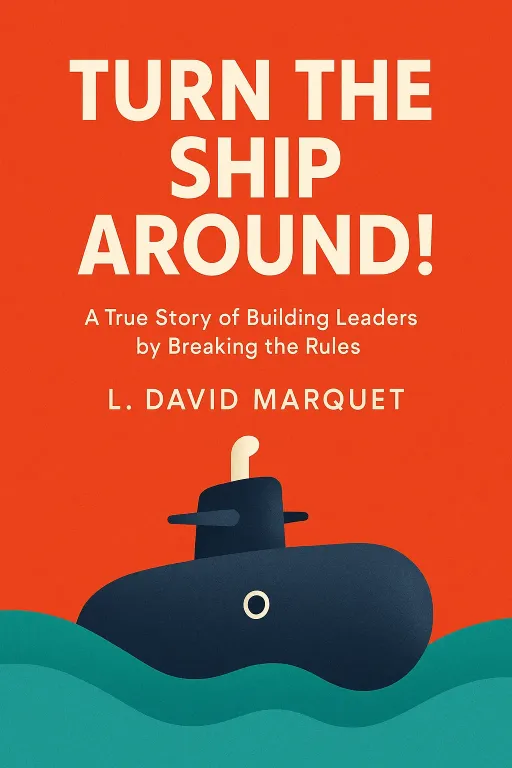
Nova: Absolutely. Today, we're challenging that very notion by diving into two pivotal works that, when combined, offer a revolutionary blueprint for leadership: L. David Marquet's "Turn the Ship Around!" and Daniel H. Pink's "Drive: The Surprising Truth About What Motivates Us." Marquet, a former nuclear submarine commander, literally took over the worst-performing submarine in the US fleet and, by flipping the traditional command structure on its head, transformed it into a top-tier performer. It’s a story of radical empowerment that defies everything we think we know about command.
The "Leader-Leader" Revolution
SECTION
Atlas: A nuclear submarine? That sounds like the absolute last place you’d want to experiment with radical empowerment. The stakes couldn't be higher. How on earth do you even begin to push decision-making down in an environment where a single mistake could be catastrophic?
Nova: That's precisely the magic of Marquet's story, Atlas. When he took command of the USS Santa Fe, it was a disaster. Low morale, poor performance, high turnover. He realized the "leader-follower" model, where he gave orders and the crew just followed, was creating a culture of dependency and disengagement. People weren't thinking; they were just waiting for instructions.
Atlas: So, the classic micromanagement trap, just on a grander, more aquatic scale. I imagine a lot of our listeners, especially those managing complex projects or scaling teams, can relate to that feeling of being the bottleneck.
Nova: Exactly. Marquet understood that if he was the only one making decisions, he was limiting the potential of his entire crew. So, he introduced the "leader-leader" model. Instead of giving orders, he started saying things like, "I intend to take the submarine to periscope depth."
Atlas: "I intend to..."? That sounds like a subtle semantic shift, but I'm guessing it had profound implications. What changed by simply rephrasing?
Nova: It was anything but subtle in its impact. When a junior officer or sailor said, "I intend to flood the forward ballast tanks," they weren't asking for permission; they were stating their plan. This immediately shifted the responsibility and the cognitive load. For the intent to be approved, the person stating it had to demonstrate competence and a deep understanding of they were doing it, and the consequences would be. They couldn't just blindly follow an order.
Atlas: So, it forced them to think, to own the decision, to understand the strategic context. That’s fascinating. It’s like they suddenly became mini-commanders of their specific domain. But how did he ensure they competent enough? That’s where the trust comes in, right?
Nova: Precisely. Marquet didn't just hand over the reins. He focused relentlessly on competence, clarity, and control. Competence meant rigorous training and knowledge. Clarity meant ensuring everyone understood the mission, the strategic objectives, and the boundaries. And control wasn't about micromanaging; it was about the crew having control over their own work, within those clear boundaries. He created an environment where people felt safe to take initiative.
Atlas: That's a huge leap, particularly for a visionary leader driven by developing others. It’s not just about delegating tasks; it's about developing the in every single person on the team. That's how you cultivate future leaders, by giving them actual leadership opportunities, even if it's just for a specific task.
Nova: It transformed the Santa Fe. Morale soared, performance metrics skyrocketed, and crucially, an unprecedented number of its officers went on to command their own submarines. Marquet proved that pushing decision-making authority to the lowest possible level doesn't create chaos; it fosters ownership, initiative, and ultimately, far superior results.
The Intrinsic Motivation Triad (Autonomy, Mastery, Purpose)
SECTION
Atlas: That’s truly incredible. It makes me wonder about the underlying human psychology at play here. Why did "I intend to..." work so powerfully? Is it just about feeling important, or is there something deeper going on?
Nova: That’s a brilliant segue, Atlas, because Marquet’s intuitive leadership style perfectly illustrates the profound insights Daniel Pink lays out in "Drive." Pink, through extensive research, challenges the traditional belief that the best way to motivate people is through external rewards—carrots and sticks. He argues that for complex, creative tasks, these extrinsic motivators often do more harm than good.
Atlas: Hold on, so bonuses and promotions aren't the ultimate motivators? That sounds a bit out there, especially in a results-driven world. I imagine a lot of our strategic navigators listening might be thinking, "But how do I incentivize performance then?"
Nova: What Pink found is that true, sustainable motivation—the kind that makes people genuinely engaged and innovative—stem from three intrinsic desires: Autonomy, Mastery, and Purpose. He calls them the three pillars of intrinsic motivation.
Atlas: Okay, so let's break those down. Autonomy first. I'm guessing that ties directly into Marquet's "I intend to..." model?
Nova: Absolutely. Autonomy is our desire to direct our own lives. It's about having control over our tasks, our time, our technique, and even our team. When people feel autonomous, they're not just following orders; they're invested. They feel a sense of ownership, which makes them far more likely to innovate and problem-solve. Think about Google's famous "20% time" where engineers could work on any project they wanted. That's autonomy in action, leading to products like Gmail.
Atlas: That makes sense. It’s not just about being told what to do, but having a say in you do it, or even you do. And that’s a powerful driver for the empathetic catalyst who wants to unleash their team's potential. What about Mastery?
Nova: Mastery is our innate urge to get better at something that matters. It’s the drive to improve, to stretch our abilities, to achieve competence. When we're engaged in tasks that are challenging but achievable, we enter a state of "flow," where time seems to disappear, and we're deeply absorbed. Marquet's crew, by having to fully understand their intentions, were constantly pushing themselves to master their roles. They weren't just performing; they were learning and growing.
Atlas: So, it’s not just about doing the job, but about doing it, and constantly seeking to do it. That’s a powerful idea for fostering self-growth within a team. And finally, Purpose. How does that fit into the picture?
Nova: Purpose is the yearning to do what we do in the service of something larger than ourselves. It's about connecting our work to a greater meaning, a mission that transcends personal gain. When people understand their work matters, how it contributes to a bigger picture, they become incredibly motivated. Marquet's crew wasn't just operating a submarine; they were protecting their country. Pink points to companies like Patagonia, whose mission to save the planet deeply resonates with its employees.
Atlas: That’s a profound connection. So, if I'm understanding this, Marquet's "leader-leader" model is essentially a masterclass in giving people autonomy, which then fuels their desire for mastery as they take ownership, and ultimately connects them to a deeper purpose. It's an ecosystem of intrinsic motivation.
Nova: Exactly. It's about designing roles and projects that naturally tap into these desires, rather than relying solely on external incentives. Instead of asking "How can I motivate them?", the question becomes "How can I create an environment where they motivate themselves?"
Atlas: That’s a critical shift for any strategic navigator. It moves from managing inputs to cultivating an environment for outputs. It’s not about pushing people; it’s about pulling them towards a shared vision by aligning with their deepest human drives. It makes me wonder, though, how does a leader transition from a traditional mindset to this, without feeling like they're losing control?
Synthesis & Takeaways
SECTION
Nova: That's the core challenge, Atlas, and it speaks directly to the visionary leader who's driven by developing others. It's not about relinquishing control; it's about redefining it. True control, in this context, comes from creating a highly competent, highly engaged, and deeply purposeful team. Marquet’s story isn't just an anecdote; it's a testament to Pink's research. He proved that when you give people autonomy, foster their pursuit of mastery, and connect them to a compelling purpose, you don't just get better performance; you get a team of self-starting, problem-solving, future leaders.
Atlas: That's actually really inspiring. It frames leadership not as a burden of constant oversight, but as the art of cultivating human potential. It turns the traditional hierarchy into a network of highly empowered individuals, all rowing in the same direction, but each with their own paddle and compass.
Nova: And for our listeners, especially those who value self-growth and seek impact, the tiny step here is incredibly powerful. Identify just one task you currently micromanage—even a small one. Now, instead of giving instructions, empower a team member to take full ownership. Provide clear objectives, yes, but allow them to determine the 'how.'
Atlas: That's a tangible action. And to build on that, consider this deep question: How can you redesign just one role or project within your team this quarter to naturally enhance autonomy, encourage mastery, and explicitly connect to a larger purpose? It's about weaving these intrinsic motivators into the fabric of the work itself.
Nova: It’s about trusting your team to be more than just followers. It's about empowering them to be leaders themselves.
Atlas: What a powerful way to shift our perspective on what leadership truly means.
Nova: This is Aibrary. Congratulations on your growth!