

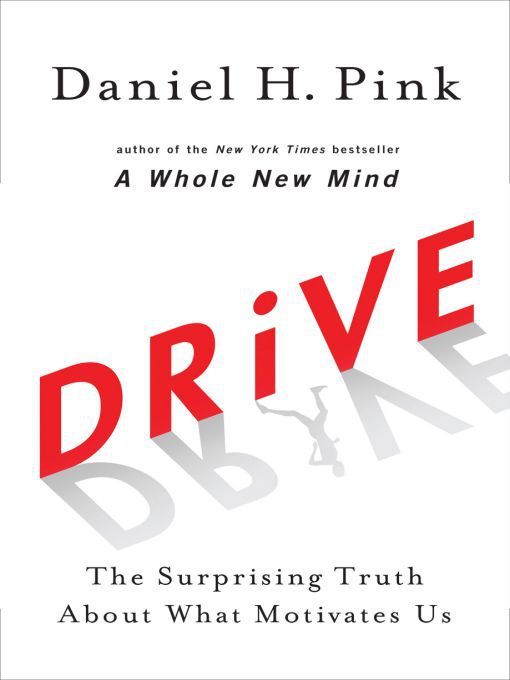
Drive
Introduction
Nova: Imagine you are a scientist in the 1940s. You give a group of monkeys a mechanical puzzle. There is no food involved, no praise, no reward at all. What do you think happens? Do they just ignore it?
Nova: That is exactly what everyone thought. But a psychologist named Harry Harlow found the opposite. The monkeys started playing with the puzzles, solving them, and actually seemed to enjoy it. They were driven by what Harlow called intrinsic motivation. The joy of the task was the reward itself.
Nova: And that is the gap Daniel Pink explores in his book, Drive. He argues that there is a massive mismatch between what science knows and what business does. We are still using the same carrot and stick methods from the industrial revolution, and according to Pink, it is actually making us less productive and less happy.
Nova: We are going to dive into all of it. From why bonuses can actually kill creativity to the three things that actually make us want to get out of bed in the morning. It is a complete rethink of how we work and live.
Key Insight 1
The Evolution of Motivation
Nova: To understand where we are going, we have to look at where we started. Pink breaks motivation down into three versions, like software updates. Motivation 1.0 was all about survival. If you did not find food or avoid the saber-toothed tiger, you died. Simple, effective, but limited.
Nova: Exactly. So as society became more complex, we upgraded to Motivation 2.0. This is the world of carrots and sticks. If you do this, you get that. It is built on the idea that humans are basically like donkeys. You dangle a reward in front of them to get them to move, or you poke them with a stick to keep them from stopping.
Nova: It worked brilliantly for the industrial age. If you are working on an assembly line and your job is to screw a cap onto a bottle, Motivation 2.0 is great. The task is routine and requires no creativity. If I pay you more per bottle, you will screw them on faster.
Nova: But here is the catch. Most of us do not screw caps onto bottles anymore. We are in the conceptual age. We solve problems, we create things, we navigate complex social systems. And Pink argues that for these kinds of tasks, Motivation 2.0 is not just ineffective, it is actually toxic. It is like trying to run modern AI software on a computer from 1985.
Nova: Science says yes, and that brings us to Motivation 3.0. This is the upgrade we need for the 21st century. It is based on our innate need to direct our own lives, to learn and create new things, and to do better by ourselves and our world.
Nova: Not at all. He says you have to pay people enough to take the issue of money off the table. If people feel they are being paid unfairly, they will focus on the unfairness, not the work. But once you pay them enough, adding more carrots does not help. In fact, it starts to hurt.
Key Insight 2
The Carrot and Stick Trap
Nova: Let's talk about the Candle Problem. It is a classic experiment by Sam Glucksberg. You give someone a candle, some thumbtacks, and a box of matches. Their job is to attach the candle to the wall so the wax doesn't drip on the table.
Nova: Exactly. It requires a little bit of creative thinking. Now, Glucksberg did this with two groups. He told the first group he was just timing them to establish a baseline. He told the second group that if they were in the top twenty-five percent of fastest times, they would get five dollars. If they were the fastest of all, they would get twenty dollars.
Nova: You would think so. But the group that was offered the money actually took three and a half minutes longer than the group that was not offered anything.
Nova: It makes sense when you understand how rewards affect the brain. Rewards narrow our focus. They create a sort of tunnel vision. That is great if the path to the solution is clear, like the assembly line. But for creative problems, you need a wide focus. You need to look around the periphery. The reward makes people focus so hard on the finish line that they miss the creative solution right in front of them.
Nova: It happens everywhere. Pink lists what he calls the Seven Deadly Flaws of extrinsic rewards. They can extinguish intrinsic motivation, diminish performance, crush creativity, and even encourage cheating. Think about the 2008 financial crisis. You had people being offered massive bonuses for short-term gains, which led them to take massive risks and ignore the long-term health of the system.
Nova: Precisely. Pink calls this the Sawyer Effect, named after Mark Twain's Tom Sawyer. Tom convinced his friends that whitewashing a fence was a privilege, not a chore. He turned work into play. Extrinsic rewards do the opposite. They turn play into work. They take something you might have enjoyed doing for its own sake and turn it into a transaction.
Key Insight 3
The Power of Autonomy
Nova: If carrots and sticks are out, what is in? Pink says Motivation 3.0 is built on three pillars. The first is Autonomy. This is the desire to direct our own lives.
Nova: Pink makes a distinction between management and autonomy. Management is great for compliance, but autonomy is for engagement. He breaks it down into the four Ts: Task, Time, Technique, and Team.
Nova: Maybe not all the time, but look at a company like Atlassian. They used to do something called FedEx Days. Once a quarter, they would tell their engineers they could work on anything they wanted for twenty-four hours, as long as it was not their regular job. The only catch was they had to deliver something overnight, hence the name FedEx.
Nova: They got a huge number of software fixes and new product ideas that never would have happened otherwise. It was so successful they expanded it. Then there is Time. Have you heard of ROWE? It stands for Results-Only Work Environment.
Nova: Exactly. No set hours, no mandatory meetings. You are judged solely on your output. Companies that have tried this often see productivity go up and turnover go down. People want to be treated like adults who can manage their own schedules.
Nova: That is the Technique and Team parts too. Letting people choose how they do the work and who they do it with. When you give people autonomy, you are telling them you trust them. And trust is a much more powerful motivator than a five percent bonus.
Key Insight 4
Mastery and Purpose
Nova: The second pillar is Mastery. This is the urge to get better and better at something that matters. Think about people who spend their weekends practicing guitar or learning to code for fun. They are not getting paid. They are doing it because the act of getting better feels good.
Nova: You have to provide what Pink calls Goldilocks Tasks. Not too hard, which leads to anxiety, and not too easy, which leads to boredom. You want tasks that are just at the edge of a person's ability. This creates a state of flow, where you lose track of time because you are so engaged in the challenge.
Nova: An asymptote is a curve that gets closer and closer to a line but never actually touches it. Mastery is the same. You can get better and better, but you never truly reach perfection. For a person driven by mastery, that is not frustrating; it is the whole point. The joy is in the pursuit.
Nova: You are right on cue. The third pillar is Purpose. This is the yearning to do what we do in service of something larger than ourselves. Pink points out that the most deeply motivated people hitch their desires to a cause larger than their own ego.
Nova: That is the difference between a purpose poster and actual purpose. Pink talks about the rise of the purpose-driven organization. Look at Wikipedia versus Microsoft's Encarta. Microsoft had all the money, the best professional writers, and huge incentives. Wikipedia had a bunch of volunteers doing it for free because they believed in the purpose of creating a free encyclopedia for the world. We know who won that battle.
Nova: Exactly. When the profit motive becomes unmoored from the purpose motive, things go south. But when they are aligned, you get a level of energy and innovation that carrots and sticks could never produce.
Conclusion
Nova: So, we have covered a lot of ground. We have seen how the old model of rewards and punishments is failing in the modern world, and how autonomy, mastery, and purpose are the real drivers of high performance.
Nova: That is the question Pink wants us all to ask. If you are a leader, stop thinking about how to control people and start thinking about how to liberate them. Give them the space to be autonomous, the challenges to achieve mastery, and the context to find purpose.
Nova: Precisely. The science is clear. We are built to be active and engaged, not passive and compliant. When we align our work with our internal drives, we don't just do better work; we live better lives.
Nova: I am glad to hear it. There is so much more to explore in the world of human potential, but this is a great place to start. Thank you for joining us on this journey through the science of motivation.
Nova: This is Aibrary. Congratulations on your growth!