

The Autonomy Algorithm: Hacking Motivation for Creative Teams
Golden Hook & Introduction
SECTION
Nova: What if I told you that the promise of a big bonus could make your smartest employees worse at their jobs? Not just less happy, but measurably slower and less creative. It sounds like a paradox, right? But it's one of the most robust findings in behavioral science, and it's the core challenge for any modern leader, especially in a creative field like marketing.
Sakibuuuu: It's a deeply counterintuitive idea, and honestly, a little scary for anyone in a management position. All the traditional business wisdom says you reward the behavior you want to see more of.
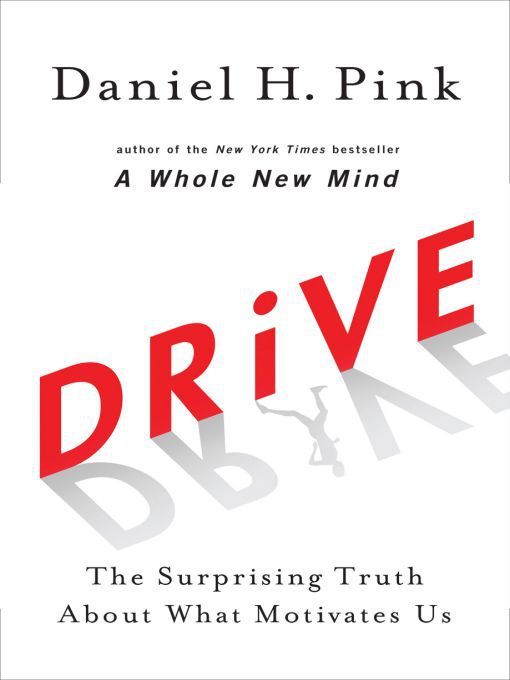
Nova: Exactly! And that's the world Daniel Pink completely deconstructs in his book, "Drive." He argues that for most of the 20th century, business ran on an operating system of motivation that he calls "Motivation 2.0"—the world of carrots and sticks. If you do this, you get a reward. If you don't, you get a punishment. But for 21st-century work, that system is failing. And with us today is Sakibuuuu, a new Marketing Manager with a PhD and a brilliantly analytical mind, who is living on the front lines of this very challenge. Welcome, Sakibuuuu!
Sakibuuuu: Thanks for having me, Nova. It's a topic I think about constantly. How do you get the best, most innovative work out of a team of smart, creative people? It feels like the central question of modern leadership.
Nova: Well, I think "Drive" offers some incredible answers. So today we'll dive deep into this from two perspectives. First, we'll explore the traditional 'carrot-and-stick' approach is fundamentally broken for creative work, using a mind-bending experiment as our guide. Then, we'll unpack the powerful three-part solution that replaces it: Autonomy, Mastery, and Purpose, and figure out how you can actually use it to build an unstoppable team.
Sakibuuuu: I'm ready. Let's deconstruct the system.
Deep Dive into Core Topic 1: The Great Mismatch: Why 'Carrots and Sticks' Kill Creativity
SECTION
Nova: Alright, so let's start with that paradox I mentioned. To really feel its power, we have to go back to a classic experiment from 1945 that Pink highlights in the book. It's called the "Candle Problem," created by a psychologist named Karl Duncker.
Sakibuuuu: The Candle Problem. Okay, I'm intrigued.
Nova: Imagine this, Sakibuuuu. I bring you into a room. On a table in front of you, I've placed a few objects: a single candle, a cardboard box full of thumbtacks, and a book of matches. Your task is simple: attach the candle to the wall in a way that, when you light it, the wax won't drip onto the table below. What do you do?
Sakibuuuu: Hmm. Okay, so my first instinct is to try and tack the candle directly to the wall. But the wax is too soft, the tack would just go through it and it wouldn't hold. Then maybe I'd try to melt some of the wax and use it as an adhesive to stick the candle to the wall?
Nova: A common attempt! But it usually fails. The candle is too heavy, the wax isn't strong enough. People get stuck. The solution requires a leap of insight. You have to look at the objects on the table not for what they, but for what they. The key is the box of thumbtacks. Most people see it just as a container for the tacks.
Sakibuuuu: Ah, I see it now. You have to overcome what psychologists call 'functional fixedness.' The box isn't just a container. It's a potential platform.
Nova: Precisely! The solution is to dump the tacks out of the box, use one of the tacks to pin the to the wall, and then place the candle inside the box. It becomes a perfect little shelf. Problem solved. It's a test of out-of-the-box thinking, literally.
Sakibuuuu: A great little puzzle. So where does motivation come into this?
Nova: This is where it gets fascinating. In the 1960s, a scientist named Sam Glucksberg used this exact problem to study the effects of incentives. He brought in two groups of people. To the first group, he said, "I'm just going to time you to see how long it takes, on average, for people to solve this kind of problem." That was the control group.
Sakibuuuu: Okay, a baseline.
Nova: To the second group, he offered a reward. He said, "If you're in the top 25% of fastest times, you get five dollars. If you're the single fastest of everyone we test today, you get twenty dollars." Now, adjusting for inflation, that's a pretty decent chunk of change for a few minutes of work. It's a strong motivator. So, Sakibuuuu, who solved the problem faster? The group with the cash prize on the line, or the group with no incentive at all?
Sakibuuuu: Based on your intro, I'm guessing the group with no incentive. But every fiber of traditional business thinking screams it should be the group with the money. The pressure should make them focus harder, think faster.
Nova: And that's the shock. The group that was offered the money took, on average, three and a half minutes to solve the problem.
Sakibuuuu: Three and a half minutes longer! That's not a small margin of error; that's a massive difference. So the reward, the very thing that was supposed to sharpen focus and accelerate thinking, actually created a kind of cognitive blindness.
Nova: You nailed it. It created tunnel vision. The reward made people focus so intently on the goal—'solve this fast, get the money'—that it blocked them from seeing the peripheral solutions. They saw the box only as a container for tacks because that's its most common function. The pressure of the reward actually extinguished the creative spark needed to see it as something else.
Sakibuuuu: This has profound implications for my world. In marketing, our entire job is a version of the Candle Problem, every single day. We're not just assembling widgets according to a manual. We're given a client's problem—low brand awareness, declining sales, a new product launch—and we have to find that 'tack the box to the wall' solution.
Nova: Right! It's all conceptual, creative problem-solving.
Sakibuuuu: So if I walk into a brainstorming session and say, "Team, a five-hundred-dollar bonus for the person who comes up with the winning campaign slogan," this research suggests I'm not actually increasing the odds of a brilliant idea. I might be actively them. I'm incentivizing everyone to come up with safe, conventional, fast ideas that fit the established pattern, because the pressure of the reward narrows their thinking. The truly weird, game-changing idea—the one that requires seeing the box as a shelf—gets lost.
Nova: That's the great mismatch Pink talks about: what science knows versus what business does. He's clear that for simple, mechanical tasks—like, say, stuffing envelopes—rewards work great. They make you work faster. But the moment a task requires even a little bit of cognitive skill or creativity, that "if-then" reward system can be a disaster.
Sakibuuuu: It's a fundamental shift in thinking. We're trying to run a creative, 21st-century knowledge economy on a motivational operating system designed for a 20th-century factory floor. It's like trying to run the latest AI software on a computer from 1985. The hardware just isn't built for it.
Nova: That is the perfect analogy. And it begs the question... if that operating system is obsolete, what's the upgrade?
Deep Dive into Core Topic 2: The New Operating System: Autonomy, Mastery, and Purpose
SECTION
Nova: You've hit the nail on the head, Sakibuuuu. And that naturally leads us to the second key idea in "Drive": if carrots and sticks don't work for creative work, what does? Pink proposes a new 'operating system' for motivation, what he calls "Motivation 3.0." It's built on three core intrinsic elements.
Sakibuuuu: And these are the famous three: Autonomy, Mastery, and Purpose.
Nova: Exactly. Let's break them down. Autonomy is our innate desire to be self-directed, to have control over our own lives and work. Mastery is the urge to get better and better at something that matters to us. And Purpose is the yearning to do what we do in the service of something larger than ourselves. Pink argues these aren't fuzzy, nice-to-have concepts; they are the primary drivers of performance and satisfaction for modern work.
Sakibuuuu: So it's moving from external control—the carrot—to internal drive. I'm particularly interested in Autonomy. As a manager, the idea of giving up control can be... unsettling.
Nova: It can be! But the results are staggering. Let's talk about a fantastic, concrete example from the book: the Australian software company Atlassian. They are a billion-dollar company, so this isn't some small, quirky startup. For years, they implemented something they called "FedEx Days."
Sakibuuuu: Why FedEx Days?
Nova: Because you had to deliver something overnight! The concept was simple. Once a quarter, on a Thursday afternoon, they would announce to their developers: "For the next 24 hours, you can work on anything you want. It can't be part of your regular project list. You can work on it alone or with a team. The only rule is that you have to show what you've created to the rest of the company in a fun, informal meeting on Friday afternoon."
Sakibuuuu: Wow. That's radical trust. You're essentially paying a team of highly skilled, expensive developers to just... follow their curiosity for a day.
Nova: It is radical trust! And what do you think happened? Chaos? Did everyone just play video games? No. In those 24-hour bursts of pure, unadulterated autonomy, a huge number of their most valuable software fixes, product updates, and even ideas for brand-new products were born. It was an explosion of innovation. They've since renamed them "ShipIt Days," and it's a core part of their culture.
Sakibuuuu: That's a brilliant real-world application. It's not total anarchy; it's structured freedom. As a manager, that's both terrifying and incredibly exciting. You're giving up control over the, but not the. The goal is clear: 'present something cool and useful in 24 hours.' But you're giving them total autonomy over what Pink calls the four T's: their Task, their Time, their Technique, and their Team.
Nova: You've got it. And you can see how it connects to the other two pillars, right? People naturally gravitated toward projects that stretched their skills and allowed them to learn something new. That's Mastery.
Sakibuuuu: Right. A programmer might decide to learn a new coding language to build their project, not because a boss told them to, but because they to. They are driven by the desire to improve.
Nova: And they often chose to fix a bug that had been annoying their colleagues for months, or build a tool that would make everyone's life easier. That's Purpose. Their work had a meaning beyond just a task on a to-do list. It served the greater good of the team and the company.
Sakibuuuu: This connects directly to my interest in leaders like Steve Jobs. Apple, under his leadership, wasn't just about making computers. The purpose, the mission, was to "make a dent in the universe." That grand purpose is what drove engineers to work insane hours to perfect the curve of a mouse or the font on a screen. They were mastering their craft in service of a purpose they believed in. Jobs was a master at creating an environment of autonomy and purpose, even if he was famously demanding.
Nova: That's a fantastic connection. He didn't tell the brilliant designer Jony Ive to design the iMac. He gave him the autonomous space and the grand purpose, and trusted him to achieve mastery.
Sakibuuuu: So, for my team, maybe a full "ShipIt Day" is too much to start with. But the principle is scalable. It could be as simple as defining the objective—'we need to increase social media engagement on this new product by 15% in the next quarter'—and then stepping back. I don't dictate the exact posts, the platforms, or the tone. I give them the 'what' and the 'why', and I give them total freedom on the 'how'. That's a tangible leadership shift I can make tomorrow. It's moving from being a micromanager to being a facilitator of their intrinsic drive.
Nova: And that's the whole game. It's about creating conditions, not commanding actions.
Synthesis & Takeaways
SECTION
Nova: So, let's pull this all together. We've journeyed through "Drive" and seen this powerful arc. First, the old model of motivation, the carrots and sticks of Motivation 2.0, can actually backfire for creative and conceptual tasks, narrowing our focus and killing the very innovation we seek.
Sakibuuuu: It's a system that's fundamentally mismatched with the nature of modern work. We saw that so clearly with the Candle Problem.
Nova: And the alternative, this upgrade to Motivation 3.0, isn't about just being 'nice' to employees. It's about being more effective. It's about tapping into our deep, human needs for Autonomy, Mastery, and Purpose to unleash performance.
Sakibuuuu: I think that's the key insight for me. This isn't a 'soft' management philosophy; it's a smart one. It's about creating the conditions for talented people to do their absolute best work, which is the ultimate goal of any leader. It's the difference between demanding compliance and fostering genuine engagement. One gets you what you ask for; the other gets you more than you could have ever imagined.
Nova: So for everyone listening, especially those in leadership roles like you, Sakibuuuu, or anyone who wants to improve their own personal drive, we want to leave you with a simple but incredibly powerful takeaway from the book.
Sakibuuuu: I love this one because it's so actionable. Ask each person on your team—or even just ask yourself—two simple questions. First: "What is my purpose? What truly motivates me to do this work every day?" It forces you to look beyond the paycheck.
Nova: And the second question?
Sakibuuuu: "What is the biggest obstacle or barrier that gets in the way of me doing my best work?" The answers to those two questions are pure gold. They give you a direct, personalized roadmap to start implementing Autonomy, Mastery, and Purpose. The first question tells you what drives them, and the second tells you what's blocking their drive.
Nova: It's their personal starting point for upgrading to this new operating system.
Sakibuuuu: Exactly. It's how you stop trying to push people with carrots and start creating an environment where they can run on their own. And that's a much more powerful, and sustainable, way to lead.