

Stop Managing, Start Leading: The Guide to Empowering Your Team's Full Potential
Golden Hook & Introduction
SECTION
Nova: Atlas, if you had to describe the core idea of "Stop Managing, Start Leading" in just five words, what would they be?
Atlas: Oh, that’s a fun challenge! Alright, my five words are: Freedom, trust, power, growth, total game-changer.
Nova: Freedom, trust, power, growth, total game-changer. Wow, Atlas, that’s a powerful five words, and you nailed it. It perfectly encapsulates the essence of our book today: "Stop Managing, Start Leading: The Guide to Empowering Your Team's Full Potential."
Atlas: It sounds like it’s flipping the script on something fundamental.
Nova: Exactly! What's fascinating about the philosophy behind this book is how it challenges a deeply ingrained assumption in the corporate world—the idea that leadership is solely about control. It often draws on principles that have revolutionized high-stakes environments, like military commands, to show how true leadership isn't about command and control, but about cultivating more leaders. It’s a complete paradigm shift.
The Flaw of Centralized Control: Why Top-Down Leadership Fails
SECTION
Atlas: Okay, but isn't that how most organizations operate? With a clear chain of command? What’s the fundamental flaw there, if it’s so common?
Nova: That’s the million-dollar question, Atlas. And the cold fact, as the book puts it, is that traditional top-down leadership often stifles initiative and creates bottlenecks. True team communication and cohesion flourish when control is distributed, not centralized.
Atlas: So, what exactly was going wrong in these traditional setups? Why did this seemingly 'normal' way of doing things lead to disaster, or at least, underperformance?
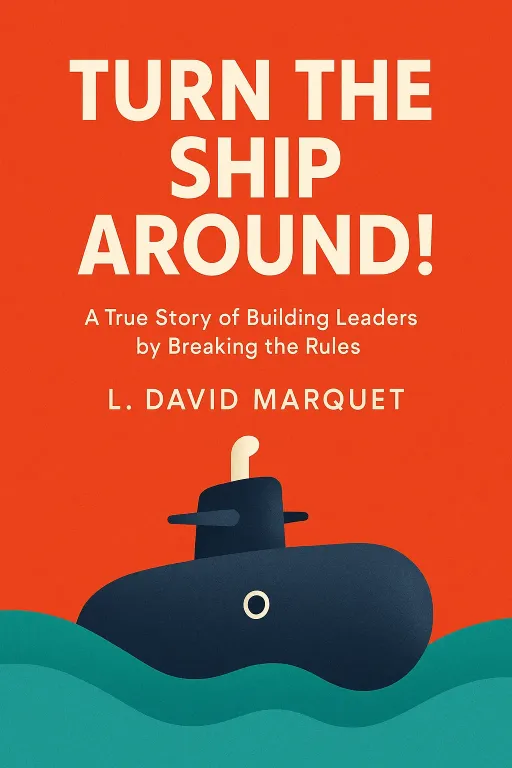
Nova: Think about the story of Captain L. David Marquet, recounted in "Turn the Ship Around!" He took command of the USS Santa Fe, a nuclear submarine. It was, by all accounts, failing. It had low morale, poor performance, and was consistently at the bottom of the fleet. The problem? It was a classic leader-follower model. Everything went through the captain. Every decision, every instruction. His officers were trained to wait for orders, not to think for themselves.
Atlas: Oh man, I can imagine the frustration. You’re highly skilled, but you’re just a cog in the machine, waiting for the top to tell you what to do.
Nova: Precisely! The cause was a system that emphasized obedience over initiative. The process was a constant bottleneck at the top, with officers unable to act without explicit permission, leading to delays, missed opportunities, and a profound lack of ownership. The outcome? A submarine that was literally sinking in performance and morale. Marquet realized that he couldn't be everywhere, know everything, or make every decision. His team was competent, but their competence was locked behind a gate of centralized control.
Atlas: Wow, that's a powerful example. So, it wasn't that the people were bad, it was the that was bad. The structure itself was preventing them from being their best.
Nova: Exactly. It created a dependency culture. When you’re constantly waiting for instructions, you stop looking for solutions. You stop engaging your full intellect. And in a high-stakes environment like a nuclear submarine, that can be catastrophic. It’s not just about efficiency; it’s about human potential being actively suppressed.
Unlocking Potential: The Leader-Leader Model and Intrinsic Motivation
SECTION
Atlas: That makes perfect sense. So if that’s the problem, how do you actually fix a system that’s designed for central command? How do you turn a failing submarine around, literally?
Nova: This is where Marquet’s genius came in, and it's the core of the 'leader-leader' model. Instead of giving orders, he started giving. He empowered his officers to make decisions, to articulate their intentions, and to take responsibility. He used phrases like, "I intend to..." instead of "Permission to..."
Atlas: Hold on, so he didn’t just delegate tasks, he delegated authority? That sounds risky! How do you give that kind of autonomy without chaos erupting?
Nova: That’s the beauty of it. He didn't just throw them into the deep end. He created a culture of competence and clarity. He pushed them to understand the 'why' behind their actions, not just the 'what.' And this connects directly to Daniel H. Pink’s groundbreaking work in "Drive." Pink argues that external motivators – like money or promotions – are far less effective than intrinsic motivators.
Atlas: Right, I’ve heard about Pink’s work! He talks about autonomy, mastery, and purpose, doesn't he?
Nova: He does! Marquet’s transformation of the Santa Fe is a living embodiment of Pink’s theory. By giving his officers – the freedom to direct their own work; by fostering – the urge to get better at something that matters; and by instilling a clear sense of – the desire to do things in service of something larger than themselves – he unlocked unprecedented levels of engagement and performance.
Atlas: That makes sense, but what does 'mastery' look like in a typical workplace, not just on a submarine? For someone who values clear communication and strong teams, how does this actually build, rather than erode, cohesion?
Nova: Great question, Atlas. Mastery in a typical workplace means providing opportunities for continuous learning and skill development, allowing people to specialize and become experts in their areas. It’s about challenging people with tasks that are just beyond their current skill level, so they’re always growing. And far from eroding cohesion, it strengthens it. When everyone feels a sense of ownership and competence, they communicate more effectively, because they’re all working towards a shared purpose, not just waiting for orders. They're all acting like leaders, watching out for the whole team. It fosters a collective intelligence.
Atlas: I can see how that would lead to better outcomes. It’s not just about delegating; it’s about cultivating an environment where everyone to lead, and has the skills and support to do so effectively. It sounds like Nova’s take, where empowering your team isn't just about delegating tasks; it's about cultivating a culture where everyone thinks and acts like a leader, driving collective success.
Synthesis & Takeaways
SECTION
Nova: Absolutely. And that's the profound insight here: the highest form of leadership isn't about being the best at everything yourself, but about making everyone around you better. It’s about understanding that the collective intelligence and initiative of a truly empowered team will always far surpass the capabilities of even the most brilliant individual at the top. It moves from a mindset of 'I need to make all the decisions' to 'I need to create a system where the best decisions are made, no matter who makes them.'
Atlas: That’s actually really inspiring. For our listeners who are looking to deepen their leadership skills and build strong teams, it sounds like a fundamental shift in perspective. So, what’s a tiny, practical step someone can take to start moving towards this leader-leader model?
Nova: The book offers a brilliant "Tiny Step." Identify one decision you usually make for your team. Just one. This week, empower a team member to make that decision, providing support but not dictating the outcome. It's a small act of trust that can have a huge ripple effect, planting the seed for that leader-leader culture.
Atlas: I love that. Start small, but start. It’s a practical application for anyone driven by self-improvement and wanting to see their team flourish. It’s about giving away a little bit of control to gain a whole lot more in engagement and performance.
Nova: Precisely. It’s an investment in your team's potential, and ultimately, in your own effectiveness as a leader.
Atlas: Freedom, trust, power, growth, total game-changer. What a journey.
Nova: This is Aibrary. Congratulations on your growth!