

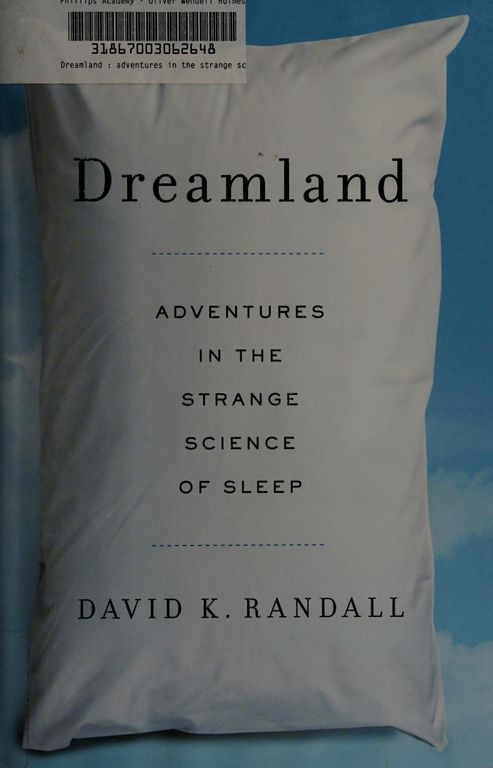
Dreamland
Adventures in the Strange Science of Sleep
Introduction
Nova: Imagine waking up in the middle of the night, not in your bed, but collapsed in a hallway, clutching your leg, howling in pain. That's exactly what happened to journalist David K. Randall one Tuesday night. His last memory was putting his head on a pillow. Then, somehow, he sleepwalked thirty feet and crashed into a wall. And when he went to his doctor for answers, the response he got was startling: There's a lot we know about sleep, and a lot we don't. Try to take it easy.
Nova: : That's it? That's the best modern medicine could offer him?
Nova: That's it. And that moment of bewilderment launched Randall on a quest that became his book Dreamland: Adventures in the Strange Science of Sleep. Here's the thing that really gets me: we spend roughly a third of our lives asleep. For most of us, that's twenty-five to thirty years. Yet as Randall discovered, sleep is, in his words, one of the dirty little secrets of science.
Nova: : So the book is basically a journalist saying, fine, if doctors can't tell me why I'm sleepwalking into walls, I'll go figure it out myself.
Nova: Exactly. And what he found is that sleep is far stranger and more important than most of us ever imagined. It affects everything from who wins Monday Night Football to whether soldiers survive on the battlefield, to whether you can be acquitted of murder. Today we're diving into Dreamland, a book that pulls back the covers on the missing third of our lives.
Nova: : I'm already hooked. Let's get into it.
The Forgotten History of Segmented Sleep
How Humans Lost the Night
Nova: One of the most mind-bending discoveries Randall shares comes from a historian named Roger Ekirch. Back in the 1980s and 90s, Ekirch combed through medieval texts, medical manuscripts, literature, and personal diaries, and he kept stumbling across these strange references to something called first sleep and second sleep.
Nova: : First sleep and second sleep? Like, people went to bed twice?
Nova: Precisely. Before the widespread use of artificial light, people didn't sleep in one eight-hour block the way we assume is natural. They would fall asleep shortly after sundown, sleep for about four hours, then wake up around midnight for an hour or two, and then go back for their second sleep until dawn.
Nova: : What did they do during that midnight waking period?
Nova: A surprising range of things. They'd pray, read, contemplate their dreams, have conversations, or be intimate with their partners. Randall quotes a 15th-century doctor who advised people to spend their first sleep on the right side, then switch to the left for the second. A cleric in England wrote that the time between sleeps was the best period for serious study. Chaucer even references it in The Canterbury Tales.
Nova: : So this wasn't some obscure practice. It was just how everyone slept.
Nova: Exactly. And here's where it gets even more fascinating. A researcher named Thomas Wehr at the National Institutes of Health decided to test this. He took volunteers and deprived them of all artificial light for several weeks. At first, they slept a ton, almost as if catching up on a massive sleep debt. But then, something remarkable happened: their sleep pattern shifted. They began waking up naturally in the middle of the night for about an hour, and then falling back asleep. Their bodies reverted to segmented sleep.
Nova: : So the eight-hour consolidated sleep block we all think of as normal is actually a modern invention.
Nova: Created by the light bulb, essentially. And Randall points out something crucial here. Many people today wake up at two or three in the morning and panic. They think something is wrong. They reach for sleeping pills. But that middle-of-the-night waking might actually be a perfectly natural pattern that our bodies are trying to return to.
Nova: : And there's a biochemical reason it might even feel good.
Nova: Yes. Researchers drew blood from subjects during that waking period and found elevated levels of prolactin, which is the same hormone chickens produce when they're sitting contentedly on eggs. Randall describes it as a naturally pleasant, contemplative state. We've essentially engineered that out of our lives with electric lights, late-night TV, and smartphones.
Nova: : So Edison didn't just invent the light bulb. He rewired human biology.
Nova: That's exactly what Randall argues. And most of us don't even know it happened.
Sleepwalking, Murder, and the Law
Asleep at the Wheel of a Crime
Nova: One of the most gripping chapters in Dreamland deals with something that sounds like it belongs in a horror movie: people who have committed violent crimes while completely asleep.
Nova: : I remember you mentioned that in the intro. Is this actually real?
Nova: It is. The most famous case is Kenneth Parks, a 23-year-old Canadian. In 1987, Parks got out of bed, got into his car, drove fourteen miles to his in-laws' house, let himself in with his key, and brutally attacked both of them. He stabbed his mother-in-law to death and nearly killed his father-in-law. Then he drove himself to the police station and turned himself in, covered in blood.
Nova: : That sounds premeditated. Fourteen miles, a car key, a drive. How could anyone believe he was asleep?
Nova: That was exactly the prosecution's argument. But Parks had no motive. He had a good relationship with his in-laws. He had massive gambling debts and had planned to tell his mother-in-law about them that very evening, but she was apparently supportive. More importantly, his defense uncovered a deep family history of sleepwalking. His father and grandfather both had documented episodes. His grandmother once caught his father trying to climb out a sixth-story window, completely unconscious.
Nova: : And the jury bought this?
Nova: They did. Parks was acquitted. The medical testimony established that a sleepwalking person is almost literally half-asleep. The eyes can be open, the body can perform remarkably complex tasks including driving, but the rational, decision-making part of the brain is not what we would consider conscious.
Nova: : But Randall notes that this defense hasn't always worked, right?
Nova: Right. There's the case of Scott Falater in Arizona in the late 1990s. He stabbed his wife to death and drowned her in their pool, then claimed he was sleepwalking. The jury didn't buy it, and he's serving life in prison. Randall highlights an interesting legal scholar, Deborah Denno at Fordham Law School, who argues that criminal law needs a new category: semi-voluntary actions. If someone knows they have a serious sleepwalking problem and does nothing to prevent it, they might bear some responsibility.
Nova: : It's terrifying to think that the person next to you in bed could be capable of something like this without even knowing it.
Nova: Randall himself found this deeply unsettling. He notes that parasomnias seem to be more common in men, and that most sleepwalkers never do anything violent. But the fact that it's possible at all reveals how much about our own brains remains mysterious, even to ourselves.
Nova: : It makes Randall's own sleepwalking incident with the wall seem almost quaint in comparison.
Nova: Indeed. He went from being a guy who crashed into a wall to learning about people who drove cars and committed homicides while unconscious. It's a stark reminder that sleep is not simply an off switch. The brain is doing all kinds of things we don't understand.
Military, Sports, and Circadian Rhythms
The High Cost of Skimping on Sleep
Nova: Randall devotes significant attention to how sleep deprivation plays out on a massive, institutional scale. And nowhere is this more consequential than in the military.
Nova: : I've heard that soldiers don't get much sleep, but Randall makes the case that this is literally a matter of life and death.
Nova: It is. During the Iraq invasion in 2003, soldiers and commanders kept reporting that their biggest enemy wasn't insurgents. It was fatigue. Tank drivers literally veered off roads because they fell asleep at the wheel. Randall cites research showing that during the first Gulf War, roughly one in four friendly fire deaths was attributable to sleep deprivation.
Nova: : One in four. That's staggering.
Nova: And the numbers only get more striking. Soldiers who slept less than four hours per night reported five times as many altercations with civilians as those who got a full eight hours. Sleep deprivation doesn't just make you tired. It impairs decision-making, communication, and the ability to improvise under pressure. Randall profiles Dr. Thomas Balkin, a military sleep researcher who envisions a future where commanders monitor soldiers' sleep data from wrist devices and order naps the same way they order ammunition resupplies.
Nova: : So napping becomes a tactical asset.
Nova: Exactly. Balkin argues that in future conflicts, friendly fire incidents could plummet toward zero simply because soldiers are getting enough sleep. The macho culture of I'll sleep when I'm dead turns out to be a genuine military liability.
Nova: : And Randall applies this circadian rhythm insight to sports too, doesn't he?
Nova: He does, and it's one of the most entertaining examples in the book. Stanford researchers looked at decades of Monday Night Football data and found a persistent, hidden bias. Monday Night games always kick off at 9 p. m. Eastern time. For West Coast teams, that's 6 p. m. Pacific, which happens to be right in the peak performance window of the human circadian rhythm, roughly 6 to 9 p. m. For East Coast teams, their bodies think it's 9 p. m., which is when the body starts winding down for sleep.
Nova: : So the West Coast teams had an invisible biological advantage.
Nova: And it showed up in the point spreads. Over many years, West Coast teams consistently outperformed expectations against East Coast teams on Monday nights. A three-hour difference in circadian timing was enough to tip the balance in a league famous for its parity.
Nova: : This makes me wonder about all the people who brag about getting by on four or five hours of sleep.
Nova: Randall addresses that directly. He notes that only in the last few years did researchers at UC San Francisco identify a rare genetic mutation that allows some people to genuinely thrive on less than six hours of sleep. For everyone else who claims they don't need much sleep, Randall's research suggests they're probably not aware of the mistakes they're making. Sleep deprivation actually impairs your ability to notice that you're sleep deprived.
Nova: : That's a cruel twist. The worse your sleep, the worse you are at realizing how badly it's affecting you.
What Sleep Does for the Brain
The Creative Power of Dreaming
Nova: So we've talked about the dangers of not sleeping. But Randall also explores the flip side. What does sleep actually do for us? Why did evolution go to such extraordinary lengths to make sure every animal, no matter how vulnerable it makes them, gets some form of sleep?
Nova: : I loved the factoid about dolphins. They sleep with half their brain awake at a time.
Nova: Yes. Dolphins have to surface to breathe and watch for predators, so evolution came up with unihemispheric sleep. Half the brain sleeps while the other half stays alert. Ducks at the edge of a flock sleep with one eye open, literally, while ducks in the middle can fully conk out. Whatever sleep does, it's so essential that natural selection goes to remarkable lengths to enable it.
Nova: : And Randall cites that famous line from a biologist: If sleep doesn't serve an absolutely vital function, it's the greatest mistake evolution ever made.
Nova: Exactly. One of the most compelling functions Randall explores is the link between sleep and creativity. He tells the story of Paul McCartney, who woke up one morning with a fully formed melody in his head. He went to his piano, played it, and asked everyone he knew if they recognized the tune, because he was convinced he must have heard it somewhere. He hadn't. His sleeping brain had composed the song Yesterday, one of the most covered songs in history.
Nova: : That's wild. But is there actual science behind this?
Nova: There is. Randall describes a study by German researchers Ulrich Wagner and Jan Born. They gave participants a tedious math task involving transforming long strings of numbers. Unbeknownst to the subjects, there was a hidden shortcut that made the task dramatically easier. After working on it for hours, only about twenty percent of people discovered the shortcut. But here's the key: the researchers let some participants sleep between sessions. Among those who slept, fifty-nine percent found the shortcut.
Nova: : So sleep nearly tripled their problem-solving ability.
Nova: Essentially, yes. Randall describes sleep as a two-stage process. First, the brain sorts through the day's events and consolidates memories, like cleaning up and organizing a filing cabinet. Then, during REM sleep, the brain starts finding connections and associations between different pieces of data. It's a genuinely creative activity. The brain isn't just resting. It's solving problems while you're unconscious.
Nova: : This connects to what Randall says about Matthew Walker's research at Berkeley, right?
Nova: Yes. Walker's work has shown that sleep is closely tied to brain plasticity, the brain's ability to form new neural pathways in response to learning. That may be the underlying mechanism for all these benefits: better creativity, sharper problem-solving, faster reaction times under stress. Randall sums it up powerfully: Health, sex, relationships, creativity, memories, all of these things that make us who we are depend on the hours we spend each night with our heads on the pillow.
Nova: : And yet for most of history, science barely studied it.
Nova: That's one of Randall's central points. Until the 1950s, scientists thought sleep was just a passive state where the brain went quiet. The discovery of REM sleep, rapid eye movement, changed everything. Researchers realized that during REM, the brain is as active as when you're awake. Now there are over seventy-five recognized sleep disorders, and sleep scientists consider themselves in the golden age of their field. We're only just beginning to understand this third of our lives.
Conclusion
Nova: So what should we take away from Dreamland? Randall's journey began with a painful collision with a wall and a doctor who essentially shrugged. What he discovered is that sleep is far from the passive, boring state we tend to assume it is.
Nova: : The segmented sleep finding alone changes how I think about my own nights. If I wake up at 3 a. m., maybe I shouldn't panic.
Nova: That's a perfect example of how Randall's research reframes everyday experience. He also gives practical, science-backed advice. Get exposure to natural sunlight during the day. Don't drink alcohol before bed. Keep your bedroom cool. And perhaps most importantly, treat sleep as something worthy of protection, not an inconvenience to minimize.
Nova: : And the mattress we spend a fortune on?
Nova: Randall is refreshingly blunt about that. The importance of mattresses, he finds, is negligible. What matters far more is the consistency of your routine and the darkness of your environment.
Nova: : One thing that stayed with me is how Randall's research reveals that women's sleep quality is a stronger predictor of marital happiness than almost any other factor. That's a finding from Dr. Wendy Troxel's work at the University of Pittsburgh. The most negative interactions between couples came after nights when the wife had slept poorly. Men, meanwhile, tend to sleep better next to a partner, partly because they're not the ones being kept awake by snoring.
Nova: It's one of nature's dark jokes, as Randall puts it. Women are far less likely to snore but tend to be lighter sleepers. The result is a nightly farce that partly explains why women suffer from insomnia more often than men.
Nova: : So what would you say is the single biggest shift Randall wants readers to make?
Nova: He wants us to stop treating sleep as the enemy of productivity. In a culture that glorifies the grind, being tired is often worn as a badge of honor. But Randall's reporting shows that this attitude is self-defeating. The military learned it the hard way, with friendly fire deaths. The NFL's point spreads quietly confirmed it for decades. And every sleep-deprived person who can't figure out a problem at work, only to wake up with the solution, experiences it firsthand.
Nova: : Sleep is not a break from our lives. It's the missing third of the puzzle of what it means to be living.
Nova: That's a direct quote from Randall, and it's the perfect note to end on. After all his research, Randall still doesn't have a cure for his own sleepwalking. Science hasn't solved that mystery yet. But he did learn that the hours we spend unconscious are anything but empty. They're when our brains do some of their most important work.
Nova: : And if you find yourself sleepwalking toward a wall, at least now you'll know you're in good company.
Nova: This is Aibrary. Congratulations on your growth!