

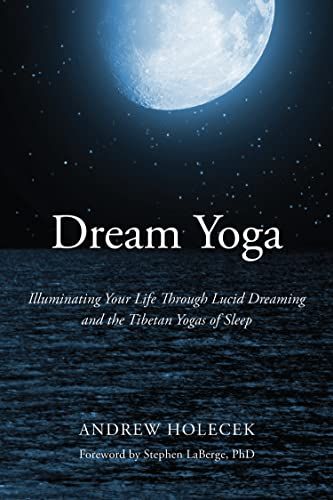
Dream yoga
Illuminating Your Life Through Lucid Dreaming and the Tibetan Yogas of Sleep
Introduction
Nova: What if I told you that you spend roughly one-third of your life in a state that most spiritual traditions consider the gateway to enlightenment — and you're probably sleeping right through it? Welcome to Aibrary, I'm Nova.
Nova: Exactly. That's the central premise of Andrew Holecek's book "Dream Yoga: Illuminating Your Life Through Lucid Dreaming and the Tibetan Yogas of Sleep." Holecek is a fascinating figure — he completed the traditional three-year Buddhist meditation retreat, holds a doctorate in dental surgery, has degrees in classical music and biology, and he's basically dedicated his life to exploring what happens in the darkness of the night.
Nova: His origin story is actually incredible. In his early twenties, after working in a maximum-security federal prison and then as a surgical orderly — pretty intense exposure to the shadow side of life — he experienced what he describes as a spontaneous spiritual awakening. His mind suddenly broke open. For two weeks, he was flooded with electrifying insights. His dream life exploded — he filled several notebooks with hyper-real, vivid dreams, many of them lucid. Meanwhile, his waking life became dreamlike and fluid. He reached a point where he literally couldn't tell if he was awake or asleep.
Nova: It was. He started asking himself, "Is this enlightenment, or am I going insane?" He actually shut the whole experience down — jumped in his Volkswagen Beetle, drove to Colorado, and spent a week skiing and drinking beer with friends to force himself back to normalcy. But that glimpse never left him. It launched a forty-year journey into the nocturnal practices that became the subject of this book.
The Crucial Distinction
Lucid Dreaming vs. Dream Yoga
Nova: Let's start with a core distinction that Holecek makes throughout the book. Lucid dreaming and dream yoga — they're not the same thing. Lucid dreaming is when you realize you're dreaming while still in the dream. You're fully conscious within the dreamscape. And for most people, what do they do with that power?
Nova: You nailed it. Holecek says the two most common lucid dreaming activities are flying and sex. He calls lucid dreaming "the ultimate in home entertainment." Your mind becomes the theater, and you're the producer, director, writer, and main actor. You can script the perfect love story or the wildest adventure. It's mostly about self-fulfillment.
Nova: Dream yoga starts where lucid dreaming leaves off. Holecek puts it this way: lucid dreaming is principally psychological and concerned with self-fulfillment. Dream yoga is spiritual and concerned with self-transcendence. Instead of using your dream mind as an entertainment center, you turn it into a laboratory. You experiment with dream meditations. You study the nature of mind itself using the medium of dreams.
Nova: That's a great analogy. And here's the critical point: lucid dreams are not karmically neutral. If you're indulging fantasies in your dreams, you're still creating mental habits. Dream yoga, by contrast, is designed to purify karma. It's about waking up in the deepest spiritual sense — and that word "waking up" is not accidental.
Nova: Exactly. From the Sanskrit root "budh," to awaken. The Buddha was someone who woke up from the deep sleep of ignorance. And here's the irony Holecek loves to point out: from the Buddhist perspective, we're actually the most spiritually awake in deep dreamless sleep, and the most asleep in so-called waking reality. We've got it completely backward.
Nova: Because in deep dreamless sleep, the ego dissolves. There's no duality — no sense of a separate self bumping up against a separate world. That non-dual awareness is, in these traditions, our most fundamental nature. We just don't recognize it because we're so habituated to identifying with forms — with thoughts, emotions, the narrative of "me." When formless awareness appears, we unconsciously say, "That's not me, I'm somebody!" and pass out. Dream yoga trains you to stay conscious through that transition.
A Ladder Into the Night
The Five Nocturnal Meditations
Nova: Holecek maps out what he calls the five nocturnal meditations — essentially a progression, a ladder descending deeper and deeper into the night. The first rung is liminal dreaming — the hypnagogic state between waking and sleep, where the ego structure starts to come undone and you can observe how the mind goes offline.
Nova: Exactly. Then comes lucid dreaming, which we've covered. Third is dream yoga proper — where lucidity is harnessed for spiritual practice. Fourth is sleep yoga — and this is graduate school. Sleep yoga is when you maintain awareness not just in dreams, but in deep dreamless sleep itself. Your body goes into sleep mode, but your mind stays awake.
Nova: It's extremely advanced, but practitioners of the Nyingma school of Tibetan Buddhism have been doing it for centuries. And then the fifth and final rung is bardo yoga — using the darkness of the night to prepare for the darkness of death.
Nova: Yes. "Bardo" means "gap" or "transitional state." In this context, it's the gap between lives. And here's where things get really fascinating. Tibetan Buddhism teaches that the process of falling asleep, dreaming, and waking up is intimately parallel to the process of dying, experiencing the after-death state, and being reborn. The Dalai Lama himself has said that a well-trained person can recognize a strict order in the four stages of falling asleep and is well prepared to ascertain an analogous order in the dying process.
Nova: Exactly. In Greek mythology, Thanatos, the god of death, and Hypnos, the god of sleep — they're not just brothers. They're twins. Holecek quotes the poet Kabir: "What is found now is found then." If you can bring lucidity to your sleep and dreams, you can bring lucidity to your death. Lucid dreaming leads to lucid living, which leads to lucid dying.
Nova: And Holecek emphasizes that this isn't just Buddhist dogma. He's a member of the American Academy of Sleep Medicine. He's authored scientific papers on lucid dreaming. He collaborates with Northwestern University's Cognitive Neuroscience Program. He's constantly bridging Eastern wisdom with Western science.
The Practices and Techniques
How to Actually Do It
Nova: So how do you actually begin? Holecek outlines three key ingredients. First, strong motivation. You have to genuinely want to become lucid. This creates what he calls "karmic momentum" that carries into the dream world.
Nova: Exactly. Have you ever had to wake up early without an alarm clock and somehow you just... do? That's intention. Holecek says you can set an internal alarm to wake up within your dreams the same way. Second ingredient: dream recall. If you can't remember your dreams, you could be having lucid dreams and never know it. He recommends keeping a dream journal by your bed. When you wake up, before moving, ask yourself, "Was I dreaming?" Close your eyes, try to recapture any fragment.
Nova: That's universal. And the third ingredient is specific induction techniques — and this is where Holecek's bridge between East and West really shines. From the Western scientific side, he talks about taking advantage of "prime-time dreamtime" — the period about two hours before you normally wake up, when REM sleep is longest and most intense. His most effective technique: set an alarm two hours before your normal wake time, stay up for fifteen minutes, then go back to sleep with the strong intention to become lucid. He also discusses the supplement galantamine for increasing dream clarity, and dream goggles that detect REM sleep and flash lights to signal you're dreaming.
Nova: Traditional Tibetan methods include visualization practices, like imagining a red lotus at your throat chakra as you fall asleep. But Holecek says one of the most effective methods for Buddhists — and really for anyone — is simple mindfulness meditation. When you train yourself to be mindful of the contents of your mind during the day, you naturally become more mindful of the contents of your mind during dreams. Multiple studies have confirmed that experienced meditators have significantly more lucid dreams.
Nova: That's the whole point. It's not just about cool dream adventures. Holecek describes a progression of dream yoga stages. Stage one: fly in your dreams. Stage two: walk through walls. Stage three: change objects — turn a table into a flower, expand a house into a mansion and shrink it back down. Stage four: deliberately create frightful situations to work with your fear.
Nova: Because it teaches you something profound: it's not the content of the nightmare that scares you, it's your habit of taking the events to be solid and real. When you discover that dreams are safe — that you don't need to fear your own mind — you can transpose that insight directly into waking life. Nightmarish life situations become softer and more workable. Tenzin Wangyal Rinpoche puts it beautifully: "Just as dream objects can be transformed in dreams, so emotional states and conceptual limitations can be transformed in waking life. We can transform depression into happiness, fear into courage, anger into love."
Emptiness, Non-Duality, and Lucid Living
The Laboratory of Reality
Nova: Let's go deeper into the philosophy. A central concept in Holecek's book is emptiness — but not in the depressing, nihilistic sense that word suggests in English.
Nova: Holecek clarifies: emptiness in Buddhism means "empty of inherent existence." If you look closely at anything, you see that it arises in dependence on other things. Nothing exists independently, solidly, on its own. The problem is reification — our deeply conditioned habit of mistaking things and thoughts to be solid and real. That, says Holecek, is the very definition of non-lucidity. Being asleep.
Nova: Yes. And this is where dream yoga becomes so powerful. In dreams, you experience directly that reality is malleable, constructed by the mind. Then you start to wonder: what if waking reality works the same way? Holecek writes that there's a "dreamlike quality to waking life that lucid dreaming illuminates." He describes how, after his awakening experience, he would walk along Lake Michigan and the waves taught him about the rising and falling of thoughts. The sun breaking through clouds was a teaching about awareness shining through the gaps between thoughts. Everything became a transparent symbol.
Nova: Holecek acknowledges this. He describes walking a fine line between "metanoia" — deriving genuine spiritual meaning — and "paranoia" — imputing excessive meaning onto things. And this is why the systematic practices matter. You're not just drifting into fantasy. You're systematically training the mind. He quotes Tarthang Tulku Rinpoche: "Experiences we gain from practices we do during our dream time can then be brought into our daytime experience." And here's a stunning claim from Namkai Norbu Rinpoche: "If a person applies a practice within a dream, it is nine times more effective than when it is applied in waking life."
Nova: Because in waking life, we're limited by our material body and the apparent constraints of physical reality. In dreams, the function of mind and the consciousness of the senses are unhindered. There's more clarity, more possibility. The first Karmapa, one of the most important figures in Tibetan Buddhism, is said to have attained his enlightenment through dream yoga. You can literally go to sleep confused and wake up transformed.
Nova: It is. But Holecek explains the mechanism. When you meditate during the day, you're mostly working with surface levels of the conscious mind. But when you fall asleep, you drop below the dualistic ego. You temporarily disconnect from the superficial layers and connect to something deeper. Working at that level — the roots rather than the branches — has vastly more transformative power. As he puts it, the smallest shifts in tectonic plates have massive surface implications. Your earth can quake toward enlightenment very quickly.
Practical Takeaways and the Bigger Picture
The Night Shift
Nova: One of the most compelling practical arguments Holecek makes is simply about efficiency. We spend roughly a third of our lives asleep. That's about twenty-five to thirty years for the average person. What if that time wasn't lost to unconsciousness, but became part of your spiritual practice?
Nova: Exactly. For those who are busy — and who isn't? — you no longer have the excuse that there isn't time to meditate. You're sleeping anyway. Why not learn to sleep consciously? And Holecek insists you won't sacrifice your rest. You'll only sacrifice your ignorance.
Nova: The awakened mind, in Holecek's framing, is a mind that is lucid under all conditions — waking, dreaming, deep sleep, and even death. It's a mind that has seen through the illusion of solidity and separation. He describes it beautifully: when your mind becomes more malleable and dreamlike, things still touch you emotionally, but they don't get to you. Your mind becomes elastic, adaptable, resilient. You become what the Tibetans call a "child of illusion" — more childlike, but not childish. He notes that many of the most enlightened beings are characterized by laughter, because they've poked through everything and delight in the levity of seeing things as they truly are.
Nova: Yes. And there's a broader cultural point Holecek makes that I find fascinating. He says the West has what he calls a "single-stage worldview" — our understanding of mind and reality is derived solely from our experience in the waking state. But ninety percent of the world's cultures are polyphasic. They derive wisdom from waking, dreaming, and deep sleep. By ignoring two-thirds of our conscious experience, we're operating with a vastly impoverished understanding of who we are.
Nova: That's exactly right. It's recovering a lost dimension of human experience. And the final, perhaps most sobering argument: if you don't wake up and take control of your mind, your unconscious habits will control it for you. Non-lucidity isn't neutral. It means being driven by patterns you don't even see. Dream yoga is about taking responsibility for the entirety of your experience — day and night, life and death.
Conclusion
Nova: So let's pull all of this together. Andrew Holecek's "Dream Yoga" is fundamentally an invitation to explore the hidden third of your life. It starts with something many people have experienced or heard about — lucid dreaming — but then systematically shows how to transform that into a genuine spiritual path.
Nova: And Holecek makes it accessible. He blends the ancient wisdom of Tibetan Buddhism — practices refined over twenty-five centuries — with modern Western science: sleep research, lucid dreaming technology, even pharmacology. He's not asking you to check your rational mind at the door. He's asking you to extend it into domains where it rarely goes.
Nova: The deeper message is perhaps the most challenging and the most liberating: you are not who you think you are. The solid, separate self you experience during the day is, in a very real sense, a dream. Waking up from that dream — becoming lucid to the nature of reality itself — is what the word "Buddha" actually means. And you don't have to wait for some dramatic enlightenment experience. Every night, when you close your eyes, you're standing at the threshold.
Nova: This is Aibrary. Congratulations on your growth.