

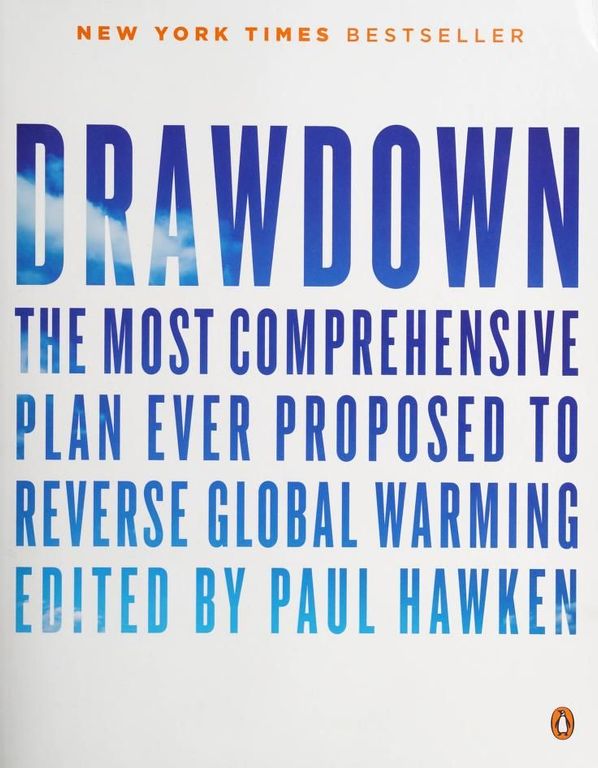
Drawdown
the most comprehensive plan ever proposed to reverse global warming
Introduction
Nova: What if I told you that the number one most powerful solution to climate change isn't solar panels, isn't electric cars, and isn't planting trees? It's managing what's inside your refrigerator and air conditioner. That's right—refrigerant management. That's the top-ranked solution in one of the most surprising and hopeful books about climate change ever written.
Nova: It does, and honestly, even the book's editor Paul Hawken admitted he wished the number one solution was sexier. But that's exactly what makes Drawdown: The Most Comprehensive Plan Ever Proposed to Reverse Global Warming such a remarkable book. It doesn't traffic in conventional wisdom or charismatic technologies. It lets the data speak.
Nova: Drawdown is that future point in time when levels of greenhouse gases in the atmosphere stop climbing and start to steadily decline. It's not about slowing the damage—it's about reversing it. Paul Hawken launched Project Drawdown in 2013 because he was tired of hearing climate conversations stuck on the problem. As he put it, people kept telling him it was game over for the climate. His response? No, it's actually game on.
Nova: Until 2017, shockingly, nobody had ever actually measured and ranked the top solutions to climate change. Hawken assembled 230 research fellows from 22 countries, all with advanced degrees—Rhodes scholars, Fulbright scholars, White House fellows—and they analyzed over five thousand references using only peer-reviewed science. They modeled 100 solutions and ranked them by how many gigatons of CO2 equivalent each could reduce by 2050.
Nova: Exactly. And the results surprised even the experts. Today we're diving into Drawdown—what it found, why it matters, and why it may be the most hopeful climate book ever written.
Refrigerant Management
The Accidental Champion
Nova: Let's start with that shocking number one solution: refrigerant management. Here's the wild thing—the chemicals in refrigerators and air conditioners, specifically hydrofluorocarbons or HFCs, are between one thousand and nine thousand times more potent as greenhouse gases than carbon dioxide.
Nova: That's not far off. And here's the key detail: ninety percent of those HFC emissions happen at the end of a unit's life—when someone just tosses an old fridge or air conditioner without properly recovering and recycling the refrigerants. According to Drawdown's analysis, properly managing and destroying existing refrigerants could reduce nearly 90 gigatons of CO2 equivalent by 2050.
Nova: We are. In October 2016, over 170 countries met in Kigali, Rwanda, and reached a binding agreement to phase out HFCs. Unlike the Paris Climate Agreement, the Kigali deal is mandatory with specific timetables. High-income countries started in 2019, with others following later. Natural refrigerants like propane and ammonia are already on the market as replacements.
Nova: Because potency multiplied by volume is enormous. A single pound of HFCs in the atmosphere traps as much heat as a thousand to nine thousand pounds of CO2. And we have huge volumes in circulation—the Lawrence Berkeley National Laboratory estimates that 700 million air conditioning units will come online worldwide by 2030. That's a massive wave of potential emissions unless we manage disposal properly.
Nova: And that's a theme running through the whole book. The data doesn't care what's trendy. It cares what works.
Food Waste and Plant-Rich Diets
Your Plate Is a Climate Lever
Nova: Here's a mind-bending stat: one third of all food raised or prepared never makes it from farm to fork. The food we waste contributes 4.4 gigatons of CO2 equivalent into the atmosphere every year. That's roughly eight percent of total human-caused greenhouse gas emissions.
Nova: It really is. And Drawdown ranks reducing food waste as the number three solution. If we cut food waste significantly by 2050, we could reduce 70.53 gigatons of CO2 equivalent. The dynamics differ by region though. In lower-income countries, food loss is structural—bad roads, poor storage, lack of refrigeration, crops rotting on farms. In higher-income countries, the waste is willful—retailers rejecting produce for cosmetic reasons, restaurants over-ordering, consumers forgetting leftovers and tossing milk that's still fine.
Nova: Exactly. And standardized date labeling would make a huge difference. Right now, sell by and best before dates are largely unregulated—they indicate peak taste, not safety. But they confuse consumers into tossing perfectly good food. Campaigns celebrating ugly produce and public feasts made from nearly wasted food are popping up, and they actually work.
Nova: Number four is adopting a plant-rich diet—66.11 gigatons of CO2 equivalent could be reduced. And here's the key nuance: Hawken isn't saying everyone must go vegan. He's talking about reducing overconsumption of animal protein in Western countries to about 50 to 60 grams per day, which is actually the healthy amount. Meanwhile, some populations in developing countries could benefit from more animal protein.
Nova: Ruminants like cows are the biggest offenders—they generate methane as they digest food. The book notes that if cattle were their own nation, they'd be the world's third-largest emitter of greenhouse gases. A 2016 Oxford study that Drawdown cites found that business-as-usual emissions could be reduced by 70 percent through a vegan diet and 63 percent through a vegetarian diet.
Nova: That surprised a lot of people. We've been so focused on solar and wind—which are absolutely critical—that we overlooked the fact that what we eat and what we throw away may be the single biggest leverage point individuals have. As the book highlights, you can't personally build a wind farm, but you can change your relationship with food starting today.
Educating Girls and Family Planning
The Most Powerful Climate Solution
Nova: Now let's talk about the two solutions that, when combined, actually become the number one climate intervention on the planet. Number six: educating girls. Number seven: family planning and reproductive health access.
Nova: It comes down to a simple, well-documented dynamic: women with more years of education have fewer children, and they have them later in life. An educated woman in a developing country will have an average of two children instead of five or six. That difference in population trajectory has an enormous climate impact when you multiply it across the globe.
Nova: Exactly. And this isn't about coercion—it's about agency. When girls stay in school, they gain literacy, economic opportunity, and the ability to make informed decisions about their own bodies and families. When women have access to reproductive healthcare, including contraception, they can choose when and how many children to have. Currently, cultural norms, child marriage, and lack of access make those choices for them.
Nova: Perfectly put. And Paul Hawken captured this beautifully when he said, quote, we think it's a solar panel that's going to save the world. It's not a panel—it's a woman. If you combine solutions six and seven together, the emissions reduction potential is greater than any single solution in the book.
Nova: And that's really the heart of Drawdown. The climate crisis isn't a single problem with a single fix. It's a system of interconnected challenges that, when addressed holistically, create cascading benefits. Educating a girl doesn't just reduce emissions—it improves health outcomes, boosts local economies, strengthens communities. It's what Hawken calls a twofer, and in many cases, a ten-fer.
Renewable Energy and Land Use
Wind, Forests, and the Power of Scale
Nova: Now let's talk about the solutions that most people expect to top the list: renewable energy. Onshore wind turbines came in at number two in Drawdown's ranking, with the potential to reduce 84.6 gigatons of CO2 by 2050.
Nova: Right. And wind is already scaling fast. As of the book's research, 314,000 wind turbines supplied 3.7 percent of global electricity. The Drawdown scenario envisions that climbing to 21.6 percent. In the United States alone, the wind energy potential of just three states—Kansas, North Dakota, and Texas—would be enough to meet electricity demand from coast to coast.
Nova: Tropical forest loss alone is responsible for 16 to 19 percent of human-caused greenhouse gas emissions. When we lose forests, primarily to agricultural expansion, all that stored carbon goes straight into the atmosphere. Protecting the forests we still have is essential. And restoration—bringing degraded land back to life—can sequester enormous amounts of carbon. Once blanketing 12 percent of the world's land masses, tropical forests now cover just 5 percent.
Nova: That's such an important point. Drawdown found that letting indigenous people manage their own land could remove 6.19 gigatons of CO2 equivalent and protect another 849.3 gigatons from being released. That's almost a thousand gigatons protected just by recognizing land rights and traditional stewardship.
Nova: And there's silvopasture, ranked number nine—integrating trees into grazing lands. Pastures with trees sequester five to ten times as much carbon as treeless pastures of the same size. It's an ancient practice that's gaining modern momentum as a climate solution. Again, it's not flashy. It's just effective.
Conclusion
Nova: So what do we take away from Drawdown? First, the scale of what's possible. Together, the 80 solutions modeled in the book could reduce or sequester 1,051 gigatons of CO2 by 2050 in the conservative scenario. Ramp up the ambition and that number jumps to 1,442 gigatons. That's enough to reach drawdown—the point where greenhouse gases actually start declining year after year.
Nova: Second takeaway: there is no single silver bullet. Hawken's most quoted line might be this: The number one thing we can do is everything. There's no such thing as a small solution. Just like there's no such thing as a small organ in your body—it all goes together. We need the whole mosaic: refrigerants and wind turbines, plant-rich diets and girls' education, forest protection and family planning.
Nova: And finally, perhaps the most important message: this is not a story of sacrifice and deprivation. It's a story of a better world. Cleaner air, healthier food, more equitable societies, stronger economies. Paul Hawken reframed climate change not as something happening to us, but as something happening for us—an invitation to build, innovate, and create the future we actually want.
Nova: Drawdown was published in 2017, but Project Drawdown continues to update its research and expand its solutions database. The work isn't finished. The point is, the pathway exists. The math is done. The plan is on the table. What remains is the will to act.
Nova: This is Aibrary. Congratulations on your growth!