

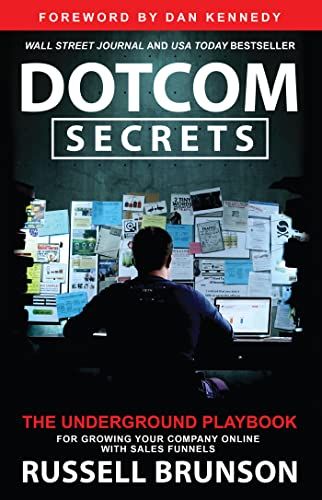
Dotcom Secrets
Introduction
Nova: You're just one funnel away. That's the phrase Russell Brunson uses throughout Dotcom Secrets, and it's the kind of statement that either makes you roll your eyes or lean in closer. Here's the thing — Brunson co-founded ClickFunnels, a company that now serves over 100,000 members and has helped entrepreneurs generate billions in sales. So when he says you're one funnel away from changing your entire business, he might actually know what he's talking about.
Nova: Fair question. And that's exactly what Dotcom Secrets addresses. Brunson argues that most online businesses fail not because they lack traffic or a good product, but because their sales funnel is broken. Think of a funnel as the deliberate path you guide a visitor through — instead of dumping them on a homepage with fifty links and hoping they figure it out. As Brunson puts it, a confused mind always says no.
Nova: Exactly. And Brunson lays out a complete playbook: how to identify your dream customer, how to build a value ladder that turns a five-dollar buyer into a five-thousand-dollar client, and the psychology behind why people actually buy. The book came out in 2015 and got a major update in 2020, but its core principles are built on timeless direct-response marketing — the kind Dan Kennedy was teaching decades ago. Today we're cracking open Dotcom Secrets and pulling out the frameworks that actually move the needle.
Key Insight 1
Know Thy Customer: The Secret Formula
Nova: Let's start with the foundation Brunson calls the Secret Formula. Before you build anything — no websites, no ads, no funnels — you need to answer four deceptively simple questions. Ari, want to guess what they are?
Nova: You're remarkably close. Here's Brunson's exact framework: Who is your dream client? Where are they congregating? What bait will you use to attract them? And what result do you want to give them?
Nova: Very much so. Brunson wants you to get uncomfortably specific. Not just demographics — what are their pains, passions, and desires? He tells this story about how he built a business selling potato cannons in college. He didn't target everyone. He found forums where potato gun enthusiasts were already gathering and talking about what they wanted. He calls these online gathering spots congregations — Facebook groups, niche forums, subreddits, comment sections on specific blogs.
Nova: That's the shift. Brunson even recommends typing keyword plus forum into Google to find these congregations. Once you're inside, you study the language they use, the problems they complain about, the solutions they've tried and hated. Then you craft your bait — your lead magnet — to match. The bait isn't about you. It's about the result they desperately want. Brunson cites Dale Carnegie here: the only way to influence people is to talk about what they want and show them how to get it.
Key Insight 2
The Value Ladder: From Browser to Buyer
Nova: Once you know your dream customer, the next framework is the Value Ladder. This might be the most important concept in the entire book. Imagine a ladder with four or five rungs. At the bottom, you've got something free or absurdly cheap — your bait. At the very top, you've got your highest-ticket, most transformative offer. Everything in between is designed to ascend customers step by step.
Nova: Right, because that almost never works. Brunson uses the example of Eben Pagan, an early online marketing pioneer who built a twenty-million-dollar-per-year business selling dating advice to men. His first product was a twenty-dollar eBook called Double Your Dating. But that was just the entry point. Almost all his profits came from backend courses priced at a few hundred dollars each. The cheap frontend offer built trust, and trust unlocked the real revenue.
Nova: Exactly. Here's how the math works: if you only have one twenty-dollar product, you can't afford to spend more than twenty dollars to acquire a customer. But if your average customer eventually spends two thousand dollars climbing your Value Ladder, you can happily spend fifty or a hundred dollars to acquire them. You outspend competitors on ads and dominate the market. The Value Ladder is your financial engine.
Nova: Brunson maps it into four funnel types. The bait funnel offers something free or cheap to capture an email address. The frontend funnel sells a low-priced tripwire product — maybe something between seven and thirty-seven dollars. The middle funnel introduces higher-ticket offers through webinars or video sales letters. And the backend funnel is where you sell your premium services, often involving an application and a phone call. Each stage filters for the right customers and builds momentum.
Key Insight 3
The Attractive Character: Your Secret Weapon
Nova: Now here's where Dotcom Secrets gets genuinely fascinating. Brunson argues that people don't connect with companies — they connect with characters. He calls this the Attractive Character, or AC, and it's the persona you share with your audience.
Nova: Much more specific. Brunson breaks the Attractive Character into four elements, four identity types, and six storylines. The four elements are: backstory — where you came from and why it matters to your customer. Speaking in parables — turning everyday events into lessons that soft-sell your products. Sharing character flaws — because nobody relates to a perfect person. And polarity — having strong opinions that some people will dislike, which makes the people who agree with you love you even more.
Nova: Right. And then there are the four identity archetypes. The Leader has walked the same path as the audience and guides them through known obstacles. The Adventurer sets out on a journey and brings back discoveries to share. The Reporter researches and curates insights for others — Brunson says this is great when you haven't blazed your own trail yet. And the Reluctant Hero is the humble person who stumbled onto something powerful and feels obligated to share it despite not wanting the spotlight.
Nova: He's a mix of Leader and Adventurer. He talks openly about his early failures, his wrestling background, his experiments with junk mail as a kid. And then there are the six storylines: Loss and Redemption, Us vs. Them, Before and After, Amazing Discovery, Secret Telling, and Third-Person Testimonial. These are narrative patterns you weave through your emails, videos, and sales pages to keep people emotionally engaged.
Nova: Brunson would say it's the difference between a transactional business and a brand people feel loyal to. When someone trusts your Attractive Character, they open your emails, they watch your videos, and when you make an offer, they buy — not because they were manipulated, but because they genuinely believe you can help them.
Key Insight 4
The Communication Funnel: Soap Operas and Seinfeld
Nova: So you've attracted someone with your bait and they've given you their email. Now what? Brunson has a very specific communication strategy that he breaks into two sequences. The first is the Soap Opera Sequence.
Nova: It's meant to be. When someone joins your list, the first five emails follow a precise script. Email one sets the stage — it's a simple thank you. Email two opens with high drama — you describe the wall you hit, the problem you couldn't solve, and you open a loop by promising the answer in the next email. Email three is the epiphany — you reveal the solution, which naturally leads to your core offer. Email four highlights hidden benefits using parables. And email five creates urgency with a special offer or deadline.
Nova: Exactly. Brunson learned this from studying actual soap operas — they always end episodes with unresolved tension so you tune in tomorrow. The open loop is the mechanism. But here's what comes after the Soap Opera Sequence, and it's my favorite part: the daily Seinfeld emails.
Nova: That's the reference. After the intense, structured welcome sequence, Brunson recommends sending daily emails that are just... entertaining. Talk about your day, something embarrassing that happened, a purchase you regret, something that made you furious yesterday and you're laughing about today. These are emails about nothing — except they're not. Every single one ties back to an offer. The story is the vehicle, but the destination is always a sale.
Nova: Brunson's counterargument is that if your emails are genuinely entertaining — if people enjoy reading them — they'll look forward to them. And here's the practical genius: he tells you to put these emails on your blog too. Now you've got consistent blog content that also drives sales, and you only wrote one thing. He's all about leverage. The key is that all of this communication feeds into the three types of traffic he identifies: traffic you own — your email list, which he says is worth about a dollar per subscriber per month; traffic you control — paid ads you can direct; and traffic you don't control — organic visitors who just show up. Every tactic is designed to convert the latter two into the first one.
Key Insight 5
Funnel Hacking and the Seven Phases
Nova: Let's talk about one of Brunson's most controversial and effective strategies: funnel hacking.
Nova: Nothing illegal. Funnel hacking is simply reverse engineering what's already working for your competitors. Brunson says before he builds any new funnel, he buys his competitors' products. He goes through their entire funnel — the ads, the landing pages, the upsells, the downsells, the follow-up emails. He uses tools like SimilarWeb to see where their traffic comes from and which ads have been running the longest. A long-running ad is a profitable ad.
Nova: Right. And this is actually a decades-old practice. Direct-response copywriters have always kept swipe files — collections of successful ads to study and model. Brunson just applied the same logic to the entire funnel experience. He pairs this with what he calls the Seven Phases of a Funnel.
Nova: It is detailed, but let me condense it. Phase one: determine traffic temperature. Hot traffic knows you, warm traffic knows someone who knows you, cold traffic has no clue who you are. Each needs a different message. Phase two: set up a pre-frame bridge — for cold traffic, you might need an educational article or video before you even mention your offer. Phase three: qualify subscribers with a squeeze page. Phase four: qualify buyers with a low-priced tripwire. Phase five: identify hyperactive buyers through upsells, downsells, and order bumps immediately after purchase. Phase six: age and ascend the relationship over time. Phase seven: for your highest-ticket offers, change the selling environment entirely — move to a phone call or live event.
Nova: Exactly. Brunson says a surprising percentage of buyers check that box because they're already in buying mode. It's the digital equivalent of McDonald's asking if you want fries with that. And then the one-time offers after purchase — Brunson often stacks two or three of these before the customer even sees the thank-you page. He credits a marketer named Armand Morin for teaching him this stacking technique, and claims it immediately transformed his sales numbers. The psychology is simple: someone who just bought from you is far more likely to buy again in that moment than at any other time.
Conclusion
Nova: So let's zoom out. Dotcom Secrets isn't really about websites or technology. It's about understanding human psychology and building a business that serves customers at every level they're ready to engage with. The frameworks — the Secret Formula, the Value Ladder, the Attractive Character, the Soap Opera and Seinfeld sequences, funnel hacking — they're all tools to answer one question: how do I guide someone from being a complete stranger to being my most loyal, highest-paying client?
Nova: And the underlying principle that ties it all together is this: most businesses leave money on the table because they never give customers a clear path to spend more. They get the first sale and stop. Brunson's entire philosophy is about what happens after that first yes. The upsells, the email sequences, the backend offers — that's where the real business lives.
Nova: So here's your takeaway: before you spend another dollar on ads or another hour tweaking your homepage, ask yourself Brunson's four questions. Who is your dream client? Where are they congregating? What bait will attract them? And what ultimate result do you want to deliver? Answer those, map your Value Ladder, and start building a funnel that actually converts. Because as Russell Brunson would say — you're just one funnel away.