Crowning Yourself: The Art of Self-Love and Healing in Modern Dating
Golden Hook & Introduction
SECTION
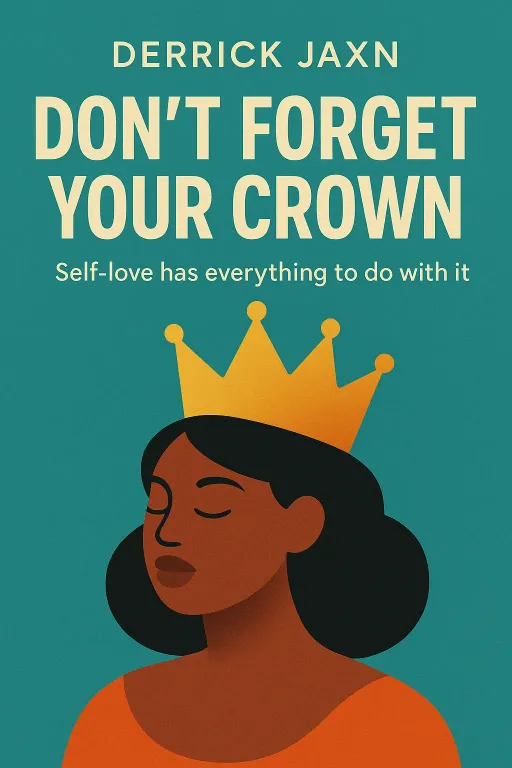
Nova: Have you ever felt like you're pouring love into someone else's cup, only to find that your own is still empty? It's a feeling so many of us know. Derrick Jaxn, in his book 'Don't Forget Your Crown,' captures this perfectly with a quote that hit me hard: 'Without self-love, no love matters. It can be poured into us endlessly, but with our broken cup, we’ll still be left empty in the end.' This is for anyone on a journey of healing and self-discovery. Today we'll dive deep into this from three powerful perspectives. First, we’ll challenge the dangerous idea of unconditional love. Then, we'll debunk the myth that a good woman can 'fix' a man. And finally, we'll learn how to build an emotional fortress around our hearts by redefining what relationship failure really means. Mandaa, welcome, I'm so glad we're tackling this today.
Mandaa: Thank you, Nova. That opening quote is everything. It really speaks to that journey of rediscovering yourself, and I think so many of us are trying to figure out how to mend that 'broken cup.'
Deep Dive into Core Topic 1: The Myth of Unconditional Love
SECTION
Nova: Exactly! And Jaxn argues that one of the biggest cracks in our cup comes from a concept we're taught to revere: unconditional love. He says, outside of love for a child or yourself, it's actually dangerous. What was your first reaction to that, Mandaa?
Mandaa: Honestly, it was jarring. We're conditioned to see unconditional love as the ultimate goal, the purest form of love. But when he explains it, it makes so much sense. It's like you're removing all consequences for bad behavior, and that doesn't encourage growth for either person.
Nova: Precisely. He shares this raw, personal story about his own past relationship with his now-wife, Da'Naia. In their youth, he was emotionally immature. His pride led him to be disloyal—not just physically, but emotionally. He'd flirt with other women, lie about small things, and neglect her emotional needs.
Mandaa: And she just… took it?
Nova: Well, that's the thing. Her love for him was so strong, it was close to unconditional at the time. But he's brutally honest and says that love didn't stop him. In fact, he says it him. He explains, and this is a direct quote, that unconditional love "turns a woman’s intuition off when it’s telling her she’s supposed to leave. It offers her denial when a man’s actions say he’s not doing any better than he was before the last time he apologized." It blurred the line for her between him being 'imperfect' and just 'not worth it.' The relationship became toxic and eventually ended, leaving them both completely broken.
Mandaa: Wow. So her unconditional love didn't heal him; it just gave him more room to hurt her. That's a heavy realization. It ties directly into building better habits and a stronger mindset—the habit of excusing things, of telling yourself a story that isn't true, is what needs to be broken first.
Nova: You've hit the nail on the head. And that's why he offers a reframe. He says conditions in a relationship aren't about being demanding or materialistic. He uses this brilliant analogy: 'Conditions are like fire extinguishers. They’re mere safety precautions that cause no harm to have around but will minimize the damage if things start going up in flames.'
Mandaa: Oh, I love that. It’s proactive self-care.
Nova: Exactly! It’s not a threat; it’s a safety plan for your own heart. It’s about having non-negotiables like respect, honesty, and fidelity. These aren't outrageous demands; they are the baseline for a healthy partnership.
Mandaa: And framing it that way builds self-confidence, doesn't it? Because you're actively affirming that you're worthy of that protection. You're saying, 'My emotional safety matters, and I will have the tools in place to protect it.' That's a powerful shift.
Deep Dive into Core Topic 2: He's Not a Project
SECTION
Nova: And that idea of protecting your heart leads perfectly to our second point. So many women, and people in general, think, 'If I just love him right, if I'm just good enough, he'll change.' Jaxn completely dismantles the myth that 'a man will act right for the right woman.'
Mandaa: This is a big one. I think a lot of us have been sold this idea, that our love has transformative powers over someone else.
Nova: It's a romantic but dangerous idea. Jaxn uses himself as the prime example again. He knew Da'Naia was an amazing woman, the 'right' woman by any measure, but he still messed up because wasn't ready. He wasn't prepared. He compares it to Beyoncé's legendary Coachella performance. She didn't just show up and become amazing because the stage was right and the crowd was ready. She put in years of rigorous, painstaking training and rehearsal.
Mandaa: Right, the performance was a result of the work she did in private.
Nova: Exactly! And he says men need to do the same work on themselves—developing compassion, a solid work ethic, emotional maturity— they're ready for a great relationship. It's not the woman's job to be his training facility or, as he puts it, his 'practice facility.'
Mandaa: That's such a powerful analogy. It shifts the responsibility entirely. It also connects to leadership principles, in a way. You can't expect your team to perform if you haven't given them the tools or done the prep work yourself. It's all about personal accountability. You can't want it for him more than he wants it for himself.
Nova: You can't. And he gets even more direct, talking about the 'broken people break people' idea. He tells this story about driving with his young niece, who was playing what he calls a 'hood-love' song. He's listening to the lyrics, and the rapper is going on and on about all his pain, his trauma, and how he just needs a good woman to come and heal him.
Mandaa: I think I know the kind of song you mean. It's a common theme.
Nova: It is, and Jaxn says this is a classic trap. He argues that broken men often present their pain as a lure to attract 'healers,' but because they aren't whole themselves, they just end up breaking the very person who is trying to help them. He has this one line that is just devastatingly true: 'a good heart counts for nothing inside a broken vessel.'
Mandaa: That is chillingly accurate. It's a manipulation tactic, even if it's subconscious. It preys on our natural empathy. And it makes you realize that your desire to 'help' or 'heal' someone can actually be a vulnerability if you don't have strong boundaries in place. It's a tough, but necessary, lesson in emotional self-preservation.
Deep Dive into Core Topic 3: Building Your Fortress
SECTION
Nova: Exactly, self-preservation! Which brings us to our final point: what happens when you leave a relationship that's not working? Society often labels it a 'failed relationship.' But Jaxn has a radical redefinition that I think is so important for anyone healing.
Mandaa: I'm curious to hear this, because that 'failure' label can be so heavy.
Nova: It can. But he says the failed relationships are the ones that are still intact on the outside but are broken beyond repair on the inside. The ones where people are miserable but stay out of fear or obligation. He says leaving a toxic situation to do better isn't a failure; he calls it a 'pit stop.'
Mandaa: A pit stop. I like that.
Nova: Isn't it great? It's a chance to refuel, to heal, and to raise your standards for the next leg of the race. He says the return on your investment in that past relationship isn't that it lasted forever; the return is the lessons you learned so you don't make the same mistakes again.
Mandaa: That reframe is so liberating. It completely removes the shame and stigma from walking away. It turns a painful experience into a source of motivation and strength. It's about seeing the lesson, not just the loss. That's a core part of improving your mindset.
Nova: It is. And to protect yourself moving forward, he introduces this amazing concept he calls the 'Relationship Membrane.' Just like a cell has a membrane to control what comes in and out, he says a healthy relationship needs one too.
Mandaa: So it's like a protective boundary for the couple?
Nova: Precisely. It's a selective barrier. You and your partner decide together what outside opinions, advice, or drama you let in, and what you keep out. It’s about creating a private, safe space for the relationship to thrive, free from the interference of friends, family, or social media.
Mandaa: A relationship membrane... I love that visual. It's a shared responsibility. It's not about building walls each other, but building a protective bubble the 'we.' That requires so much trust and communication, which, again, are habits you have to build together. It’s a conscious, daily practice.
Synthesis & Takeaways
SECTION
Nova: So, to bring it all together: we've learned that love needs conditions to be safe, that a partner's readiness is their own job, and that leaving a broken situation is a victory, not a failure. It all comes back to that crown, to that core of self-love that protects you and allows you to build something healthy.
Mandaa: It really does. And I think the biggest takeaway for me, and for anyone listening who is on this journey of self-improvement, is to ask yourself: What is one 'fire extinguisher' I can install in my life right now? What is one boundary—with a partner, a friend, or even on social media—that I can set today to protect my peace and honor my own worth? It starts with one small, conscious act of self-protection.
Nova: A perfect, powerful question to end on. Mandaa, thank you for these incredible insights. And to our listeners, don't forget your crown.