The Unseen Architect: How Language Shapes Our Political Minds
Golden Hook & Introduction
SECTION
Nova: Most people think political debates are all about facts, figures, and rational arguments. We assume if we just present the right data, minds will change.
Atlas: Right? That's the ideal. Just hit 'em with the undeniable truth. But I have a feeling you're about to tell me that's not quite how it works, are you?
Nova: Oh, Atlas, what if I told you that focusing solely on facts is actually the biggest blind spot in political understanding, and that your mind is being quietly shaped by unseen forces every single day?
Atlas: Wait, unseen forces? That sounds less like political science and more like a sci-fi thriller. But I’m intrigued. You’re saying it’s not really about the bullet points on a policy paper?
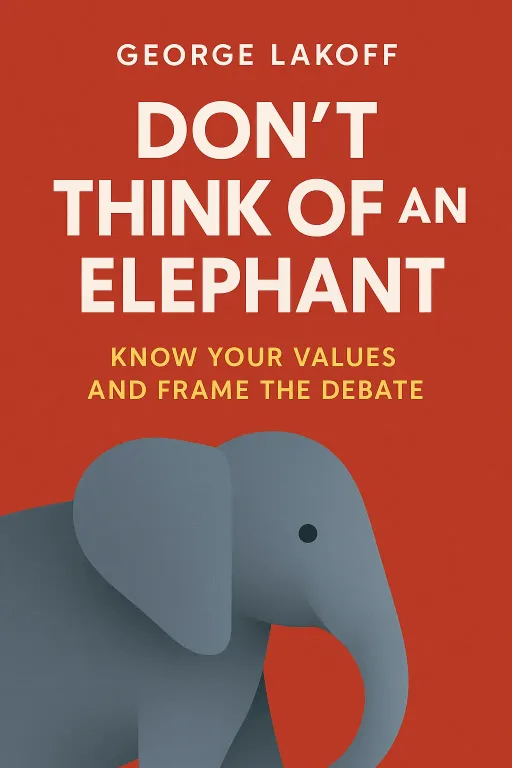
Nova: Not primarily. Today, we’re peeling back the curtain on something truly profound, drawing heavily from the groundbreaking work of George Lakoff, particularly his insights in "Don't Think of an Elephant!" and his seminal collaboration with Mark Johnson, "Metaphors We Live By."
Atlas: What’s fascinating is that Lakoff started as a cognitive linguist. How does someone who studies the structure of language end up profoundly influencing political analysis? It feels like a massive leap.
Nova: It's precisely that background that gave him the unique lens. He wasn't looking at politicians say, but they say it, and more importantly, how that language taps into deep cognitive structures. He revealed that political discourse isn't just about surface arguments, but about deeply embedded, often unconscious, cognitive metaphors and frames. And once you understand that, you can't unsee the unseen architects at work.
Atlas: So, it’s not just about winning the argument, it’s about winning the… framework of the argument?
Nova: Exactly. And that naturally leads us into our first deep dive today: how these invisible architects literally build our political reality.
The Unseen Architects: How Unconscious Metaphors Shape Our Political Reality
SECTION
Nova: Let's start with Lakoff's most famous example, the one that gives his book its title. I’m going to tell you something, and I want you to try to do it.
Atlas: Okay, I’m ready. Challenge accepted.
Nova: Don't think of an elephant.
Atlas: Too late. Big, gray, floppy ears, trunk… it’s there. Why? Because you said the word "elephant."
Nova: Precisely. And that, in a nutshell, is the power of framing. When political strategists tell you to think about something, or when they try to negate an opponent's frame, they're actually that frame in your mind. They're reinforcing the very idea they claim to oppose.
Atlas: That's incredible. So, if a political campaign says, "We're not going to raise your taxes," they're actually making me think about… taxes raising? And maybe even associate them with campaign?
Nova: You got it. It's why just refuting an opponent's claims with facts often falls flat. The facts are bouncing off a pre-existing cognitive structure, a mental scaffolding that's already built by the language and metaphors people live by. These aren't just rhetorical tricks; they are fundamental ways humans conceptualize the world.
Atlas: Wow, that’s kind of groundbreaking. So it’s not about winning arguments with better facts, it's about winning the frame? I imagine many listeners, especially those who dive deep into policy and data, might find that frustrating. It feels almost unfair.
Nova: It can feel that way, but it’s just how our brains work. Lakoff identified two dominant, deeply rooted metaphorical models that often shape political thought: the "Strict Father" model and the "Nurturant Parent" model.
Atlas: Strict Father, Nurturant Parent… okay, tell me more.
Nova: The Strict Father model, often associated with conservative thought, views the world as dangerous and difficult. Children, or citizens, are inherently bad and need discipline. Morality is about obedience to authority. Prosperity comes from self-reliance and hard work, and punishment is necessary for moral growth. So, policies are framed around personal responsibility, tough-on-crime approaches, and minimal government intervention, because too much 'nurturing' leads to weakness.
Atlas: I can see how that plays out. So, something like "pull yourself up by your bootstraps" fits perfectly into that frame. But what about the Nurturant Parent?
Nova: The Nurturant Parent model, often aligning with progressive thought, sees the world as a place where children are inherently good, and it's the parents' job to protect them, empathize, and help them thrive. Morality is about empathy and social responsibility. Policies are framed around social safety nets, universal healthcare, environmental protection, and community support. The goal is collective well-being, because a strong community nurtures strong individuals.
Atlas: That makes sense. It’s like these aren't just political positions, they're deeply ingrained worldviews that then inform every single argument. So when you hear debates about, say, welfare programs, the Strict Father frame might see it as enabling laziness, while the Nurturant Parent frame sees it as essential support. The facts might be the same, but the interpretation is wildly different because of the underlying metaphor.
Nova: Exactly. And the crucial part is, these frames are largely unconscious. We don't wake up thinking, "Today, I'm going to apply my Nurturant Parent frame to the news." They operate below the level of conscious thought, making them incredibly powerful and resistant to direct factual challenge.
Atlas: So, for our listeners who are trying to understand the 'why' behind political divisions, this isn't just academic. It's literally the foundational code for how people process political information. It almost feels like a new superpower, once you can recognize it.
Nova: It absolutely is. And that's our next step: moving from this blind spot to gaining genuine insight.
From Blind Spot to Insight: Decoding Political Language for Informed Engagement
SECTION
Nova: So, Atlas, once you understand that these unseen architects are constantly at work, building our political minds with metaphors, you can't unsee them. It's like gaining a new pair of glasses that reveal the hidden structures of language.
Atlas: That’s a powerful image. But what does that mean for someone trying to make sense of a political debate right now? How do we even begin to dissect this? I’m thinking about the deep questions our listeners grapple with – like why certain issues feel perpetually stuck, or why communication often seems to fail.
Nova: Great question, and it speaks directly to our user's desire for informed engagement. The first step is to listen not just to the words, but to the and embedded within the language. Let's take an issue that many people are grappling with: climate change.
Atlas: Okay, climate change. It’s a huge, complex issue. How do metaphors play into that?
Nova: Think about how it's often framed. For some, it's an "existential threat," a "war on nature," or a "runaway train." These evoke urgency, danger, and a need for immediate, drastic action, often requiring collective sacrifice and strong government intervention – a classic Nurturant Parent concern for the collective.
Atlas: Right, I hear that. It’s about protecting our planet, safeguarding future generations.
Nova: But then consider another common frame: "green regulations are a job killer," or "environmental policies are a burden on the economy." Here, the metaphor shifts. The economy is a "fragile system" that needs to be "protected" from "external forces" like environmental mandates. Or, government intervention is an "overreach" into individual liberty – a Strict Father concern for individual autonomy and self-reliance against perceived external threats.
Atlas: Hold on. So, in one frame, the planet is in danger and needs saving, and in the other, the economy is in danger and needs saving. Both sides are talking about "saving" something, but they're using completely different underlying metaphors, leading to totally different solutions. It’s not just a disagreement on facts; it’s a disagreement on what the core problem.
Nova: Exactly! The scientific facts about rising temperatures might be the same, but how those facts are through these underlying metaphors dictates whether someone perceives it as a call to radical action or an unnecessary economic burden. If you don't recognize the deep frame, you'll just keep throwing facts at a wall.
Atlas: So, for our listeners who care deeply about informed engagement and want to contribute meaningfully, this isn't just an academic exercise. This is literally the Rosetta Stone for understanding why people vote the way they do, and how to actually have more productive conversations. It's about finding the shared human story, not just the data points.
Nova: Absolutely. It empowers you to dissect political rhetoric, seeing beyond surface arguments to the underlying cognitive structures that shape public opinion. It means that when you're engaging in a conversation, you're not just countering statements, you're trying to understand or even subtly shift the itself. It's about speaking from your own deeply held values and metaphors, rather than accidentally activating your opponent's.
Atlas: That’s amazing. It makes me think about how much of civic engagement often feels like shouting into the void, with everyone talking past each other. This gives a philosophical 'why' to that frustration, and also an 'how' to potentially overcome it.
Synthesis & Takeaways
SECTION
Nova: So, what we've really uncovered today is that language is far from neutral. It's the unseen architect, constantly shaping our political minds, often without our conscious awareness. Understanding these deep cognitive metaphors, these frames, allows us to move beyond simply debating facts.
Atlas: It really makes you question everything you thought you knew about "rational" debate. It's empowering to realize you can actually decode what's happening beneath the surface, but also a little daunting to think about how susceptible we all are to these frames.
Nova: That's the beauty of it. The key takeaway here isn't to become cynical, but to become more discerning. The next time you're grappling with a political issue, or listening to a debate, don't just listen to is being said. Listen for it's being framed. What metaphors are at play? Is the speaker treating the government as a "strict father" or a "nurturant parent"?
Atlas: That’s a fantastic challenge for our listeners. It encourages that deep, philosophical inquiry they crave. So, the next time you're engaging with a political issue, take a step back. Ask yourself: what unseen architects are at work here? What metaphors are shaping mind, and the minds of others?
Nova: And remember, understanding these frames isn't about manipulation; it's about clarity. It's about communicating your own ideas more effectively and truly understanding where others are coming from.
Atlas: It's about informed engagement, not just engagement.
Nova: Precisely.
Nova: This is Aibrary. Congratulations on your growth!