

Decision Velocity: A Project Manager's Guide to Conquering Overthinking
Golden Hook & Introduction
SECTION
Atlas: Meron, you're a project manager in tech. Picture this: you're facing a decision. Path A and Path B. Both are viable, both have merit. But you're stuck in a loop, re-analyzing, second-guessing, while the clock is ticking and your team is waiting. That state of 'analysis paralysis' is more than just frustrating; it's a thief of momentum and mental energy.
Meron: Absolutely. It's the enemy of velocity. You want the optimal path, but the search for 'perfect' ends up being worse than just picking 'good enough' and moving. It’s a trap many high-achievers, especially in demanding fields, fall into.
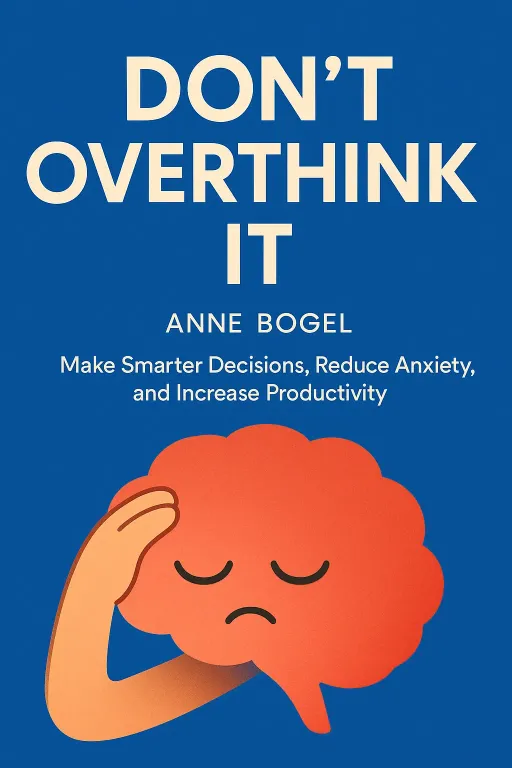
Atlas: Exactly. And that's why we're diving into Anne Bogel's "Don't Overthink It." It's not just a self-help book; it's a tactical manual for escaping these exact traps. It’s for anyone who feels their brain is working against them sometimes.
Meron: I love that framing. A manual. Something with actionable steps, not just philosophy. As someone who loves growth, I'm always looking for a better framework.
Atlas: Well, you're in luck. Today we'll tackle this from two perspectives, straight from the book's playbook. First, we'll explore the internal mindset shift needed to break out of analysis paralysis when you're already stuck in the mud.
Meron: The reactive strategy. Got it.
Atlas: Then, we'll discuss the external systems you can build to prevent decision fatigue from ever taking hold in the first place.
Meron: The proactive strategy. Okay, I'm ready. This is the core of effective management, whether it's a project or your own life.
Deep Dive into Core Topic 1: Breaking the Loop: The Experimental Mindset
SECTION
Atlas: So let's start with that internal battle. How do you break the cycle when you're already in it? When you're just spinning your wheels? Bogel tells this brilliant, almost painfully relatable story about her own family.
Meron: I'm listening. The best lessons come from real-life examples.
Atlas: For over a decade, Meron, a, her family would debate the same exact question every single summer. They lived in Louisville and took an annual trip to a Gulf Coast beach. The drive was a miserable eleven hours. So, the question was: should they power through it in one brutal day, or split it into two days with a hotel stay?
Meron: Okay, a classic logistics problem. Trade-offs between time, cost, and energy.
Atlas: Precisely. And every year, they'd start the debate. They'd talk about the cost of the hotel, the hassle of unpacking and repacking, but also the misery of the long drive with four kids. They'd consider all the options, resist making up their minds, and finally, they'd wait so long to decide that the opportunity passed them by. They'd just end up doing the one-day drive by default, miserable as ever. They were completely paralyzed.
Meron: That's incredible. It's a perfect microcosm of a project team getting stuck on a non-critical feature decision. You see it all the time. The cost of the endless meetings and the debate itself becomes far higher than the potential downside of just picking a path. The indecision is the real failure.
Atlas: That's the core insight! So what finally broke the cycle? Bogel writes that she recognized the overthinking for what it was and decided to adopt what she calls an "experimental mindset." She told her husband, "Let's just try it once. We'll see what happens."
Meron: Ah, so she reframed it. It wasn't a permanent, binding decision for all future vacations. It was a single, low-stakes experiment. In tech, we'd call that shipping a Minimum Viable Product, or an MVP.
Atlas: Exactly! Tell me more about that.
Meron: The whole philosophy of agile development is to avoid this exact trap. You don't spend a year designing the 'perfect' product in a vacuum. You build the simplest possible version that delivers some value—the MVP—you ship it, and you get real user data. The family's two-day trip was their MVP. Even if it had been a total disaster, they would have had for next year's decision, instead of just the same old circular opinions. They broke the loop by choosing to act and learn.
Atlas: And the data, in this case, was a huge win. The experiment was a success! They loved the two-day trip. It became their new standard. But as Bogel points out, even if they had hated it, the experiment would have been a success because it would have answered the question once and for all. They would have stopped wondering. The key wasn't finding the 'right' answer, but simply getting answer and moving on.
Meron: That is so powerful. It lowers the stakes of any single decision. It’s not "What is the perfect choice?" It's "What is the fastest way to get the data I need to make the choice better?" That's a mindset that can unlock so much progress, on a project or in your personal life.
Deep Dive into Core Topic 2: Systematizing Serenity: Liberating Through Limitation
SECTION
Atlas: Exactly. And that experimental mindset is a fantastic tool for when you're stuck. But Bogel argues for an even more powerful, proactive strategy: designing your life so you don't get stuck in the first place. This is about limiting your options to free your mind.
Meron: Okay, this feels counterintuitive, especially for a "Commander" personality type who might want to evaluate all possible options to ensure the best outcome. You're saying the path to better decisions is... fewer options?
Atlas: That's the radical idea. It's about fighting what's called 'decision fatigue.' Every choice we make, from what to wear to what to eat, drains a little bit of our mental energy. The book's most famous example of this principle in action is President Barack Obama.
Meron: Right, I think I've heard this one.
Atlas: He told a Vanity Fair interviewer that, during his presidency, he almost exclusively wore gray or blue suits. He said, and I'm quoting here, "I'm trying to pare down decisions. I don't want to make decisions about what I'm eating or wearing. Because I have too many other decisions to make." He was ruthlessly protecting his cognitive bandwidth for the things that actually mattered, like, you know, matters of state.
Meron: That's a masterclass in managing cognitive load. As a Project Manager, you have a finite amount of high-quality decision-making energy per day. Every minute you spend debating a trivial issue is a minute you can't spend solving a critical blocker. It's a direct loss of your most valuable resource.
Atlas: So how do you apply that in your world?
Meron: We create playbooks. Or frameworks. For example, a development team might create a 'Definition of Done' checklist. It's a pre-agreed set of criteria that every piece of work must meet. Does it have unit tests? Is the documentation updated? By pre-deciding these things, no one has to waste energy debating "is this really finished?" for every single task. You establish rules to reduce cognitive load so you can focus on the complex architectural problems. Obama was essentially creating a style guide for his own life.
Atlas: A style guide for life! I love that. And it works on a much smaller, more relatable scale too. Bogel tells another story about needing to buy new bedding. She started looking online and was immediately paralyzed by the infinite choices. Thousands of duvets, endless colors and patterns.
Meron: The paradox of choice. I know it well.
Atlas: So she just gave up. Instead, she called an interior decorator friend and asked a simple question: "Can you just tell me one store to look at?" The friend suggested Pottery Barn and even pointed her to a few specific styles. By accepting that limitation—one store, a few options—Bogel went from being paralyzed for hours to making a decision she was happy with in five minutes.
Meron: She outsourced the boundary-setting. She didn't ask the friend to make the final choice, but to create the container for the choice. That's a brilliant hack. It's like telling your team, "We're only going to evaluate solutions that use our existing tech stack." You've just eliminated 90% of the noise and can have a much more focused, productive conversation. Define your constraints to unleash your focus.
Synthesis & Takeaways
SECTION
Atlas: So there we have it. Two powerful, complementary strategies from "Don't Overthink It." When you find yourself stuck in a decision loop, reframe the choice as an experiment. Just try something to get data.
Meron: The reactive approach. Ship the MVP.
Atlas: And to keep from getting stuck in the first place, be proactive. Build systems of limitation. Create a playbook for the recurring, low-stakes decisions in your life so you can save your best thinking for the problems that truly deserve it.
Meron: The proactive approach. Define your constraints. They're two sides of the same coin: optimizing for decision velocity. Both are about treating your mental energy as your most valuable and finite resource.
Atlas: It’s a total shift from thinking you need to be better at decisions, to realizing you need to be better at your decisions as a system.
Meron: Exactly. The goal isn't to win every battle, it's to design a system where you only have to fight the battles that matter.
Atlas: So, Meron, to bring this home for all the Commanders and project managers listening. What's one simple 'playbook rule' they could create this week to immediately free up some of that precious mental energy?
Meron: Easy. Automate your lunch. Seriously. Decide on Sunday what you'll eat for lunch Monday through Friday. Or just pick two simple options and alternate. It sounds ridiculously small, but you've just eliminated five decisions and the accompanying mental chatter from your peak working hours. That's five more moments of clarity you now have for the one critical problem that actually needs your full attention. Start small, reclaim your focus, and build from there.
Atlas: Automate your lunch. Simple, actionable, and powerful. A perfect place to start. Meron, thank you.
Meron: This was great. A lot to think about... or, rather, not overthink.









