

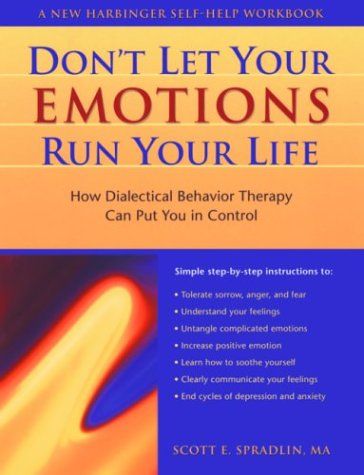
Don't let your emotions run your life
How Dialectical Behavior Therapy Can Put You in Control
Introduction
Nova: Have you ever had one of those days where a single snarky comment from a coworker or a minor traffic jam just completely hijacks your entire afternoon? You know the feeling, where your heart starts racing, your face gets hot, and suddenly you are making decisions based entirely on a temporary surge of adrenaline and frustration.
Atlas: Oh, I know that feeling intimately. It is like being in the passenger seat of your own brain while a very angry toddler takes the wheel. You are watching yourself do things or say things, thinking, this is a bad idea, but the toddler does not care. He is driving us into the ditch.
Nova: That is exactly what Scott E. Spradlin is talking about in his book, Don't Let Your Emotions Run Your Life. He is a therapist who specializes in Dialectical Behavior Therapy, or DBT, and he wrote this workbook to help people reclaim the driver's seat. It is not about suppressing emotions or becoming a robot. It is about learning that emotions are data, not directives.
Atlas: Data, not directives. I like that. But it is easier said than done when the data feels like a Category 5 hurricane. How do we actually stop the toddler from driving?
Nova: That is what we are diving into today. We are going to break down Spradlin's toolkit for emotional intelligence, from the concept of the Wise Mind to the radical idea of accepting things you absolutely hate. By the end of this, you will have a roadmap for navigating those internal storms without letting them wreck your life.
Key Insight 1
The Three Minds
Nova: To understand how to manage our emotions, Spradlin says we first have to understand the three different states of mind we operate in. He calls them the Reasonable Mind, the Emotion Mind, and the Wise Mind.
Atlas: Okay, I think I can guess which one I am in when I am yelling at a slow computer. That is definitely the Emotion Mind.
Nova: Exactly. The Emotion Mind is when your thoughts and behaviors are controlled almost entirely by how you feel. Facts don't matter as much as the intensity of the feeling. It is hot, it is impulsive, and it is usually where we make our biggest mistakes. But then there is the Reasonable Mind. That is the cold, logical side. It is great for solving math problems or organizing a spreadsheet, but it can be totally detached from the human experience.
Atlas: So the Reasonable Mind is like Mr. Spock, and the Emotion Mind is like... well, a reality TV star during a finale. But where does that leave us? Surely we can't just be Spock all the time. That sounds miserable.
Nova: You are right, and Spradlin agrees. If you live only in the Reasonable Mind, you lose your passion, your empathy, and your intuition. The goal is the third state: the Wise Mind. This is the overlap. It is where you acknowledge your feelings without letting them dictate your actions. You use the logic of the Reasonable Mind to evaluate the intensity of the Emotion Mind.
Atlas: So it is like a committee meeting between the two? How do you actually get there when you are already spiraling?
Nova: Spradlin suggests a technique called WIP, which stands for Wait, Inquire, and Pause. When you feel that surge, you Wait. You don't send the email. You don't scream. Then you Inquire. You ask yourself, what am I feeling right now? Is this the Emotion Mind talking? And finally, you Pause to let the Wise Mind step in. It is about creating a gap between the stimulus and your response.
Atlas: That gap sounds like a very small space to try and fit into when you are angry. It feels like trying to catch a bullet with your teeth.
Nova: It takes practice, for sure. Spradlin emphasizes that the Wise Mind is like a muscle. You don't just find it; you cultivate it. He points out that emotions are actually biological complexes. When you are triggered, your whole body lights up. Your nervous system is literally under fire. You can't just think your way out of a biological reaction; you have to recognize it for what it is: a physical event that will eventually pass.
Key Insight 2
The Anchor of Mindfulness
Nova: The primary tool Spradlin gives us to reach that Wise Mind is mindfulness. Now, I know that word gets thrown around a lot these days, but in DBT, it has a very specific, practical meaning. It is the act of observing and describing your experience without judging it.
Atlas: I always struggle with the non-judgmental part. If I am feeling anxious, my first thought is, why am I being so weak? Or, I shouldn't feel this way. That is a judgment, right?
Nova: Absolutely. And Spradlin says those judgments are like adding fuel to the fire. If you feel anxious, that is one layer of pain. If you then judge yourself for being anxious, you have just added a second layer of suffering. Mindfulness is about stripping away that second layer. You just say, I am noticing a tight feeling in my chest. I am noticing thoughts about failing this project. You describe it like a scientist observing a lab rat.
Atlas: So, instead of being the emotion, I am the person watching the emotion? Like I am sitting on the bank of a river watching the thoughts float by?
Nova: That is a classic analogy Spradlin uses. He breaks mindfulness down into what skills and how skills. The what skills are Observe, Describe, and Participate. You observe the sensation, you describe it with words, and then you throw yourself completely into the present moment. The how skills are doing it non-judgmentally, one-mindfully, and effectively.
Atlas: One-mindfully? Does that just mean stop multitasking?
Nova: Precisely. Spradlin argues that our emotions run wild because we are constantly living in the past or the future. We are worrying about what happened yesterday or dreading what might happen tomorrow. Mindfulness forces you into the right now. If you are washing dishes, you just wash the dishes. You feel the warm water, you smell the soap. When you are fully present, the Emotion Mind has less room to operate because it thrives on those stories we tell ourselves about the past and future.
Atlas: It sounds like a way to lower the volume on the internal noise. But what if the noise is just too loud? What if I am in the middle of a full-blown panic attack or a rage spiral? Mindfulness feels a bit too gentle for a crisis.
Nova: You are hitting on a crucial point. Mindfulness is the foundation, but Spradlin knows that sometimes you need an emergency brake. That is where Distress Tolerance comes in. If mindfulness is the anchor, Distress Tolerance is the life jacket for when the boat is already sinking.
Key Insight 3
Surviving the Storm
Nova: Spradlin is very clear that Distress Tolerance is not about solving the problem. It is about surviving the moment without making things worse. We have all been there where we are upset, and then we do something impulsive that creates a whole new set of problems.
Atlas: Like quitting a job in a huff or saying something you can never take back to a partner. I have definitely made things worse while trying to make myself feel better in the moment.
Nova: Exactly. Spradlin introduces the concept of Radical Acceptance here. This is one of the most challenging but transformative parts of the book. Radical Acceptance means accepting reality as it is, even if you hate it, even if it is unfair, and even if you want it to change.
Atlas: Wait, if I accept something bad, doesn't that mean I am okay with it? Like, if someone treats me poorly, Radical Acceptance sounds like I am just letting them walk all over me.
Nova: That is the biggest misconception. Acceptance is not approval. It is simply acknowledging the facts of the situation so you can decide what to do next. If your car breaks down, you can scream and kick the tire, which is non-acceptance. Or you can radically accept: My car is broken. I am stuck here. Now, from that place of acceptance, you can actually call a tow truck. Non-acceptance keeps you stuck in the pain of the moment.
Atlas: So it is about stopping the fight against reality because the fight itself is what is exhausting us.
Nova: Yes! Spradlin says that pain plus non-acceptance equals suffering. You can't always avoid pain, but you can avoid the extra suffering that comes from resisting it. For those moments when the pain is too intense to even think about acceptance, he gives us the TIPP skills. It is an acronym for changing your body chemistry fast.
Atlas: I love a good acronym. What does TIPP stand for?
Nova: T is for Temperature. Splashing ice-cold water on your face can trigger the mammalian dive reflex, which instantly slows your heart rate. I is for Intense exercise. P is for Paced breathing, and the second P is for Paired muscle relaxation. These are physical hacks to force your nervous system to calm down when your Emotion Mind has taken over.
Atlas: I have actually tried the cold water thing. It is shocking, but it really does work. It is like a hard reset for your brain. It doesn't fix the problem, but it stops the screaming in your head for a second.
Nova: And that second is all you need to get back to the Wise Mind. Spradlin's point is that you can't use logic when your brain is in survival mode. You have to handle the biology first, then the psychology.
Key Insight 4
Regulation and Relationships
Nova: Once you have survived the crisis, Spradlin moves into Emotion Regulation. This is about reducing your overall vulnerability to those emotional spikes. He uses an analogy of a cup. If your cup is already 90 percent full of stress, it only takes a tiny drop to make it overflow. Regulation is about keeping the level in that cup low.
Atlas: So how do we drain the cup? Is it just self-care stuff like sleeping and eating right?
Nova: That is a big part of it. He uses the acronym PLEASE to remember physical health: treat Physical illness, balanced Eating, avoid mood-Altering substances, Sleep, and Exercise. It sounds basic, but Spradlin argues that most of our emotional instability comes from being physically run down. But he also goes deeper into a skill called Opposite Action.
Atlas: Opposite Action? That sounds like doing the opposite of what you feel like doing.
Nova: That is exactly what it is. If you feel depressed and your emotion is telling you to stay in bed and hide from the world, the Opposite Action is to get up and go for a walk. If you are angry and want to attack, the Opposite Action is to walk away or be exceptionally kind. The idea is that emotions have action urges. If you change the action, the emotion often follows suit.
Atlas: That sounds incredibly difficult. If I am furious, the last thing I want to do is be kind. It feels fake.
Nova: It does feel fake at first. But Spradlin explains that you aren't trying to suppress the anger; you are choosing not to let the anger run the show. You are acting in your own best interest. This leads directly into the final piece of the puzzle: Interpersonal Effectiveness. This is how we use these skills in our relationships.
Atlas: Because let's be honest, other people are usually the ones triggering our emotions in the first place.
Nova: Exactly. Spradlin teaches us how to ask for what we need and how to say no without destroying the relationship or losing our self-respect. He uses the DEAR MAN technique. It is a script for communication: Describe the facts, Express your feelings, Assert what you want, Reinforce the benefits, stay Mindful, Appear confident, and Negotiate.
Atlas: I like that it starts with facts. It goes back to that Reasonable Mind. Instead of saying, you are always late and you don't care about me, you say, you arrived twenty minutes after we agreed to meet. It is much harder for someone to argue with a fact than a judgment.
Nova: And it keeps the other person from getting defensive, which prevents the whole situation from escalating into an emotional war. Spradlin's goal is to help you build a life that feels worth living, and that requires being able to navigate the world and other people without being a victim of your own internal weather.
Conclusion
Nova: We have covered a lot of ground today. From the balance of the Wise Mind to the physical hacks of the TIPP skills and the strategic communication of DEAR MAN. Scott Spradlin's Don't Let Your Emotions Run Your Life is really a manual for becoming the master of your own experience.
Atlas: It is a lot to take in, but the main takeaway for me is that emotions aren't the enemy. They are just signals. If my smoke alarm goes off, I don't have to burn the house down; I just need to check if there is actually a fire or if I just burned some toast.
Nova: That is a perfect analogy. Your emotions are the alarm, but your Wise Mind is the one who decides how to respond. The more you practice these skills, the more space you create between the feeling and the action. You start to realize that you can feel a massive wave of sadness or anger and still choose to act with kindness and wisdom.
Atlas: It is about moving from being a victim of your feelings to being an observer of them. It takes work, but it sounds a lot better than letting the toddler drive the car.
Nova: It absolutely is. If you are looking for a practical way to start this journey, Spradlin's workbook is full of exercises to help you track your triggers and practice these skills in real-time. Remember, you don't have to be perfect at this; you just have to be a little bit more mindful than you were yesterday.
Atlas: I think I can handle that. One-mindfully, right?
Nova: One-mindfully. Thank you for joining us on this deep dive into emotional mastery. This is Aibrary. Congratulations on your growth!