

The Resilience Blueprint: Deconstructing 'Toughness' with Science
Golden Hook & Introduction
SECTION
Dr. Warren Reed: A 19-year-old football player, Jordan McNair, collapses during a workout. He's showing clear signs of heatstroke, struggling to stand. But instead of getting medical help, his coaches yell at him to keep going, to be 'tough.' He died two weeks later. This tragedy isn't just a freak accident; it's the fatal endpoint of a broken model of toughness that we've all been sold.
Toluwanimi: That's a horrifying story. And it immediately makes you question a word we use all the time without really thinking about its implications. 'Tough.'
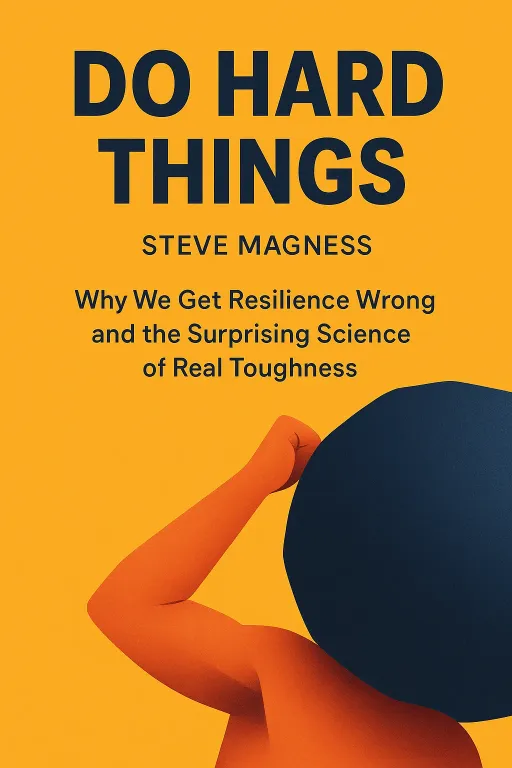
Dr. Warren Reed: Exactly. And that's why we're here today. We're diving into Steve Magness's book, "Do Hard Things: Why We Get Resilience Wrong and the Surprising Science of Real Toughness." With me is Toluwanimi, a curious and analytical thinker who loves to deconstruct big ideas. Welcome.
Toluwanimi: Thanks for having me, Warren. I think this is a critical conversation. That story proves it.
Dr. Warren Reed: It really is. Magness argues our entire cultural script for toughness is flawed, and today, we're going to explore his work to find a better way. We'll tackle this from two perspectives. First, we'll deconstruct the myth of old-school toughness and see why it so often fails. Then, we'll explore a new blueprint for resilience, one that reframes toughness as a skill of profound self-awareness.
Deep Dive into Core Topic 1: Deconstructing the Myth
SECTION
Dr. Warren Reed: So, to understand how we got here, how we got to a place where coaches could make such a fatal mistake, we have to look at the icons of this old model. Toluwanimi, when you think of a 'tough' coach, what kind of image comes to mind?
Toluwanimi: I immediately picture a figure, usually a man, who is screaming, red-faced, on the sidelines. Someone who believes that pressure and intimidation are the primary tools for motivation. It's a very specific, and very loud, archetype.
Dr. Warren Reed: You've just described the poster child for this model: the legendary college basketball coach, Bobby Knight. Knight won over 900 games, three national championships. His 1976 team was undefeated. By all external metrics, a massive success. And his brand was toughness. He defined it as "being able to overcome obstacles. You can’t feel sorry for yourself."
Toluwanimi: That sounds reasonable on the surface. Stoic, even.
Dr. Warren Reed: On the surface, yes. But Magness shows us what was underneath. Knight's method for instilling this toughness was pure, unadulterated fear. He was famously abusive. He would curse out players constantly. He once hung tampons in the lockers of players he thought were being 'soft.' There's even a video of him choking one of his players during a practice.
Toluwanimi: Wow. So his definition of 'overcoming obstacles' was really about players overcoming the obstacle of his abuse.
Dr. Warren Reed: Precisely. And this is the core of the old model: toughness is equated with callousness. It’s the idea that to make someone strong, you have to be hard on them, break them down, and rule by fear. It's the 'sink or swim' philosophy, taken to its extreme. Magness brings up another classic example: the 'Junction Boys.'
Toluwanimi: I'm not familiar with that story.
Dr. Warren Reed: In 1954, the new football coach for Texas A&M, a guy named Bear Bryant, took his team to a remote, desolate camp in Junction, Texas for a brutal ten-day preseason. It was over 100 degrees, there was a drought, and he worked them to the point of collapse, with almost no water. One player famously summarized the attrition rate by saying, "We went out there in two buses and came back in one."
Toluwanimi: And I assume the story is romanticized as the moment the team was forged in fire?
Dr. Warren Reed: That's exactly how it's told. But Magness digs into the data. The immediate result? That team went 1-9, one of the worst seasons in the school's history. The team that eventually won a championship two years later was mostly made up of new recruits who never went to Junction. And here's the kicker: many of the talented players who quit the camp went on to have incredible lives. One, Foster 'Tooter' Teague, became a TOPGUN fighter pilot. He flew in Vietnam and commanded an aircraft carrier.
Toluwanimi: That's fascinating. So, it's a classic confusion of correlation with causation. They see a survivor who is 'tough' and assume the brutal process the toughness. But Magness is arguing it's not a system for, it's a system for. It doesn't make people tough; it just filters out everyone who isn't already a certain way, or who has other options. It's a brute-force algorithm with a high rate of false negatives, discarding people like 'Tooter' Teague who were clearly not lacking in fortitude.
Dr. Warren Reed: A destructive algorithm. That's the perfect way to put it. It doesn't build anything; it just breaks things and keeps the pieces that didn't shatter. Which leads to the most important question: if that's the wrong code, what's the right one?
Deep Dive into Core Topic 2: The Resilience Blueprint
SECTION
Dr. Warren Reed: So if the old model is a destructive algorithm, what's the alternative? Magness argues it starts with a radical idea: listening to the 'error messages' our body sends us instead of just trying to delete them. This brings us to our second point: toughness as a skill of self-awareness.
Toluwanimi: The idea that feelings are data. I like that. It's an engineering approach to psychology.
Dr. Warren Reed: Exactly. And there's no better story in the book to illustrate this than that of a runner named Meredith Sorensen. Meredith was a talented senior on a college cross-country team. But she had a problem: severe performance anxiety. Before big races, she would get so anxious she would vomit, and her performance would suffer dramatically. She'd end up in the medical tent.
Toluwanimi: A classic case of the body's alarm system going haywire. The fight-or-flight response is supposed to help, but in her case, it's derailing her completely.
Dr. Warren Reed: Completely. So, the night before the biggest race of the season, her coach, who is the author Magness, is desperate. He calls a friend, a social worker, for advice. And the advice he gets is completely counter-intuitive. He goes to Meredith and says, "Okay, you feel like you're going to throw up. Let's plan for it. When do you want to do it? Let's schedule it."
Toluwanimi: Wait, what? He tells her to schedule it?
Dr. Warren Reed: Schedule it. Put it on the calendar. Meredith, confused, says, "Okay... how about 9:45 AM, right after my warm-up, before my final strides?" The coach says, "Perfect. Set an alarm on your phone." So, the next day, they go through the whole pre-race routine. At 9:45, her alarm goes off. The coach looks at her and asks, "Well?" And Meredith just looks back at him and says, "I don't need to." She went on to have the best race of her career.
Toluwanimi: That is brilliant. It's a real-world example of Viktor Frankl's idea: 'Between stimulus and response there is a space.' The old model of toughness, the Bobby Knight model, would be to scream at her, 'Don't be anxious! Just be tough!' It tries to suppress the stimulus.
Dr. Warren Reed: It's the bulldoze method. Just ignore the feeling and power through.
Toluwanimi: Right. But this new model, the one the coach used, is so much more sophisticated. It focuses on widening that space between stimulus and response. The stimulus is the anxiety, the feeling she's going to be sick. The automatic response is to panic and vomit. By scheduling the response, she created a pause. She took an involuntary, reactive process and made it a voluntary, conscious choice. And in that pause, in that space, she found the power to choose a different response.
Dr. Warren Reed: She regained a sense of control.
Toluwanimi: Exactly. She regained agency. The focus shifted from the external event—the race—to her internal choice. It proves that real toughness isn't about being fearless; it's about having the tools to act with intention the fear. It's about responding, not just reacting.
Synthesis & Takeaways
SECTION
Dr. Warren Reed: I think that's the perfect summary of the book's core message. We've journeyed from a model of toughness as suppression—ignoring the signals, bulldozing through pain—to a model of toughness as interpretation.
Toluwanimi: It's the difference between a dumb system that just powers through error messages until it crashes, and a smart, adaptive system that uses those messages to improve. The anxiety, the pain, the desire to quit—in the old model, that's a weakness to be stamped out. In the new model, it's just data.
Dr. Warren Reed: And if it's data, it's useful. It can be analyzed. It can be acted upon with intelligence. The old model says, "Your feelings are the enemy." The new model says, "Your feelings are your most important scouts, sending back reports from the front line."
Toluwanimi: And you'd be a fool to shoot your own scouts. You need to learn their language.
Dr. Warren Reed: Which brings us to the final takeaway for our listeners. Magness gives us a new way to think about doing hard things. So the challenge for all of us is this: The next time you feel that urge to quit, that spike of anxiety, that wave of discomfort—don't just fight it. Don't just try to bulldoze it. Pause.
Toluwanimi: Create that space.
Dr. Warren Reed: Create that space. And in that space, ask yourself one simple question: What is this signal telling me? What data is here for me to use? Because true toughness isn't about being numb to the message; it's about being skilled enough to read it.
Toluwanimi: A powerful and much more empowering way to think about our own resilience.
Dr. Warren Reed: Toluwanimi, thank you for helping us deconstruct this.
Toluwanimi: It was my pleasure, Warren. A fascinating topic.









