

School, Disrupted
Content
Content
Narrator: Introduction
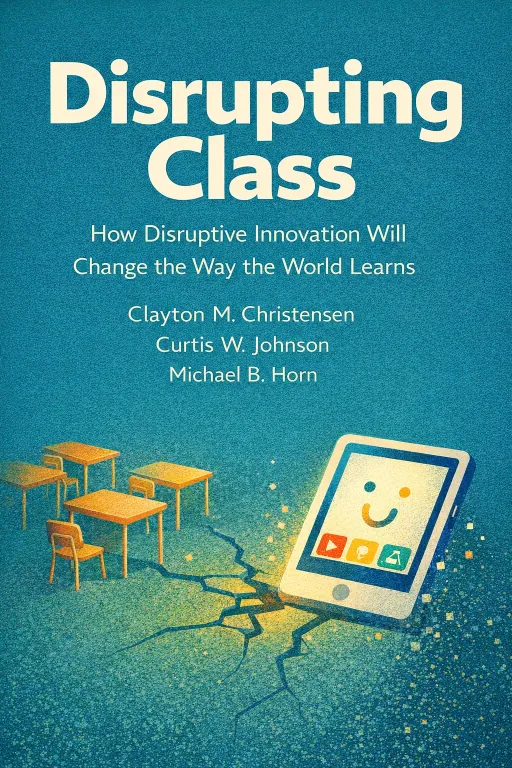
A high school junior named Rob sits in his car, dreading the morning bell. He used to love science, but now he’s on the verge of failing chemistry. He’s not lazy, and his teacher, Mr. Alvera, is a good man who has been teaching for twenty-five years. But with 120 students to manage, Mr. Alvera can only explain the concepts "slower and louder," which does nothing for Rob. Later, Rob’s father, an engineer, explains the same chemistry principle using balloons in the family car, a hands-on, spatial demonstration. Suddenly, the concept clicks. Rob isn’t unintelligent; the school is simply not built for the way he learns. This disconnect—between standardized teaching and individual minds—is at the heart of our schools' struggles. In their groundbreaking book, "Disrupting Class," Clayton Christensen, Michael Horn, and Curtis Johnson argue that the problem isn't a lack of funding, technology, or dedicated teachers. The problem is the system’s fundamental architecture, and the only way to fix it is not by tinkering, but by disrupting it from the ground up.
Key Insights
Key Insight 1: The Factory Model's Flaw: Why Standardized Schools Fail Diverse Learners
The authors assert that the central conflict in modern education is a mismatch between how students learn and how schools are designed to teach. The story of Rob and his chemistry class is not an exception; it is the rule. Students’ brains are wired differently, a fact supported by decades of cognitive science and powerfully illustrated by Howard Gardner’s theory of multiple intelligences. This theory posits that intelligence isn't a single, fixed measure like an IQ score, but a spectrum of distinct abilities, including linguistic, logical-mathematical, spatial, bodily-kinesthetic, and interpersonal skills. Maria, Rob's classmate, excels with her logical-mathematical intelligence and grasps the formulas instantly. Rob, however, needs a spatial or kinesthetic hook to understand the same concept.
The problem is that our school system is not built to accommodate this diversity. It operates on an "interdependent architecture," a term the authors borrow from industrial design. Much like an early, proprietary computer where every component is custom-built and inextricably linked, the traditional school system has tightly connected parts: grade levels, 50-minute periods, standardized curricula, and age-based cohorts. Changing one part requires changing everything, making customization for individual students prohibitively expensive and complex. This forces schools into a "factory model" of batch processing, where students are moved along an assembly line at the same pace, regardless of their individual needs or talents. The result is a system that efficiently serves students who happen to align with its dominant teaching style, while failing countless others like Rob.
Key Insight 2: The Innovator's Blind Spot: Why Billions in Technology Haven't Changed a Thing
For decades, the proposed solution to education's woes has been technology. Policymakers and administrators have poured over sixty billion dollars into putting computers in classrooms, yet studies show this massive investment has produced almost no effect on student achievement. "Disrupting Class" explains this paradox with a simple, powerful diagnosis: schools have "crammed" new technology into the old, broken model.
Using a computer to write an essay is merely a faster typewriter. Using the internet for a research paper is just a more convenient encyclopedia. These are "sustaining innovations"—they make the existing system marginally more efficient but do nothing to change its fundamental structure. The authors draw a parallel to the electronics giant RCA in the mid-20th century. When the transistor was invented, RCA, a master of vacuum tube technology, tried to cram the new, smaller transistors into its existing large, high-profit tabletop radios. The effort failed. Meanwhile, a small startup named Sony used transistors to create a completely new market: cheap, tinny, portable radios for teenagers. Sony wasn't trying to build a better tabletop radio; it was creating a product for people who had no radio at all. By "cramming" technology into their old model, schools have acted like RCA, missing the truly transformative, or "disruptive," potential of computers to create an entirely new model for learning.
Key Insight 3: Competing Against Nothing: How Online Learning Can Disrupt from the Sidelines
If cramming technology into the existing system is the wrong approach, what is the right one? The authors argue that the path forward lies in the core principle of disruptive innovation: new technologies succeed not by attacking powerful incumbents head-on, but by competing against "nonconsumption." This means finding customers whose alternative is nothing at all.
In education, these pockets of nonconsumption are everywhere. Consider a rural high school that can't afford to hire a full-time AP Physics teacher. For its students, an online AP Physics course isn't competing with a great teacher; it's competing against no course at all. The same is true for students needing to recover a failed credit, homebound students, or those wanting to study a niche subject like Arabic that their school doesn't offer. In these scenarios, online learning provides a simple, affordable solution that is infinitely better than the alternative of nothing.
The book shows how this is already happening. Online course enrollments have skyrocketed, starting in these overlooked niches. This growth follows a predictable "S-curve" of adoption. Initially slow, the technology gains a foothold, improves, and then rapidly "flips" the market. The authors predicted that this disruptive force would lead to a majority of high school courses being delivered online within a decade, fundamentally reshaping the educational landscape from the outside in.
Key Insight 4: The Student's Real Job: Uncovering the True Source of Motivation
Even with the right technology, a system will fail if it ignores human psychology. The book tackles the persistent problem of the "unmotivated student" by reframing the question entirely. Using the "jobs-to-be-done" theory, the authors argue that people don't just buy products; they "hire" them to do a specific job in their lives.
The book illustrates this with the famous milkshake story. A fast-food chain wanted to sell more milkshakes and tried improving the product based on customer feedback, but sales didn't budge. Researchers then discovered that half the milkshakes were sold before 8:30 a.m. to lone commuters. These customers weren't hiring the milkshake for its flavor, but for the "job" of making a long, boring commute more interesting and staving off hunger until lunch. The milkshake's real competitors weren't other milkshakes, but bagels, bananas, and coffee.
Applying this to education, the authors ask: What "job" are students hiring school to do? They conclude that for most students, the core jobs are to feel successful and to have fun with friends. The tragedy of the current system is that it outsources these critical jobs. Success and progress are found in "extracurriculars" like sports or band, while the classroom is often a place of frustration and failure. Students who seem unmotivated aren't lazy; they are simply hiring other things—video games, social media, part-time jobs—to do the job of feeling successful, because school has failed to offer them a compelling way to do so.
Key Insight 5: Architects of Change: Why Real Innovation Requires New Blueprints for Schools
If the system's architecture is the problem, then real change requires new architects. The book argues that an organization's structure dictates what it is capable of producing. A school organized by traditional departments like Math, English, and Science is designed for incremental improvements within that structure, not for creating a fundamentally new model of learning.
To achieve architectural innovation, a different structure is needed: the "heavyweight team." These are autonomous, cross-functional groups given the freedom to design a new system from the ground up. The authors point to innovative charter schools like KIPP and High Tech High as real-world examples of heavyweight teams in education. Operating with autonomy from the district's bureaucracy, they have created entirely new academic and behavioral architectures tailored to the specific "jobs" of their students.
However, creating these autonomous spaces is a political challenge. In a system with deep disagreement on goals and methods, like public education, the authors argue that traditional tools like negotiation and democracy often lead to gridlock. Instead, leaders must be willing to use "power" and "separation" to carve out the space for these new models to grow, protecting them from the gravitational pull of the old system.
Conclusion
The single most important message of "Disrupting Class" is a call to stop trying to fix the unfixable. The monolithic, factory-model school system cannot be incrementally improved into a student-centric one. Instead of pouring more resources into a broken architecture, true progress will come from enabling new, disruptive models to emerge from the outside in. These models, powered by technology and a deep understanding of student motivation, will start by solving problems the current system ignores, and will eventually grow to become the new foundation of learning.
The book leaves us with a profound challenge. It asks every parent, teacher, and policymaker to stop asking, "How can we make our schools better?" and to start asking a more disruptive question: "What are the unmet 'jobs' in our students' lives, and how can we build the tools and create the schools that they will be truly excited to hire?"