

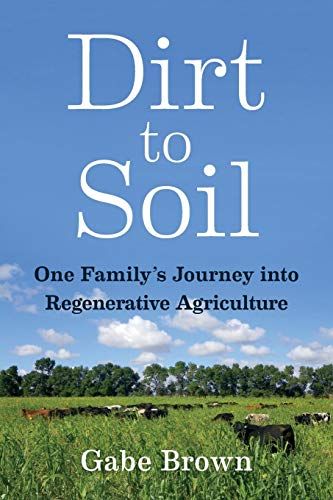
Dirt to Soil
Introduction
Nova: Picture this: It's 1998. You're a farmer in North Dakota. For four straight years, you've lost everything. Hail destroyed your crops in '95 and '96. A blizzard killed your calves in '97, followed by a drought that wiped out every acre. Then in '98, just when you think your luck has turned, another hailstorm flattens 80 percent of your harvest. You have no crop insurance. Your input budget has hit absolute zero. What do you do?
Nova: Most people would. But Gabe Brown didn't. Instead, those four years of catastrophe became the catalyst for one of the most remarkable transformations in modern agriculture. He wrote about it in his 2018 book Dirt to Soil: One Family's Journey into Regenerative Agriculture. And the title says it all — because what Brown discovered is that there is a fundamental difference between dirt and soil.
Nova: That's the whole book in a nutshell. Dirt is dead. It's degraded, lifeless, compacted powder. Soil is alive — teeming with billions of microorganisms, fungi, earthworms, and organic matter. Brown's journey is about turning one into the other. And here's the wild part: conventional wisdom says it takes a thousand years to grow an inch of topsoil. Gabe Brown grew several inches in just twenty years.
Nova: Let's find out. This is the story of Dirt to Soil.
The Crisis That Sparked a Revolution
Four Years of Failure That Changed Everything
Nova: So let's rewind to 1991. Gabe and his wife Shelly buy her parents' 5,000-acre ranch near Bismarck, North Dakota. He's farming the way everyone farms — monocultures of small grains, frequent tillage, synthetic fertilizers, pesticides, season-long grazing. The standard industrial playbook.
Nova: It looked like it did. But underneath, the soil was dying. Brown later wrote that he wished he'd archived soil samples from 1991 just to see how degraded they truly were. The soil organic matter was sitting at just 1.7 to 1.9 percent. The water infiltration rate? Half an inch per hour. So whenever it rained, water ran off instead of soaking in.
Nova: Pretty close. And then came the disasters. 1995, hail destroys everything. 1996, hail again — 100 percent crop loss. 1997, a brutal blizzard kills newborn calves, followed by a summer so dry he harvested nothing. 1998, one more hailstorm wipes out 80 percent. Four years, four catastrophes, no insurance.
Nova: He was sinking in debt. But here's where the story turns. Brown writes about attending a conference where a Canadian rancher named Don Campbell said something that hit him like lightning: "If you want to make small changes, change the way you do things. If you want to make major changes, change the way you see things."
Nova: Exactly. Brown realized he'd been making small changes and praying for big results. He needed to see his entire operation differently. And the crisis forced his hand — he literally had no money for fertilizers and chemicals anymore. So he started looking at how natural ecosystems actually function. He began asking: what would nature do here?
Nova: They weren't. Brown later wrote, "Those four years were hell to go through, but they turned out to be the best thing that could have happened to us, because they forced us to think outside the box, to not be afraid of failure, and to work with nature instead of against her." That mindset shift is the foundation of the entire book.
Nature's Playbook for Building Living Soil
The Five Principles of Soil Health
Nova: So Brown's transformation is built on what he calls the five principles of soil health. These aren't his inventions — he credits them to mentors like Jon Stika, Jay Fuhrer, and Ray Archuleta — but his book popularized them worldwide. And they're deceptively simple.
Nova: Limit disturbance. Every time you till the soil, you're tearing apart the "house" that soil organisms have built. You're shredding fungal networks, collapsing pore spaces, destroying the infrastructure of life underground. Brown puts it bluntly: every tillage pass costs you biology. And it's not just mechanical — chemical disturbance from herbicides and synthetic fertilizers also suppresses that underground life.
Nova: Principle two: Armor the soil. Keep it covered at all times. Bare soil is an anomaly in nature — she always works to cover herself. Brown says naked soil bleeds moisture, loses topsoil to wind and rain, and heats up to temperatures that literally kill biology. Even crop residue or a winter cover crop makes a massive difference.
Nova: Exactly. Principle three: Diversity. Monocultures above ground mean monocultures below ground, and that's a brittle system. In a native prairie, you'll find grasses, forbs, legumes, shrubs — each with different root architectures, each feeding different microbial communities. Brown started planting cover crop mixes with seven, fifteen, even twenty-five different species.
Nova: You let nature manage it. Different species fill different niches. Some have deep taproots that break up compaction. Others are shallow and fibrous, adding organic matter near the surface. Some fix nitrogen. Some scavenge phosphorus. Together they create a self-regulating system.
Nova: Living roots year-round. In North Dakota, Brown used to think his growing season was just 120 days between frosts. Now he plants fall-seeded biennials that grow into early winter and break dormancy earlier in spring. His goal is to always have a living root in the ground because those roots pump carbon into the soil through root exudates — essentially feeding the underground economy.
Nova: Integrate animals. Brown is emphatic about this: nature does not function without animals. On his ranch, cattle, sheep, pigs, and chickens all play roles. Grazing stimulates plants to pump more carbon underground. Manure seeds the soil with diverse biology. Hooves press depressions that catch water. He moves his 300 cow-calf pairs daily, sometimes multiple times a day, mimicking how wild herds used to move across grasslands.
Why Polycultures Crushed Monocultures
The Drought Experiment That Stunned Everyone
Nova: One of the most memorable stories in the book takes place in 2006. Brown had been using cover crops and no-till for about a decade, but only a few species, planted separately. Then he attended a conference where a Brazilian agronomist named Ademir Calegari said something that stopped him cold.
Nova: "Cover crops are meant to be seeded in multispecies combinations." Brown had a lightbulb moment. He thought about native prairies — they're never monocultures. Grasses, legumes, forbs, they all grow together. Why wouldn't the same principle work for agriculture?
Nova: He and his friend Jay Fuhrer, a conservationist with the NRCS, planted a demonstration on ten acres. They seeded monoculture strips of radish, turnip, soybeans, cowpeas, and lupins into very dry soil. Then they planted two more strips mixing all those species together — one at half rate, one at full rate.
Nova: Historically dry. Only three inches of rain in the first seven months. By the end of July, sixty days after planting, they'd gotten less than one additional inch. The monoculture strips were dead — burnt up, barely hanging on. But the mixed-species strips? They produced more than three times the biomass of any single monoculture strip.
Nova: Dr. Kris Nichols, a soil microbiologist, explained it to Brown: it's the mycorrhizal fungi. In a diverse plant community, these underground fungal networks connect different plants and allow them to share resources — water, nutrients, carbon. The plants aren't competing; they're collaborating. Brown's takeaway quote from the book: "Nature is more collaborative than competitive."
Nova: And that demonstration plot changed everything. Farmers and scientists came from all over to see it. Most were bewildered. It upended decades of agricultural training. From that point on, Brown rarely used a cover crop mix with fewer than seven species. He'd discovered that diversity above ground creates resilience below ground.
Soil Health By the Data
The Numbers Don't Lie
Nova: Let's talk results, because the numbers from Brown's Ranch are staggering. Remember, when he started in 1991, his soil organic matter was 1.7 to 1.9 percent. After twenty years of regenerative practices, it's now between 5.3 and 7.9 percent.
Nova: Organic matter is the engine of soil function. It holds water, stores nutrients, feeds microbes. And here's the number that blows my mind: his water infiltration rate went from half an inch per hour to thirty inches per hour.
Nova: Exactly. Runoff never occurs on his land anymore. Every drop of rain enters the soil. During droughts, his fields stay productive while neighbors' fields wither. That's the power of living soil — it acts like a giant sponge.
Nova: Here's the kicker: Brown has a proven dryland corn yield of 127 bushels per acre, while the county average is under 100. That's more than 25 percent higher, and he hasn't used synthetic fertilizers since 2008. No fungicides. No pesticides. His input costs are a fraction of conventional farmers.
Nova: From the soil biology itself. The diverse cover crop mixes feed soil organisms, and those organisms cycle nutrients back to the plants. Brown had his soil tested against three neighboring farms with similar soil types. His soil had seven times as much nitrogen, five times the phosphorus, eight times the potassium, and four times the organic carbon as the nearest competitor.
Nova: That's the whole point of the book — it's not too good to be true. It's how nature has always worked. We just forgot. And here's the thing that really drives it home: Brown says he's grown several inches of new topsoil in twenty years. Conventional wisdom says that takes a millennium.
Nova: Brown's quote is: "The formation of fertile topsoil can be breathtakingly rapid once the biological dots have been joined." The life in the soil is the force. Once you unleash it, it builds on itself.
Scaling Regeneration
From One Ranch to a Global Movement
Nova: The book isn't just one farmer's story — it's become a blueprint. In 2017, Brown co-founded Understanding Ag, a consulting company, alongside Ray Archuleta, David Brandt, and Allen Williams. Today they consult on operations managing 36 million acres globally.
Nova: And he also co-founded Regenified, a regenerative agriculture certification program that verifies soil health practices and even measures phytochemical density in crops. The idea is that food grown in living soil is more nutrient-dense, and consumers should be able to choose that and verify it.
Nova: According to Regenified's consumer research, 47 percent of American consumers are aware of the term "regenerative," and 20 percent say they're willing to pay more for regeneratively grown food. That number is projected to keep rising.
Nova: Not at all. Brown now travels more than 200 days a year speaking to everyone from farmers to CEOs to boardrooms to royalty. In one recent year, he spoke to over 23,000 people at more than 100 presentations. Over 2,000 people from all 50 states and 21 countries visited his ranch. His open-door policy has made Brown's Ranch one of the most studied regenerative agriculture case studies in the world.
Nova: And he's adamant that this isn't about ideology — it's about practicality. He writes in the book: "Why in the world would we want to sustain a degraded resource? We instead needed to work on regenerating our ecosystems." That distinction between sustaining the degraded and regenerating the healthy is central to his message.
Nova: Exactly. And Brown sees regenerative agriculture as a solution to multiple global crises — the health crisis, water scarcity, rural community decline, climate change. He says in the book that managing farms and ranches as ecosystems is "absolutely key to healing our families, our farms, our communities, and our planet."
Conclusion
Nova: So let's bring it all together. Gabe Brown's Dirt to Soil is, at its heart, the story of a farmer who hit rock bottom and discovered that the solution was under his feet the whole time. The book traces his path from industrial commodity producer to ecosystem manager, from treating soil like dirt to fostering it as a living community.
Nova: And the results speak volumes. Soil organic matter tripled. Water infiltration sixty times faster. Crop yields 25 percent above the county average. Zero synthetic fertilizer since 2008. Several inches of new topsoil where the textbooks said it would take centuries. And a consulting business helping farmers across 36 million acres.
Nova: That's the core insight. Brown had to stop seeing his land as a substrate for extracting commodities and start seeing it as a living ecosystem to nurture. He had to stop thinking of farming as war against nature and start thinking of it as partnership with biology. The book's title captures the entire philosophy: the fusion of life transforms dirt into soil.
Nova: Beautifully put. Gabe Brown's story reminds us that the most powerful solutions are often the oldest ones — and that regeneration is not just possible, but essential. This is Aibrary. Congratulations on your growth!