

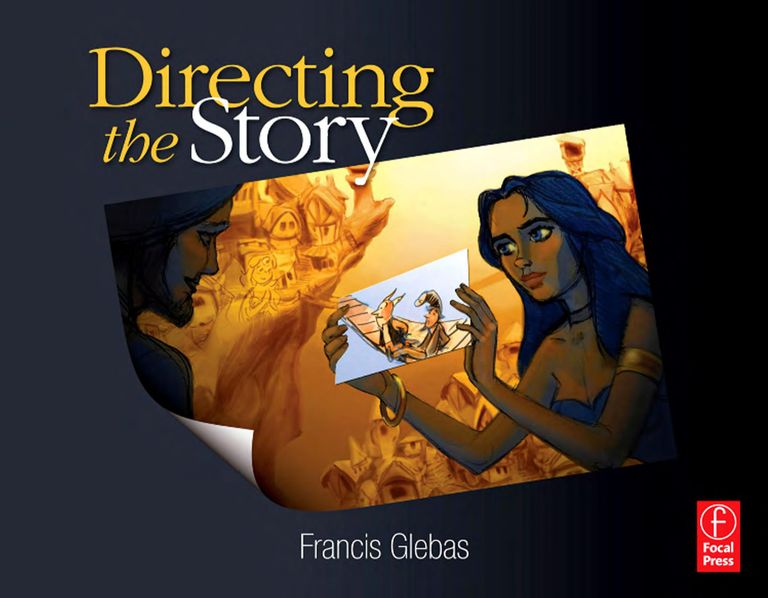
Directing the story
Professional Storytelling and Storyboarding Techniques for Live Action and Animation
Introduction
Nova: Imagine you're sitting in a dark theater. The screen flickers to life. Two hours later, you walk out feeling like you've been on a journey — you've laughed, you've cried, your heart has raced. But here's the strange thing: you were just staring at a flat rectangle of light. So how did that happen? How did a series of flickering images make you feel anything at all?
Nova: That's the question at the heart of our episode today, because we're diving into a book that takes this mystery apart piece by piece. It's called Directing the Story by Francis Glebas, and if you've ever watched a Disney classic like Aladdin or The Lion King and felt completely swept away, you've experienced the work of a master — and Glebas was one of the story artists behind those very films.
Nova: Francis Glebas spent decades at Disney as a storyboard artist and director. He worked on Aladdin, The Lion King, Pocahontas, Hercules — the list goes on. He directed the Donald Duck segment in Fantasia 2000 and even directed Piglet's Big Movie. This is someone who has lived and breathed visual storytelling at the highest level. And in this book, he basically opens up his entire playbook.
Nova: What I love about this book is that the title says it all. It's not called Directing the Movie. It's Directing the Story. That distinction is everything. Glebas argues that the director's real job isn't just moving cameras and staging actors — it's guiding the audience through an emotional experience without them ever noticing the strings being pulled.
Nova: So that's exactly what we're going to unpack today: the invisible architecture of storytelling, the psychological tricks that make you forget you're watching a movie, and why the secret to great storytelling might just be... learning how to delay. Stick around — this one is a masterclass.
Key Insight 1
The Reverse-Engineering of Emotion
Nova: Let's start with the question Glebas asks every single one of his film students on the first day of class. It sounds simple, but it's surprisingly deep. He walks in and asks: Why do we watch movies?
Nova: And students say things like — to escape, to learn, to see spectacular worlds, to share experiences with characters. And then, inevitably, someone says: to be entertained. And Glebas says, great, we watch movies to be entertained. But then he throws the curveball: does knowing that actually help you make a better film?
Nova: The answer, his students unanimously agree, is no. It's too vague. It's like saying you eat food to stop being hungry — true, but useless if you're trying to become a chef. So Glebas takes this as his starting point for a much deeper investigation. He reverse-engineers the entire moviegoing experience.
Nova: Here's what he discovered, and this is the real gold. When someone watches a film, their brain is going through a very specific sequence of steps. First, they pay attention to the screen. Then they perceive what's being shown and identify things — that's a character, that's a desert, that's a magic lamp. Then they read the signs as characters perform actions and they start following the story. Then — and this is the crucial step — they start making connections about what it all means.
Nova: And here's the breakthrough: Glebas realized that meaning automatically evokes emotions. The moment the audience connects the dots and understands what something signifies, the feeling hits them. You don't have to force emotion onto the screen. You just have to guide the audience toward meaning, and the emotion takes care of itself.
Nova: After making meaning, the audience starts guessing what will happen next. They form hypotheses. Then they worry about the characters. They adjust their predictions as new information comes in. And finally, when the film ends, they should feel emotional closure — surprise and vindication that it ended the way they thought, but not in the way they expected.
Nova: That last bit is so important — ended the way they thought but not in the way they expected. It's that sweet spot between predictability and chaos. Give the audience what they need, but never quite how they imagined it. That's the tightrope every great storyteller walks.
Key Insight 2
The Scheherazade Secret
Nova: So if the audience's journey through a film follows that sequence — attention, perception, meaning-making, prediction, worry, closure — then the filmmaker's goal is to keep them moving through it without ever breaking the spell. And that brings us to one of the most delightful ideas in this entire book: the secret of storytelling is story-delaying.
Nova: Glebas illustrates this through the framing device he uses throughout the entire book. He storyboards the tale of Scheherazade from One Thousand and One Nights. If you don't know the story, Scheherazade is the woman who must tell stories to a murderous Sultan every night to save her own life. Every morning, she leaves the story unfinished at a cliffhanger, forcing the Sultan to keep her alive another day so he can hear the ending.
Nova: And Glebas points out: Scheherazade is the ultimate director. Her very life depends on keeping her audience engaged. And her technique? She delays the resolution. She poses narrative questions and then makes you wait for the answers. That's what suspense actually is — a question you desperately want answered, deliberately withheld.
Nova: What's brilliant is that Glebas actually storyboards the entire Scheherazade tale right there in the book, and every single chapter of his own book ends on a cliffhanger. He's not just teaching you the technique — he's doing it to you while you read. The book itself becomes a demonstration of its own principles.
Nova: And this connects to something he calls the hierarchy of narrative questions. At any given moment in a film, the audience is holding multiple questions in their head. What will happen next? Will the hero survive? Who is the real villain? What does that mysterious object do? A great director manages these questions like a conductor leading an orchestra — introducing them, building tension around them, answering some while raising new ones. You never want the audience to have zero questions, because that's when they get bored and check their phones.
Nova: Glebas also introduces this concept he calls the pendulum of suspense. Think of it as swinging between what the audience knows and what the characters know. Sometimes the audience knows more than the characters — that's dramatic irony, and it creates agonizing tension. You're screaming at the screen because you can see the danger and the character can't. Other times, the character knows more than the audience, and that creates mystery. The pendulum swings back and forth, and that movement is what keeps people gripping their armrests.
Key Insight 3
Every Shot Is a Close-Up
Nova: Now let's talk about the visual side of this, because Glebas has one statement that completely changed how I think about film composition. He says: every shot is a close-up.
Nova: At first that sounds absurd. Of course not every shot is a close-up — you've got wide shots, medium shots, establishing shots. But what he means is that every shot should focus the audience's attention on exactly one thing — the thing that matters most in that moment. Even in a wide shot of a crowded marketplace, the director's job is to make sure your eye goes to the right place. The shot might be physically wide, but it's psychologically a close-up on the essential information.
Nova: And Glebas is meticulous about how to achieve this. He talks about what he learned from watercolor artists — the missing piece of design, as he calls it. Watercolorists understand that you don't paint everything with equal detail. You paint the focal point with sharp edges and high contrast, and everything else fades into softer focus. The eye naturally goes where the contrast is highest. Filmmakers can do the same thing with lighting, with depth of field, with movement, with color.
Nova: He introduces what he calls the design equation. Every frame is a balancing act of multiple elements: line, shape, tone, color, movement, and staging. The director's job is to arrange these so that the viewer's eye lands exactly where it needs to, in exactly the right order, without the viewer ever realizing they're being directed. That's the magic — invisible guidance.
Nova: There's another concept he explores that I find fascinating: the speaking metaphor. Glebas argues that visual storytelling works just like verbal communication. When you speak to someone, you say one idea at a time. You don't rattle off five sentences simultaneously and expect them to follow. Visual storytelling should work the same way. Each image should communicate one clear idea. If you cram too much into a single frame, it's like shouting five sentences at once — the audience gets confused, and confusion is the enemy of emotional engagement.
Nova: And his rule for beginners is beautifully simple: make sure every image passes the squint test. If you squint at your storyboard panel and you can't immediately tell what's happening, it needs more clarity. The silhouette should tell the story all by itself.
Key Insight 4
The Director as Magician
Nova: One of the most provocative ideas in this book is that a director is essentially a magician. Not in the sense of special effects wizardry — though that's part of it — but in the sense of attention control. A stage magician makes you look at the right hand so you don't see what the left hand is doing. A film director does the same thing, but with narrative.
Nova: Glebas devotes an entire section to how the brain organizes information, drawing on Gestalt psychology. The human brain is hardwired to seek patterns, to group similar things together, to follow lines of sight, to notice things that break a pattern. These aren't artistic choices — they're built into our neurology. And a skilled director exploits every single one of them.
Nova: He uses what he calls the power of suggestion. You don't have to show everything. In fact, showing everything is often less powerful than implying it. If you show a character reaching for a door handle while looking terrified, the audience's imagination fills in what might be behind that door — and whatever they imagine is probably scarier than anything you could actually put on screen. Glebas calls this speaking indirectly, and he traces it through everything from horror films to romantic comedies.
Nova: Let me give you a concrete example from the book. Glebas talks about how to introduce a character effectively. Many beginners think you need to show the character's face right away, give them a name, explain who they are. But Glebas says no — show the character struggling with something. Show what they want and what's standing in their way. The audience will lean in because they recognize that struggle. They'll project themselves into it. That's identification, and it happens before you even know the character's name.
Nova: He also has this wonderful breakdown of the enemies of good design, and there are really just two: boredom and confusion. Every creative decision you make as a director should be fighting one of these two monsters. If the audience is bored, they disconnect. If they're confused, they can't make meaning, and without meaning there's no emotion. Clarity and drama — those are your weapons.
Nova: And here's a practical gem: Glebas teaches that the structure of your story should be invisible. The audience should never think about the three-act structure or the hero's journey while they're watching. They should just feel the story unfolding naturally. But for the structure to be invisible to the audience, it has to be completely visible to you, the creator. You have to know it so well that you can hide it.
Key Insight 5
The Rubberband Theory and Emotional Truth
Nova: Let's talk about some of the specific emotional genres Glebas breaks down, because he has theories here that are genuinely original and practical. My favorite might be what he calls the rubberband theory of comedy.
Nova: The idea is this: comedy works by stretching expectations to their limit and then snapping them back in a surprising direction. You set up a pattern, you stretch it further and further until the audience thinks they know exactly where it's going, and then — snap — you break the pattern in an unexpected but perfectly logical way. The laugh comes from that snap. The sudden release of tension combined with the surprise of the new direction.
Nova: For horror, he asks a fascinating question: what is so scary about horror? And his answer is that horror works by making the familiar feel unsafe. The home becomes a trap. The reflection in the mirror becomes a threat. The people you trust become suspect. Horror takes the foundations of everyday life and cracks them. The audience's own imagination does the rest.
Nova: For love stories, he asks: what keeps lovers apart? And the answer is never just external obstacles. The most compelling love stories are about internal obstacles — fear of vulnerability, past trauma, conflicting values. The external plot is just a way to make the internal struggle visible.
Nova: But beyond any specific genre, Glebas keeps circling back to one core idea: emotional truth. He argues that audiences can smell falseness from a mile away. If a character's reaction doesn't feel honest, if a plot twist feels contrived, if the resolution feels unearned — the spell breaks. The audience is no longer lost in the story; they're suddenly aware they're watching a movie, judging it, picking it apart.
Nova: This connects back to his seven-step audience model. Step four — making meaning — only works if the story has genuine emotional logic. The connections the audience makes have to feel true to life, even in a fantasy world with talking animals and magic carpets. That's why Aladdin works: the emotions are real even though the setting is fantastical.
Nova: Glebas also makes a point that I think is especially valuable for anyone trying to break into creative work. He talks about criticism as opportunity. He recounts how painful feedback helped him grow as a storyteller. The goal isn't to defend your work — it's to understand why something didn't land, and to fix it so it does. Every note is a clue about what the audience needs that you haven't given them yet.
Conclusion
Nova: So let's pull all of this together. What Francis Glebas has given us in Directing the Story is essentially a user manual for the audience's brain. He's reverse-engineered the experience of being lost in a story, and then built a toolkit for creating that experience on purpose.
Nova: The framework is deceptively simple. Start by understanding that the audience goes through a predictable sequence: attention, perception, meaning-making, prediction, worry, and closure. Your job at every moment is to keep them moving through that sequence. Never let them get stuck. Never let them get bored. Never let them get confused.
Nova: Use narrative questions like Scheherazade — pose them, delay the answers, and always have a new question ready before the old one is fully resolved. That's the engine of suspense and engagement.
Nova: Treat every shot as a close-up on the essential information. Compose your frames so the eye goes exactly where it needs to. Make your structure invisible but rock-solid. And above all, pursue emotional truth — because meaning triggers emotion, and if the meaning rings false, no amount of visual spectacle can save you.
Nova: The book itself is a remarkable object. Glebas storyboarded an entire version of the Scheherazade tale to demonstrate every technique he teaches. Every chapter ends on a cliffhanger. He's showing you and doing it to you at the same time. It's the kind of teaching that only comes from someone who has spent decades in the trenches — someone who storyboarded the magic carpet ride in Aladdin, who helped bring Simba to life in The Lion King.
Nova: And maybe the most inspiring thing about this book is the implicit message behind it: great storytelling is not a mystery. It's a craft. It can be learned, practiced, and mastered. The tools are there for anyone willing to pick them up and do the work.
Nova: So the next time you watch a movie and find yourself completely transported — just for a moment, after the credits roll — think about the invisible architecture that made it happen. Somewhere, a director was thinking about where your eyes would go, what questions you'd be asking, and exactly when to give you the answers.
Nova: This is Aibrary. Congratulations on your growth!