

The Hidden Cost of Constant Connectedness: Reclaiming Your Mental Space
Golden Hook & Introduction
SECTION
Nova: If this episode found you, you probably pick up your phone fifty times a day, feel constantly overwhelmed, and secretly wonder if your brain is slowly turning into digital mush.
Atlas: Oh man, I feel personally attacked right now! That's not just a feeling; it’s a daily reality for so many of us trying to keep up. The fragmentation is real.
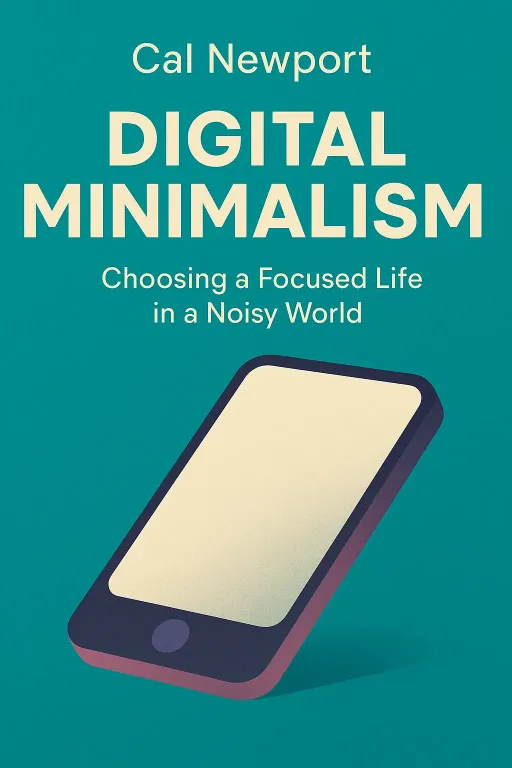
Nova: Absolutely, Atlas. And that feeling isn't an accident; it's a consequence. Today, we're diving into that exact sensation, guided by two pivotal books: "The Shallows" by Nicholas Carr, and "Digital Minimalism" by Cal Newport. You know, Newport actually wrote "Digital Minimalism" after realizing that even, a computer science professor and renowned productivity expert, was struggling with the insidious pull of his devices and the erosion of his own deep work capacity. It’s a powerful personal admission from someone you'd expect to be immune to the very problems he diagnoses. It shows just how pervasive this issue is.
Atlas: Wow, that's a pretty stark admission from someone who literally studies this stuff. It makes me wonder, if he's struggling, what hope do the rest of us have? And how does this constant digital pull really impact us beyond just feeling a bit scattered?
The Cognitive Erosion of Constant Connectivity
SECTION
Nova: That’s exactly where Nicholas Carr’s "The Shallows" comes in. Carr argues that the internet isn't just a tool; it's an environment that actively reshapes our cognitive processes. Think about the structure of the internet: hyperlinks, constant notifications, fragmented information, quick jumps from one thing to another. Our brains are incredibly adaptable, and over time, they start to mirror that environment.
Atlas: So you're saying our brains are actually changing? Not just that we're distracted, but our ability to focus is degrading? That sounds rough.
Nova: Precisely. Carr details how our neural pathways, originally designed for sustained, linear thought, are being rewired for rapid, shallow processing. It’s like our brains are becoming expert at skimming and scanning, but losing their capacity for deep dives. Imagine a brilliant architect trying to design a groundbreaking, complex building. They need hours of uninterrupted focus to conceptualize, iterate, and solve intricate structural problems.
Atlas: Right, like trying to hold an entire blueprint in your head.
Nova: Exactly. Now, picture that architect sitting down, ready for some deep design work, and every five to ten minutes, a notification pings: an email from a colleague, a message from their spouse, a news alert about a market fluctuation, a quick check on social media. Each interruption, however brief, forces a context switch. It's not just the time lost during the interruption; it’s the significant mental effort required to get back to that deep cognitive state. Studies show it can take up to twenty-five minutes to fully re-engage with a complex task after an interruption.
Atlas: Twenty-five minutes? That's incredible. For someone who needs to be strategically sharp, constantly evaluating markets, innovating features, or leading a team, that kind of cognitive erosion sounds like a silent killer of competitive advantage. It's not just about getting things done; it's about the quality of the thinking.
Nova: It absolutely is about the quality of thinking. Over time, this constant context-switching leads to a default mode of shallow processing. We become less adept at synthesizing complex information, forming new ideas, and sustaining the kind of concentrated effort required for truly innovative work. It's a fundamental erosion of our mental peace and our creative energy, which, for an innovator, is your most vital fuel.
Atlas: I can definitely relate to that. There are days where I feel like I'm just reacting to everything, putting out fires, and the big, strategic thinking that actually moves the needle just never gets the dedicated space it needs. It's like my brain is stuck in a constant state of triage.
Nova: That's a perfect example of the cognitive cost. The hidden cost of constant connectedness isn't just lost productivity; it's the gradual diminishment of our capacity for deep thought, for sustained attention, and ultimately, for genuine creativity and strategic insight. It's a profound shift that impacts everything from personal well-being to organizational innovation.
Digital Minimalism as a Strategic Imperative
SECTION
Atlas: Okay, so if our brains are getting rewired for shallowness, what's the counter-strategy? How do we fight back, especially when so much of our work digital tools and staying connected? It feels like we can't just unplug and disappear.
Nova: That’s where Cal Newport’s "Digital Minimalism" offers a powerful framework. He's not advocating for abandoning technology altogether; that's unrealistic for most of us, especially innovators. Instead, he proposes a philosophy of technology use where you focus your online time on a small number of carefully selected and optimized activities that strongly support your values, and then happily miss out on everything else.
Atlas: So it’s not about abstinence; it's about intentionality. I like that. But what does that look like in practice for someone who needs to keep a pulse on their industry, communicate with a global team, and constantly iterate on products?
Nova: It starts with three core principles. The first is: clutter is costly. Every digital tool, every notification, every app you indiscriminately add to your life comes with a hidden cost to your attention and mental peace. The second is: optimization is important. For the digital tools you decide are essential, you need to optimize how you use them to minimize their negative impact. And the third: intentionality is satisfying. The deliberate act of choosing to engage with, and, brings a profound sense of control and calm.
Atlas: I can see how that would be satisfying. But wait, for our listeners who are managing high-pressure teams, isn't being "constantly connected" part of the game? How do you implement this without becoming isolated or missing crucial opportunities?
Nova: That’s the strategic imperative. Consider the case of an entrepreneur I know who was constantly juggling investor emails, team Slack messages, and social media for brand building. She felt perpetually behind and creatively drained. After reading Newport, she decided to implement a digital declutter. She identified her core values: deep creative work for product development, and focused communication with her leadership team.
Atlas: And what did that look like for her day-to-day?
Nova: She started by scheduling non-negotiable "deep work" blocks every morning, turning off notifications during those times – even for her most critical communication channels. She designated specific times to check email and Slack, and completely removed social media apps from her phone, only accessing them via desktop for planned, strategic engagement.
Atlas: That sounds like a huge leap of faith, especially in a fast-moving industry. Did it actually work?
Nova: It transformed her business and her well-being. Initially, there was anxiety about missing something, but she had communicated her new approach to her team, setting clear expectations for response times. What happened was a profound shift. Her creative output skyrocketed. She developed more innovative features, her strategic planning became clearer, and she reported feeling significantly less overwhelmed. Her team also started adopting similar practices, seeing her renewed focus as a model for their own productivity.
Atlas: That’s actually really inspiring. It sounds like she didn't just reclaim her mental space; she strategically amplified her impact. It ties directly into sustaining vision and building personal resilience, which are crucial for any leader. So, it's not about being less connected, but being connected.
Nova: Exactly. It's about conscious engagement. It's a strategic necessity, not a luxury, especially for those in demanding roles who need their minds sharp, their energy sustained, and their vision clear. It's about protecting that inner creative wellspring.
Synthesis & Takeaways
SECTION
Atlas: So, Nova, we've talked about how our brains are literally being rewired for shallowness and how digital minimalism can be a strategic counter-move. For someone listening right now, feeling that fragmentation, what’s the smallest, most immediate step they can take to start reclaiming some of that mental peace?
Nova: That’s a fantastic question, Atlas, and it goes right back to a simple yet powerful idea: deliberate disengagement. My recommendation, and one that mirrors a "healing moment" from this concept, is to choose notification on your phone—just one—and turn it off for the next twenty-four hours.
Atlas: Just one? That sounds almost too simple. Like, what difference can one notification make?
Nova: The difference isn't in the quantity of notifications, but in the quality of the shift it creates. When you turn off that one notification, you're not just silencing an alert; you're sending a signal to your brain that are in control. It's a small act of defiance against the constant demands for your attention. Pay close attention to the subtle shift it creates—the slight decrease in urgency, the tiny bit more mental space, the feeling of agency. That small shift is the first step towards reclaiming your most valuable asset: your attention. The ability to think deeply, to cultivate creative energy, and to sustain your well-being in a noisy world is no longer a given; it's a skill that must be fiercely protected and strategically cultivated. It's the ultimate differentiator.
Atlas: Wow, that’s such a hopeful way to look at it. It's not about an overwhelming digital detox, but a tiny, intentional act that builds momentum. I’m doing that right after this episode.
Nova: Excellent. That intentionality is the root of sustainable change. This is Aibrary. Congratulations on your growth!









