

The 'Always On' Trap: Why You Need Mindful Disconnection.
Golden Hook & Introduction
SECTION
Nova: POV: you’re caught in a never-ending loop of notifications, emails, and 'just checking' your phone, wondering why you feel busy but never truly accomplished. If this episode found you, you're not alone.
Atlas: Oh, I know that feeling! That's actually really relatable. It’s like being on a treadmill – moving constantly, but not really getting anywhere.
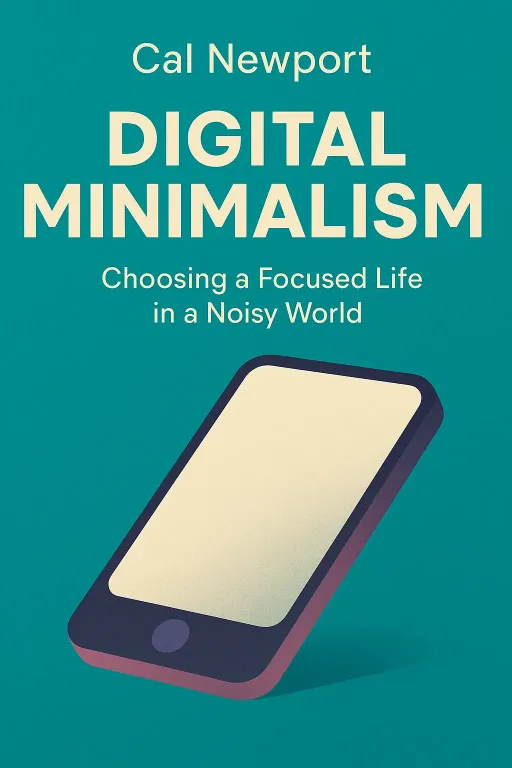
Nova: Exactly! And that feeling of constant motion without true progress is precisely what we're dissecting today, thanks to the brilliant insights of. He’s a computer science professor at Georgetown University, and he's not just another self-help guru; he's bringing a rigorous, academic lens to our digital habits and, more importantly, how we can do it better.
Atlas: That’s a great way to put it. So, he's got the research and the logic to back up these ideas, which is what our audience, the clear-minded innovators, really appreciates. It's not just a feeling, it's a phenomenon.
Nova: Absolutely. And he fundamentally challenges this assumption that more technology equals more progress, revealing the hidden costs of constant digital engagement. It's time to intentionally step back.
The Illusion of Constant Connection: Unpacking the 'Always On' Trap
SECTION
Nova: So, let's dive into what Newport calls the 'always-on' trap. We've all been conditioned to believe that constant connection is synonymous with productivity, right? The more emails we answer, the quicker we respond to messages, the more available we are, the better we're doing. But what if that belief is actually sabotaging our ability to do truly meaningful work?
Atlas: Wait, you're saying that even if I busy, I might not be productive? That sounds a bit counterintuitive for anyone in a fast-paced environment. I imagine a lot of our listeners in high-pressure roles feel immense pressure to be constantly available.
Nova: That's the illusion! Think of your brain like a computer. Every time you switch tasks – from an email to a report, then a quick social media check, then back to the report – you're dealing with what's called 'context switching.' It's like having twenty tabs open at once. Each tab takes a little bit of your processing power, slows everything down, and leaves you with what Newport describes as 'mental clutter.'
Atlas: So, it's not just the spent on distractions, but the of interrupting your flow? Like, my brain has to reboot for every new task?
Nova: Precisely. That constant mental clutter prevents deep work and genuine reflection. Deep work, as Newport defines it in his book, is the ability to focus without distraction on a cognitively demanding task. It's essential for mastering complex information, for creating high-quality results. When you're "always on," your brain never gets the chance to achieve that state. You feel drained and scattered, often without understanding why.
Atlas: That makes sense. I can definitely relate to that feeling of being busy all day but looking back and thinking, "What did I actually that truly moved the needle?" It often feels like I'm just putting out fires instead of building something.
Nova: Exactly! And this isn't just about personal well-being; it has huge implications for innovation and creativity. If you’re constantly bouncing between shallow tasks, you never have the sustained focus required to solve complex problems or come up with truly novel ideas. You're stuck in reactive mode.
Reclaiming Focus: The Power of Intentional Disconnection and Deep Work
SECTION
Atlas: Okay, so we've identified the problem – this pervasive "always-on" trap that leaves us feeling scattered. How do we actually this without just abandoning technology altogether and moving to a cabin in the woods? Because for our listeners, that's not exactly a practical solution.
Nova: That's a perfect question, Atlas, because Newport is not advocating for Luddism. He's advocating for intentionality, which he outlines beautifully in his book,. This isn't about throwing out your smartphone; it's about being more thoughtful about and you use your digital tools.
Atlas: So, it's like a strategic diet for your tech use? You're not cutting out food entirely, but you're being very deliberate about what you consume and why?
Nova: That's a great analogy! Digital Minimalism is a philosophy of technology use where you focus your online time on a small number of carefully selected and optimized activities that strongly support things you value, and then happily miss out on everything else. It’s about cultivating a life where technology serves goals, rather than you serving demands.
Atlas: That gives me chills. That sounds like a superpower for personal mastery. But how does someone actually this without feeling like they're falling behind or missing out on crucial information in their highly connected roles?
Nova: It often starts with a period of intentional disconnection. Newport suggests a "digital declutter," where you take 30 days away from optional technologies. During this time, you observe what truly brings value and what you genuinely miss. From there, you reintroduce technology, only bringing back what serves a deep value. This clears the mental clutter and allows for deep work.
Atlas: Wow. So, it's not just about willpower; it's about redesigning your relationship with technology. And then, once you've decluttered, you make space for that "deep work" concept we talked about earlier.
Nova: Precisely. Deep work is the concentrated, uninterrupted time where you're fully immersed in a task. Think of a surgeon performing a delicate operation, or a writer crafting a novel. They can't be constantly checking their phone. Newport illustrates how consistently scheduling these deep work blocks, creating a ritual around them, can drastically improve the quality and quantity of your output. It's about training your focus like a muscle.
Atlas: That’s actually really inspiring. For our audience, who are often innovators and thinkers, this sounds like the key to unlocking their next big idea. It’s about creating the mental space for true creativity.
Synthesis & Takeaways
SECTION
Nova: So, what we’re really talking about here isn't just a productivity hack; it's a fundamental shift in how we approach our lives in a hyper-connected world. It's about understanding that true value and impact come from focused, intentional engagement, not from the frantic pace of constant digital noise.
Atlas: Exactly. It's about realizing that the most powerful thing we can do for our well-being and our output isn't to add more apps or tools, but to subtract the noise and create space for what truly matters. It’s about reclaiming our most valuable asset: our attention.
Nova: And it leads us to a really deep question, one that Newport poses and we want to leave our listeners with today: What specific digital activity could you intentionally remove for just one week to observe its impact on your focus and well-being?
Atlas: That’s a powerful challenge. Just one week. I encourage everyone listening to try it. Pay attention to what changes. We'd love to hear what you discover.
Nova: It's incredible how much clarity and focus you can reclaim with even a small, intentional step back.
Atlas: Absolutely. This is Aibrary. Congratulations on your growth!









