

** The Experience Dividend: Redefining Productivity to Die with Zero
Golden Hook & Introduction
SECTION
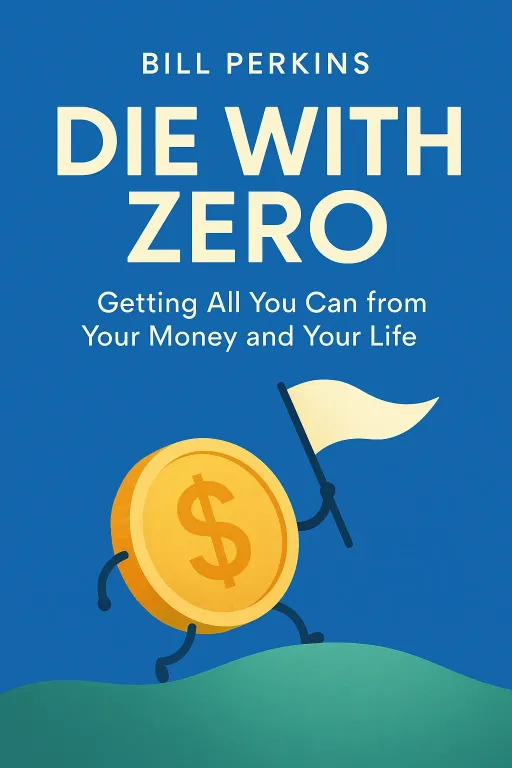
Nova: What if I told you that one of the biggest financial mistakes you can make is… dying with too much money? It sounds absurd, right? We're all taught to save, save, save. But author Bill Perkins argues in his book 'Die with Zero' that every dollar you don't spend is a tragic waste of the life energy you spent earning it. He says the goal isn't to accumulate wealth, but to accumulate experiences. This isn't just about spending more; it's about a radical re-engineering of your life's productivity.
Kerubo: It’s such a provocative starting point. It completely flips the script on what we define as a "successful" life. We measure net worth, not net fulfillment. The idea that being 'too good' at saving could actually be a life strategy failure is, from an analytical perspective, just fascinating.
Nova: It really is. And that's exactly what we're going to get into. Today, we're going to tackle this book from two powerful perspectives. First, we'll explore the 'Experience Dividend' and how to redefine your life's ROI. Then, we'll discuss the radical idea of planning your 'Personal Peak'—the exact time you should stop saving and start living. Kerubo, as someone who loves analyzing new frameworks, I can't wait to dive into this with you.
Kerubo: I'm ready. It feels like we're about to perform a system update on some very old, very ingrained programming about money and life.
Deep Dive into Core Topic 1: The Experience Dividend
SECTION
Nova: Exactly! Let's start with the core idea that powers this whole philosophy: investing in experiences. Perkins tells a fantastic story about this from his youth, and it really sets the stage. Imagine this: it's the early 1990s in Manhattan. Perkins and his roommate, Jason Ruffo, are in their early twenties, living in a tiny apartment, both working as screen clerks and making about eighteen thousand dollars a year. They're barely scraping by.
Kerubo: Okay, I can picture it. Young, broke, and in New York City. The classic starting point for many stories.
Nova: Precisely. Now, one day, Jason comes up with what sounds like a completely insane plan. He wants to take three months off to go backpacking through Europe. The problem, of course, is he has no money. So what does he do? He goes to a loan shark and borrows the money at a ridiculously high interest rate.
Kerubo: Wow. Okay, from a purely financial standpoint, that is a terrible, terrible decision. High-interest debt for a non-essential purchase. Every personal finance book would have a heart attack.
Nova: Every single one! Perkins thought his friend was nuts. But Jason went. He traveled through London, Germany, Paris, the Greek islands. He visited the Dachau concentration camp, which he said was a profound experience. He met locals, fell in love for the first time on a beach... he truly lived. He came back three months later, got his job back, and was no worse off financially in the long run. But Perkins, who had stayed behind and been 'responsible,' was filled with this deep sense of regret and envy.
Kerubo: I can see why. He missed out.
Nova: He missed out. And years later, Jason said, "Whatever I paid, I feel it was a bargain because of the life experiences I gained. You can’t take those away, and I would never have them erased for any amount of money." That's the core of the first big idea.
Kerubo: That's such a powerful illustration of asymmetric risk, but applied to life, not just finance. The downside for Jason was temporary debt, which he could and did recover from. But the upside was a lifetime of memories, stories, and personal growth. The potential gain was almost infinite, and the potential loss was finite and manageable.
Nova: That's the perfect way to put it. Perkins gives this a name: the 'memory dividend.' He says material things, like a fancy car, start depreciating the second you buy them. But experiences? They pay you dividends for the rest of your life. Every time you remember the trip, tell a story about it, or look at a photo, you are cashing a dividend check of joy, nostalgia, and connection.
Kerubo: So, from a productivity standpoint, an experience is an asset that generates passive income, but the income is happiness. A new watch is a depreciating asset in every sense. An unforgettable trip, on the other hand, appreciates in value every time you share the story. It’s a total paradigm shift in how we should value our spending.
Nova: It really is. You're not just 'spending' money on a vacation; you're in your future happiness. You're building a portfolio of memories that will sustain you, especially, as Perkins points out, when you're older and your health might prevent you from having new, adventurous experiences.
Kerubo: It reframes the whole concept of an asset. An asset is something that provides future benefit. We've just been trained to think that benefit can only be measured in dollars and cents. Perkins is arguing for a different kind of balance sheet for our lives.
Nova: A balance sheet of memories. I love that. But it begs a question, doesn't it? If we're supposed to be investing in experiences, how do we know when we have enough money to do that? When can we take our foot off the gas?
Kerubo: Right. How do you balance investing in memories with the very real need to, you know, pay for a roof over your head in the future?
Deep Dive into Core Topic 2: Your Personal Peak
SECTION
Nova: A total paradigm shift! And that leads us to the next, even more radical idea. If experiences are the goal, how do we know when we have enough money them? This is where Perkins introduces the concept of your 'Net Worth Peak'.
Kerubo: Okay, this sounds very analytical. My curiosity is piqued.
Nova: It is! He argues that for most people, there is a specific age—a date on the calendar, not a dollar amount—when their net worth should be the highest it will ever be. He suggests this is typically between 45 and 60. After that point, you should no longer be focused on accumulation. You should begin a phase of strategic 'decumulation'—actively spending your money down to, you guessed it, die with zero.
Kerubo: It sounds crazy, right? To plan the moment your wealth should start. It goes against every instinct we have about security and growth.
Nova: It does. And he uses another powerful story to show the danger of not doing this. He talks about his former colleague, John Arnold, who is a legendary energy trader. When they were starting out, Arnold told Perkins, "Once I make 15 million dollars, if I’m still trading, punch me in the face."
Kerubo: A clear goal. A finish line.
Nova: You'd think so. But then he hit 15 million. And the goalpost moved. Then it was 25 million. Then 100 million. He was so good at the game of accumulation that he couldn't stop playing. He eventually retired at age 38, but by then his net worth was over 4 dollars.
Kerubo: That's a problem most of us would like to have, but I see the point.
Nova: Exactly. Arnold himself later admitted he had "worked past the point of optimal utility" of his money. He had so much money he couldn't possibly spend it in a way that would bring him proportional joy, and he'd sacrificed years of his life in the process—years he could have spent having experiences when he was younger. He won the game, but he kind of missed the point of playing.
Kerubo: This is fascinating. It treats life like a project with a finite timeline and a resource curve. In any well-run project, you have an accumulation phase for resources—budget, materials, team members. But then you have a deployment phase, where you use those resources to build the thing you set out to build. What Perkins is saying is that most of us stay in the accumulation phase for our entire lives and never properly deploy our resources—our money, our time, and our health.
Nova: And that's the key trio, isn't it? Money, time, and health. When you're young, you have time and health, but no money. In middle age, you might have money and health, but no time. And when you're old, you might have money and time, but no health. The 'Net Worth Peak' is about finding that sweet spot to start deploying your money before your health declines and you can no longer enjoy the experiences you saved for.
Kerubo: It's the ultimate productivity hack, in a way. It forces you to define 'enough' and then build a plan to actively what you've built, rather than just admiring it in a bank account. It's about shifting the primary metric of your life's dashboard from 'net worth' to 'net fulfillment'. It’s a much more active, engaged way of living.
Nova: You become the CEO of your life, not just a passive employee.
Kerubo: Exactly. You're making strategic decisions about resource allocation to maximize the final output, which is a well-lived life. It’s a beautiful, logical framework when you think about it that way.
Synthesis & Takeaways
SECTION
Nova: It really is. So, as we wrap up, we have these two powerful, interconnected ideas from "Die with Zero." First, we need to think of experiences as investments that pay a 'memory dividend' for the rest of our lives.
Kerubo: And second, we need to strategically plan for a 'net worth peak'—a point where we consciously shift from accumulating money to deploying it, to ensure we actually get to enjoy the fruits of our labor before it's too late.
Nova: It's about being an active, strategic CEO of your own life, not just a passive employee saving for a future that's not guaranteed. It's a profound shift in mindset.
Kerubo: It is. It’s about taking the same analytical rigor we might apply to our careers or our finances and applying it to our own happiness and fulfillment.
Nova: It's a lot to think about, but it's so important. So, for everyone listening, we want to leave you with one question, inspired by this book: What is one experience—big or small—that you've been putting on the back burner, waiting for the 'right time'?
Kerubo: And what's one small step you could take this week to start making it a reality? Maybe it's researching the flight. Maybe it's calling the friend. Maybe it's just putting a dollar in a jar. But it's about starting that shift from passive saving to active living.
Nova: A perfect thought to end on. Thank you so much for this, Kerubo. This was an incredibly insightful conversation.
Kerubo: Thank you, Nova. It was a pleasure to analyze such a life-changing idea.









