Re evaluating Reason and Meaning in a High Speed Era
Golden Hook & Introduction
SECTION
Nova: You can track your sleep, your daily steps, your caloric intake, and your focus cycles with surgical precision. You can build a system for every single hour of your Tuesday. And yet, there is a lingering, persistent feeling that the more you optimize, the less you actually feel.
Atlas: That hits home. It is the paradox of the modern high-performer. We are constantly building these elaborate frameworks to manage our lives, but sometimes it feels like we are just managing a machine rather than living a life. It is like we are so busy polishing the lens that we forget to look at the view.
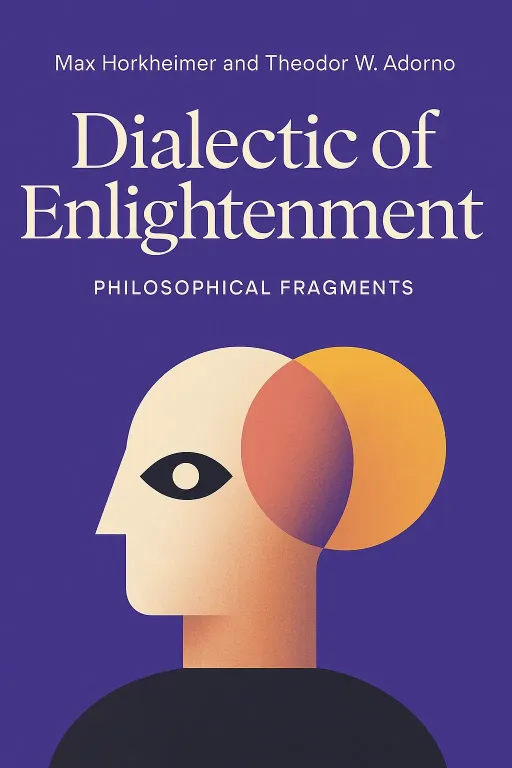
Nova: That tension is exactly where we find ourselves today. We are looking at two heavy hitters of twentieth-century thought who tackled this exact problem from different directions. We are diving into the critique of instrumental reason found in Dialectic of Enlightenment by Max Horkheimer and Theodor Adorno, and then we are going to pivot to the radical, immediate reality described by Karl Barth in his work, God Here and Now.
Atlas: Those are two very different worlds colliding. Horkheimer and Adorno were writing from a place of profound cultural critique, wrestling with how the Enlightenment—which promised to liberate us—ended up creating these massive, crushing systems of control. And then you have Karl Barth, who brings this intense, almost disruptive theological perspective to the table. It is an interesting pairing for someone who is trying to balance technical mastery with actual human meaning.
Nova: It is the perfect pairing because both of these works challenge the idea that we can solve the problem of existence purely through better systems or more rigid frameworks. Horkheimer and Adorno were writing in the shadow of the Second World War. They saw how the same rational, scientific mind that could cure diseases could also be turned toward industrial-scale destruction. They were looking at the dark side of progress, specifically how we treat the world as something to be calculated, measured, and ultimately, dominated.
Atlas: I can see why that resonates with the strategist mindset. We love to calculate and dominate our environments. We want to master the variables. But the warning here is that when you treat your own life like a project to be managed, you might accidentally turn yourself into an object to be managed, too.
Nova: Exactly. Let’s dig into that first piece of the puzzle.
The Trap of Instrumental Reason
SECTION
Atlas: Okay, so let’s get specific. What is this concept of instrumental reason? I hear that term and I think of someone using a tool to get a job done. That sounds productive. Why would Horkheimer and Adorno have a problem with that?
Nova: It is not the tool itself that is the problem. It is the shift in how we view the world. Instrumental reason is the mode of thinking that asks, how can I use this to get what I want? It reduces everything—nature, other people, and even our own time—into a means to an end. It is the ultimate efficiency mindset.
Atlas: That sounds like every corporate strategy meeting I have ever been in.
Nova: Precisely. And in a vacuum, efficiency is a virtue. But Horkheimer and Adorno argue that when this becomes the dominant way we engage with reality, we lose the ability to see the inherent value in things. Think of a forest. If you are using instrumental reason, you do not see a complex, living ecosystem. You see timber. You see board feet. You see a resource to be optimized.
Atlas: I see that in my own work. When I am looking at a complex problem, my first instinct is to break it down into data points, KPIs, and deliverables. It is a way of creating order. But I can see the danger you are pointing toward. If I only see the project as a collection of metrics, I am missing the human element. I am missing the actual people involved, or the creative spark that does not fit into a spreadsheet.
Nova: You hit on the crucial point. The danger is that we start to view ourselves through that same lens. We begin to treat our own lives as a collection of inputs and outputs. If my output is low, I must be broken. I need to optimize my routine. I need a new app. I need a better framework. We become both the manager and the managed, and we lose that sense of spontaneous, uncalculated meaning.
Atlas: That is the core of the burnout cycle, isn't it? We push ourselves to be more efficient, but we are not actually becoming more fulfilled. It is like we are running faster and faster on a treadmill, but the treadmill is not actually moving us toward a destination. It is just keeping us busy.
Nova: Yes, and Horkheimer and Adorno would argue that this is a form of social control. When everything is standardized, when every experience is categorized and measured, we lose the capacity for critical thought. We just follow the system. We become part of the machinery.
Atlas: That is a sobering thought. It makes me wonder, how do we break out of that? If we are so deeply embedded in a system that values efficiency above all else, how do we reclaim that sense of meaning? Is it just about quitting the system?
Nova: That is the big question. And it brings us to the second part of our discussion. It is not necessarily about abandoning the system entirely, because we have to live in the world. It is about how we relate to the reality we are in. And that is where Karl Barth comes in.
Confronting Transcendent Reality
SECTION
Atlas: I have heard the name Karl Barth, but I am not as familiar with his specific take on this. How does he offer a counterpoint to the efficiency trap?
Nova: Barth was a theologian, but his work in God Here and Now is deeply relevant even if you strip away the religious context. He was obsessed with the idea of the event. He believed that reality is not something we can capture in a box or a dogma. It is something that happens to us. It is an encounter. He argued against rigid, static constructs. He wanted people to confront the immediate, transcendent reality of existence.
Atlas: That sounds like the opposite of the spreadsheet approach. Instead of trying to predict or measure the world, you are suggesting we just show up to it?
Nova: Exactly. Think about the difference between a map of a city and actually walking the streets of that city. The map is useful. It is a framework. It is the instrumental reason we talked about earlier. You need the map to navigate. But the map is not the city. The city is the smells, the sounds, the unexpected conversations, the way the light hits a building at four in the afternoon. Barth is saying, don't mistake the map for the city.
Atlas: That is a powerful distinction. For someone who loves blueprints—and I do—that is a hard pill to swallow. I want the map to be the reality. I want to know exactly what is around the corner because it makes me feel safe. It makes me feel in control.
Nova: And that is the human temptation, right? We want to turn the mystery of life into a solved problem. We want to turn the living, breathing encounter into a set of rules. But Barth would say that when we do that, we are actually closing ourselves off from the very thing that makes life meaningful. We are prioritizing our control over the actual experience of being alive.
Atlas: I can see that in my own life. When I am planning a project, I am so focused on the outcome that I often miss the process. I am so focused on the goal that I miss the lessons I am learning along the way. I am living in the future, in the hypothetical, instead of the here and now.
Nova: That is it. That is the bridge between these two thinkers. Horkheimer and Adorno show us the danger of the system—the way we reduce our lives to data. Barth shows us the alternative—to engage with the immediate, unfolding event of life, without trying to force it into our pre-existing boxes.
Atlas: So, how do we apply this? If I am an architect—metaphorically speaking—building my life, I need a structure. I need a plan. I cannot just wander around in the "event" of life without any direction. I would never get anything done. How do I balance the need for structure with the need for this kind of open, immediate experience?
Nova: It is about intent. It is about how you hold your plans. You can have a blueprint, but you have to be willing to tear it up when the reality of the situation demands it. You have to treat your plans as a servant to your life, not the master of it.
Atlas: I like that. The plan as a servant, not a master. That changes the dynamic. It means the plan is there to support the life I am living, not to dictate it.
Nova: Precisely. And it means leaving room for what Barth might call the encounter. It means building in time for the unplanned, for the conversation that goes off-script, for the experience that cannot be measured or optimized. It means acknowledging that the most important parts of your life are the ones that you cannot put on a spreadsheet.
Atlas: That feels like a shift from a "closed" system to an "open" one. In a closed system, you are trying to minimize risk and maximize efficiency. In an open system, you are maximizing the capacity for experience and growth, even if that means things get a little messy or unpredictable.
Nova: That is a perfect way to put it. We often think that complexity is something to be reduced, but maybe complexity is something to be embraced.
Synthesis & Takeaways
SECTION
Atlas: This has been a fascinating journey. We started with the danger of turning our lives into a series of metrics and efficiency problems, and we ended with the idea of engaging with the immediate, unscripted reality of the present moment. It feels like the challenge is to be a builder who knows when to put down the tools.
Nova: That is exactly the challenge. The goal is to build a life that has a strong foundation—because you do need that—but to build it in a way that allows the light to get in. You want to be a person who is capable of analytical rigor, who can solve problems and build systems, but who is also capable of standing still and experiencing the world as it is, not just as a set of variables.
Atlas: I think for our listeners, the takeaway here is to look at their own "blueprints." Where are they trying to over-control? Where are they trying to force their lives into a pre-defined shape? Maybe the next step is to find one area of their life where they can let go of the optimization and just be present.
Nova: I love that. It is a practical, almost radical act of rebellion against the pressure to optimize everything. It is a way of saying, my life is not a project to be managed. It is an experience to be lived.
Atlas: And that is a foundation that actually lasts. It is not a structure that is brittle and rigid, but one that is flexible and alive.
Nova: That is the ultimate goal of wisdom, isn't it? To build something that holds up under pressure but remains open to the unexpected.
Atlas: I am definitely going to take that with me into the rest of my week. I have a few projects on my desk that feel very rigid right now, and I think I am going to try to approach them with a bit more of this "Barthian" spirit of openness.
Nova: That is the best way to honor these ideas. It is not about agreeing with everything, but about letting these thoughts change the way you see the world. It is about taking that step back from the constant rush and asking, is this how I want to be living?
Atlas: And that is a question that never gets old. Thank you for walking through this with me. It was a lot to untangle, but I feel like I have a much clearer sense of what it means to be a "purposeful seeker" in a high-speed world.
Nova: It was a pleasure to explore this with you. We have covered a lot of ground, from the shadows of the twentieth century to the immediate reality of today. But the most important part is what you do with these ideas next.
Atlas: I am ready to get to work—but maybe with a little more room for the unexpected.
Nova: That is the way to do it. This is Aibrary. Congratulations on your growth!