Deconstructing Systems to Cultivate Autonomy
Golden Hook & Introduction
SECTION
Nova: We are obsessed with the idea that if we just optimize our systems enough, we will finally be free. We track our habits, we automate our email replies, we batch our tasks. But there is a hidden cost to this relentless pursuit of efficiency.
Atlas: That sounds like a pitch for a productivity app, but I have a feeling you are going to tell me that the app is actually the problem.
Nova: Exactly. We are building prisons for ourselves and calling them workflows. Today, we are going to deconstruct this obsession with control by looking at two very different books that, when put together, reveal a massive blind spot in how we lead our teams and manage our own lives.
Atlas: I am intrigued. Which books are we smashing together today?
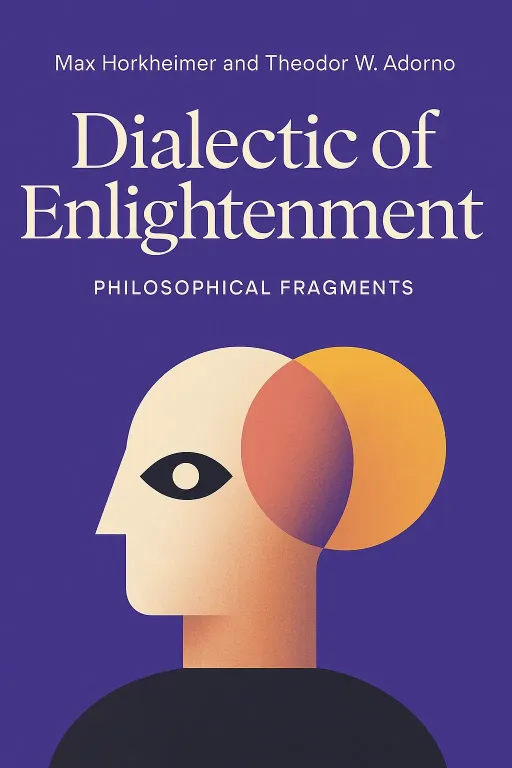
Nova: We are starting with a heavy hitter, Dialectic of Enlightenment by Max Horkheimer and Theodor W. Adorno. And we are pairing it with a surprisingly revolutionary guide, The Montessori Toddler by Simone Davies.
Atlas: Hold on. You are putting a dense, mid-20th-century critique of Western civilization in a room with a book about how to deal with a two-year-old who refuses to eat their peas? That feels like a collision of worlds.
Nova: It is, but that is where the insight lives. Horkheimer and Adorno were writing in the mid-1940s, fleeing Nazi Germany, trying to understand how a civilization that prided itself on reason and logic could descend into total barbarism. They argued that we have become so focused on instrumental reason—meaning, using logic purely as a tool to control nature and people—that we have lost our actual freedom.
Atlas: So, they are saying our desire to control everything is actually what is making us slaves to the system?
Nova: Precisely. And that is why Simone Davies’ work is the perfect counterpoint. She is not talking about political theory; she is talking about 'prepared environments.' She argues that if you want a child to grow, you do not control them; you control the environment so they can exercise their own agency.
Atlas: I see where this is going. We are trying to manage our teams like we are controlling a factory, when we should be designing environments like we are cultivating a garden.
The Trap of Instrumental Reason
SECTION
Nova: You hit the nail on the head. Let’s dig into the Horkheimer and Adorno side first. They talk about this concept of the Culture Industry, where everything becomes a commodity. In a professional context, we often treat our team members like cogs in a machine. We think, if I just add this new project management software, or this new KPI tracking system, or this new meeting cadence, the output will increase.
Atlas: That is the daily reality of every manager I talk to. They think the system is the solution. But what is the specific trap Horkheimer and Adorno are warning about?
Nova: The trap is that the system becomes the goal. When you prioritize the system over the human, you get what they called the 'administered world.' In an administered world, there is no room for the unexpected, for creativity, or for genuine human connection. Everything is predictable. Everything is measurable. And the moment you make everything measurable, you kill the very things that make a business truly resilient—intuition, risk-taking, and autonomy.
Atlas: This resonates with anyone who has ever sat in a meeting that was purely about tracking the progress of other meetings. It is the illusion of productivity. We feel like we are doing work because we are managing the system, but we are actually just creating more friction.
Nova: Exactly. And the danger is that we start to view ourselves through that same lens. We become instrumentalists of our own lives. We ask, how can I optimize my sleep? How can I optimize my diet? How can I optimize my networking? We lose the ability to just be, or to do something simply because it is meaningful, not because it is efficient.
Atlas: That is a harsh mirror to look into. I think a lot of our listeners are high-performers who have spent their entire careers trying to optimize their way to the top. Are you saying that by being 'efficient,' we are actually eroding our own agency?
Nova: I am saying that when you treat your life as a project to be optimized, you are the project manager and the product. You are trapped in your own factory. Horkheimer and Adorno would argue that true enlightenment—or true growth—requires us to step outside of that cycle of constant calculation. We need to stop asking 'what is the most efficient way to do this' and start asking 'what is the most authentic way to engage with this.'
Atlas: Okay, but let’s play devil’s advocate for a second. If I stop optimizing, if I stop tracking my KPIs, if I let go of that control, won’t the whole thing fall apart? Isn’t structure necessary for growth?
Nova: That is the perfect transition. Structure is necessary, but the of structure matters. This is where Simone Davies enters the chat.
The Architecture of Autonomy
SECTION
Atlas: Right, let’s bring in the toddler expert. How does someone who manages two-year-olds teach a high-level strategic architect how to lead?
Nova: Because Davies understands something that most corporate leaders miss: the difference between 'control' and 'enablement.' In the Montessori philosophy, the teacher is not a dictator; they are a designer. They design the environment—the shelves, the tools, the flow of the room—so that the child can succeed without the teacher having to hover over them.
Atlas: So, instead of standing over the child saying 'do this, do that,' you change the room so the child naturally knows what to do?
Nova: Exactly. It is about removing the obstacles to autonomy. If a child keeps making a mess because the water pitcher is too heavy, the Montessori approach is not to punish the child or set a rule saying 'no water.' It is to find a smaller, lighter pitcher that the child can handle. You change the system to empower the user.
Atlas: That is a massive shift. In a corporate environment, when a team member fails, the standard response is to add more rules, more oversight, more check-ins. You are saying we should be looking at the 'pitcher.' We should be looking at the environment to see what is making the task impossible.
Nova: Yes. Think about the 'structural constraints' we impose. We set up meetings that are too long, or we use software that is too complex, or we create hierarchies that force people to ask for permission for basic tasks. These are the heavy pitchers. When you have a team of smart, capable people, and you force them to navigate an environment that limits their agency, you are not creating order. You are creating dependency.
Atlas: I love this analogy. It changes the role of the leader from 'controller' to 'architect.' An architect doesn't build the house for the people to live in; they build the house so the people can live their lives.
Nova: That is a brilliant way to put it. When you act as an architect of your team's environment, you are giving them the autonomy they need to excel. You are trusting that they are capable of self-correction. And here is the link back to Horkheimer and Adorno: by creating a space where people can be autonomous, you are actively resisting the 'administered world.' You are creating a pocket of humanity where the individual matters more than the system.
Atlas: So, how do we actually do this? Let’s get practical. If I am a leader in a high-pressure environment, how do I apply this 'prepared environment' concept without causing chaos?
Synthesis & Takeaways
SECTION
Nova: You start by auditing your daily professional environment. Identify one structural constraint that limits your team's autonomy. Is it a approval process that takes three days? Is it a mandatory meeting that could be an email? Is it a software tool that everyone hates using?
Atlas: And instead of just complaining about it, I need to treat it like a design problem. I need to ask, 'what is the smallest, lightest pitcher I can give them?'
Nova: Exactly. Replace that constraint with a self-correcting, organic framework. For example, instead of requiring approval for every single budget decision, set a clear 'spending lane'—a dollar amount they can spend without asking you. You have created an environment where they can succeed on their own.
Atlas: That is a fantastic example. It is a win-win. They get autonomy, and you get time back because you are not micromanaging expenses.
Nova: And you are also signaling trust. Horkheimer and Adorno were right to be skeptical of systems that prioritize efficiency over humanity. But they did not give us a blueprint for how to live differently. Davies gives us that blueprint. By focusing on the environment, we can build systems that actually support human freedom rather than constraining it.
Atlas: It sounds like the path forward is to be a bit more humble about our role as leaders. We are not the ones who should be 'doing' the work. We should be the ones who ensure the work can be done well by others.
Nova: That is the ultimate growth mindset. It is about letting go of the ego of control and stepping into the role of the designer. It is about realizing that the most powerful thing you can do is not to build a bigger cage, but to open the door and make sure the room is ready for people to thrive.
Atlas: This has been a fascinating shift in perspective. From the dark, heavy critique of the 1940s to the practical, sunny wisdom of a modern classroom, the thread is the same: trust the human.
Nova: Precisely. And for our listeners, the challenge is simple. Audit your space. Find one thing that is making people act like cogs, and change it so they can act like creators.
Atlas: I am definitely going to look at my team’s workflow this week with that 'prepared environment' lens. It is going to be a much more interesting exercise than just checking off tasks.
Nova: That is exactly what we want to hear. Thank you for joining us in this exploration. Remember, the goal is not just to build a better system, but to build a better experience for everyone within it. This is Aibrary. Congratulations on your growth!