Critiquing the Systems We Inhabit
Golden Hook & Introduction
SECTION
Nova: The feeling that you are an imposter is not a glitch in your professional life. It is a feature of the system you are working in. Most of the pressure you feel to perform, to standardize your output, and to constantly prove your worth is actually a direct result of the environment that modern society has constructed for us.
Atlas: That is a heavy way to start, but I can see why it resonates. We are constantly told to fix our mindset, to build better habits, or to adopt a new morning routine to silence that inner critic. But you are suggesting that the critic is just responding to a very specific, very loud external signal.
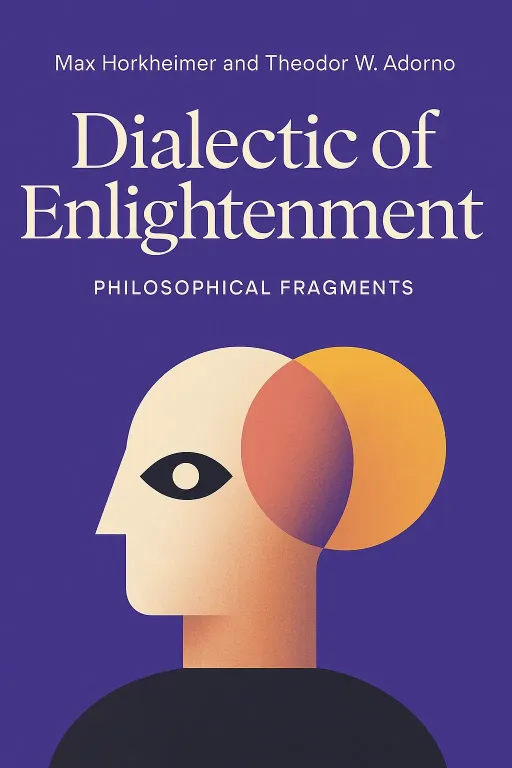
Nova: Exactly. We are looking at this through the lens of two very different but complementary texts. We are diving into The Dialectic of Enlightenment by Max Horkheimer and Theodor W. Adorno, and we are pairing that with Michael Newman’s Socialism. Horkheimer and Adorno were writing from a place of deep concern during the mid-twentieth century, as they watched how the tools meant to liberate us—like technology and rational planning—began to reshape our culture into something that demands total conformity. They were key figures in the Frankfurt School, and their work basically acts as a warning label for the modern age.
Atlas: And Newman’s book on Socialism? That usually conjures up images of parliaments and economic policies, not personal fulfillment or creative architecture.
Nova: That is the beauty of it. Newman deconstructs the history of social movements not just as a political history, but as a long, human attempt to solve the very problems that Horkheimer and Adorno identified. It is about how we use collective cooperation to push back against the crushing weight of a system that prioritizes efficiency over humanity.
The Trap of Instrumental Reason
SECTION
Atlas: I am curious about how these two fit together. Horkheimer and Adorno seem like heavy-duty philosophers, and Newman is dealing with the mechanics of social movements. How do they actually connect to the person sitting at their desk, trying to design a building or write a proposal, feeling like they are not quite measuring up?
Nova: Consider the concept of instrumental reason. Horkheimer and Adorno argued that we have become obsessed with the "how" of things. We have become incredibly efficient at solving problems, but we have completely lost sight of the "why." We treat everything, including our own human potential, as a resource to be optimized. When you are working, you are not just a person creating something; you are a unit of production. The system rewards you for being predictable and efficient.
Atlas: That sounds like the corporate world in a nutshell. I have been in rooms where the conversation is entirely about metrics, deliverables, and optimization. Nobody ever stops to ask if the thing we are building actually adds value to the human experience. We just want to know if it fits the quarterly goals.
Nova: That is the exact trap. When you operate in that environment, your personal self-doubt is not a sign that you are failing. It is a sign that you are trying to be a human being inside a machine that only values your output. Horkheimer and Adorno saw this coming. They observed that culture itself—art, music, even the way we design our cities—has become standardized. Everything is designed to be consumed easily, to be measured, and to be replicated.
Atlas: This reminds me of the way modern architecture feels sometimes. You walk into a new office building or a housing complex, and it feels like it was generated by an algorithm designed to maximize square footage and minimize cost. It serves the system perfectly, but it feels empty.
Nova: That is a perfect example. If you are an architect or a creator, you feel the tension between your desire to create something meaningful and the system’s demand for something efficient. That tension creates the imposter syndrome. You think, "I am not good enough because I cannot make this standardized thing feel alive." But the reality is that the system makes it impossible for the thing to be alive in the first place.
Atlas: So, you are saying that the anxiety I feel when I cannot force my creative work to fit into a rigid, optimized box is actually a healthy reaction?
Nova: It is a profound reaction. It means you are still connected to your humanity. The moment you stop feeling that tension is the moment you have fully surrendered to the system. The goal is not to eliminate that anxiety; the goal is to understand it as a signal that the environment you are in is hostile to your creative truth.
Atlas: That puts a completely different spin on the advice to just "work harder." If the system is the problem, then working harder just makes you a more efficient cog in a machine that you don't even like.
The Collective Antidote
SECTION
Nova: And that brings us to the second piece of the puzzle: Michael Newman’s work. If Horkheimer and Adorno identify the problem—the crushing weight of instrumental reason and standardization—Newman provides the historical context for how we have tried to fight back. He explores the evolution of social movements. While we often think of these movements in terms of government policy, they are really about the human need for collective cooperation.
Atlas: I can see that. But how does collective cooperation help someone who is struggling with their own creative fulfillment? It feels like a massive jump from "I feel like an imposter at work" to "I need to join a social movement."
Nova: The jump is not as wide as you might think. When you feel alone in your struggle, the system wins. It wants you to believe that your success or failure is entirely your own responsibility. It wants you to believe that if you are not flourishing, it is because you are not smart enough, not talented enough, or not disciplined enough.
Atlas: That is the classic individualistic trap. We are taught that if we just optimize our own lives, we will be happy.
Nova: Exactly. But Newman highlights that the most significant progress in human history—whether it is labor rights, civil rights, or urban planning improvements—did not happen because one individual optimized their life. It happened because people realized that their problems were shared. They moved from competition to cooperation.
Atlas: So, you are suggesting that instead of trying to "hack" my way out of this feeling of inadequacy, I should be looking for ways to connect with others who are fighting the same battle?
Nova: That is the core of it. Think about the "conscious creator" profile. You are looking for impact. You want to align your work with your personal truth. The system will try to isolate you. It will make you compete with other architects, other designers, other writers for the same limited pool of recognition. That competition keeps you focused on the "standard." It keeps you worried about whether you are keeping up with the competition.
Atlas: I have definitely felt that. You look at what everyone else is doing, and you feel like you have to copy their style or their process to stay relevant. It is a race to the bottom of homogenization.
Nova: And what happens when you decide to stop running that race? When you decide that your work is not about competing for a spot on a leaderboard, but about contributing to a larger, more meaningful dialogue? That is when you start to reclaim your agency. You stop asking, "How can I be better than them?" and you start asking, "How can we build something that actually matters?"
Atlas: That feels like a massive shift in perspective. It moves the focus from "I am not enough" to "What are we trying to build together?" It is much less lonely.
Nova: It is also much more sustainable. The system is designed to burn you out. It wants you to give everything you have until you are exhausted, and then it wants you to be replaced by someone younger and cheaper. But when you root your work in community and shared purpose—when you align with others who value depth over efficiency—you build a support system that can withstand the pressure.
Atlas: I am thinking about how this applies to someone who is just trying to get through their daily tasks. If I am an architect or a designer, I can't just dismantle the global economy. I have to work within the systems that exist. How do I apply this "collective" mindset when I am sitting at my desk, alone, facing a deadline?
Nova: You start by rejecting the premise that you are alone. Even if you are physically alone, you can choose to work in alignment with values that are bigger than your current project. You can seek out collaborators who prioritize the same things you do. You can mentor others. You can share your process openly instead of hoarding it. You can build a small, intentional community of peers.
Atlas: That makes sense. It is about creating a sub-culture within the system. You are essentially building a pocket of resistance where you can breathe.
Nova: You hit the nail on the head. Resistance does not always mean tearing the building down. Sometimes it means designing a room inside that building that operates by a different set of rules.
Synthesis & Takeaways
SECTION
Atlas: This has been a fascinating journey. We started with the idea that our self-doubt is a systemic issue, not a personal failure. We looked at how Horkheimer and Adorno warned us about the dangers of instrumental reason—that constant, grinding push for efficiency—and how that leads to a standardized, soulless output. And then we looked at Newman’s take on how we can use collective cooperation to push back against that pressure.
Nova: It is a powerful combination. It gives you the diagnostic tools to understand why you feel the way you do, and it gives you a strategy for how to move forward. You are not failing; you are resisting. And that resistance is not just for you; it is for everyone else who is feeling the same pressure.
Atlas: So, for the listener who is feeling that imposter syndrome right now, the takeaway is not to try harder or to optimize their life further. The takeaway is to recognize that the system is doing exactly what it is designed to do: make you feel small so you will keep producing.
Nova: Precisely. The next time you feel that wave of doubt, stop and ask yourself: "Am I failing, or is the system failing to support my humanity?" That question changes everything. It moves you from a place of defensiveness to a place of clarity.
Atlas: And from there, you can start to find your people. You can start to build those connections, share those burdens, and focus on the work that actually matters. It is about shifting your allegiance from the "standard" to your own "truth."
Nova: That is the path to creative fulfillment. It is not about being the best in the system; it is about being the most authentic person you can be, in spite of the system.
Atlas: I love that. It takes the pressure off the individual and places it where it belongs. It turns "I need to be better" into "I need to be more connected."
Nova: And that is the most radical thing you can do today. So, for our listeners, here is your challenge for the week: Identify one thing in your work that you have been doing just to "fit in" or "keep up," and decide to do it differently—or stop doing it altogether—in favor of something that feels more aligned with your own values. See who notices, and see who resonates with that change. You might be surprised by how many people have been waiting for someone else to make that move.
Atlas: That is a great, actionable step. It is about testing the boundaries of the system.
Nova: Exactly. Thank you for diving into this with me. It is a heavy topic, but there is so much hope in understanding the architecture of our own lives.
Atlas: I agree. It has been a pleasure to break this down.
Nova: This is Aibrary. Congratulations on your growth!