Beyond the Surface: Critical Theory for Sharpening Your Analytical Edge
Golden Hook & Introduction
SECTION
Nova: Here's a thought for you, Atlas: what if the things we are making us free are actually just building a more comfortable cage around us?
Atlas: Oh, Nova. You're already going for the existential dread, aren't you? My therapist told me to avoid those kinds of questions before my second cup of coffee.
Nova: Fair enough! But it's a question that gets right to the heart of what we're exploring today. We often stride through life, accepting the world around us—its norms, its entertainment, its news—as just.... Inevitable, even. But what if that very acceptance is a kind of blind spot?
Atlas: A blind spot? Like, we're driving along, minding our own business, and suddenly there's a huge truck in the lane we didn't even see coming?
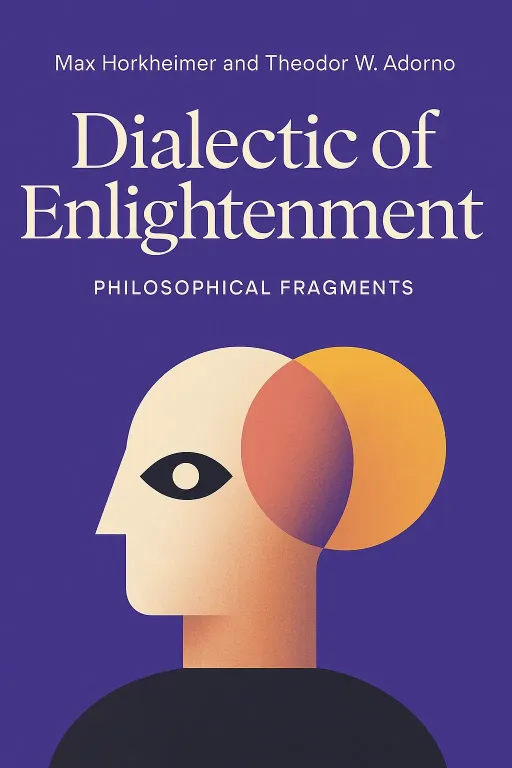
Nova: Exactly! Except this "truck" isn't an external force. It's often the very structures and systems we participate in, the ones we rarely, if ever, question. Today, we're diving into the powerful ideas from. Our journey will be guided by two truly foundational works: Max Horkheimer and Theodor W. Adorno's, and Herbert Marcuse's. These texts emerged from the Frankfurt School, a group of thinkers grappling with the profound disillusionment after World War II, asking how the very 'enlightenment' and 'progress' that promised liberation could lead to such devastation. They challenged the very notion of what 'rationality' truly meant.
Atlas: That's a heavy start. So, this blind spot then, what exactly are we missing when we're in it? What's the cost of this passive acceptance?
Unmasking the 'Blind Spot' & The Culture Industry
SECTION
Nova: Well, the cost, Atlas, is a critical engagement with the world. We become consumers of reality rather than active shapers or even conscious observers of it. We fail to see the underlying power structures and historical forces that didn't just but were actively.
Atlas: So basically, we're living in a meticulously designed set, and we just assume it's the natural landscape.
Nova: A brilliant analogy! And Horkheimer and Adorno, in, really tear into one of the biggest architects of that set: the "culture industry." Now, when they talk about the culture industry, they're not just complaining about bad movies. They're describing how mass-produced culture—think popular music, Hollywood films, radio shows of their time—becomes a system that standardizes thought and behavior.
Atlas: Hold on. Are they saying that listening to a pop song or watching a blockbuster movie is actually a form of control? That sounds a bit out there. It feels like harmless entertainment.
Nova: That's precisely the insidious brilliance of it. It harmless, even pleasurable. But Horkheimer and Adorno argued that this industry, driven by profit and mass appeal, churns out cultural products that are essentially interchangeable. They have predictable formulas, familiar tropes, and happy endings that resolve all tension.
Atlas: Like how so many romantic comedies follow the exact same arc, or action movies have the same explosion sequence?
Nova: Exactly! Think of the cause: the relentless pursuit of profit, the need to appeal to the widest possible audience, which leads to lowest common denominator content. The process is the homogenization of cultural forms—music that sounds similar, films with predictable plots, narratives that avoid challenging the status quo. The outcome? It creates a passive, uncritical audience. Instead of inspiring genuine reflection or dissent, it offers escape and affirmation. It tells you, "Don't worry, everything's fine, just keep consuming." It stifles critical thought, making you comfortable with the way things are, rather than questioning why they are that way.
Atlas: Wow, that's kind of heartbreaking. So, it's not just entertainment, it's a kind of ideological factory, churning out consent. But what about genuine art then? The stuff that challenge us? Are they saying that's all just a lost cause?
Nova: Not a lost cause, but certainly marginalized. They saw the true, challenging art struggling against this tide. The point is that the dominant cultural forces subtly shape our desires, our values, and even our understanding of what "freedom" means, often without us ever realizing it. It's a form of soft power, far more effective than overt censorship.
From Culture Industry to One-Dimensional Thought
SECTION
Nova: And if Horkheimer and Adorno showed us the comfortable cage being built by the culture industry, then Herbert Marcuse, in, shows us how we become comfortable it, even losing the desire to leave.
Atlas: So, we don't just accept the current reality; we can't even an alternative? That's a terrifying thought.
Nova: It really is. Marcuse argued that advanced industrial societies create what he called "one-dimensional" thought and behavior. He observed how these societies, through technological progress and material abundance, manage to integrate and neutralize dissent. Any potential for radical change, for true freedom, gets stifled.
Atlas: Give me an example. How does a society integrate dissent? I imagine someone protesting, and then... what, they get a reality TV show?
Nova: That's actually a surprisingly good analogy for one aspect of it! Think about how counter-culture movements are often commodified. What starts as a rebellion against consumerism might end up with major brands selling "rebel chic" clothing. Or, environmental activism, which could challenge the very foundations of industrial production, gets channeled into buying "eco-friendly" products from the same corporations.
Atlas: Oh, I see. So the system doesn't crush the dissent; it just absorbs it, repackages it, and sells it back to us as another choice within the existing framework. It makes us think we're being rebellious by buying a certain brand, when in fact, we're just reinforcing the system we thought we were fighting against.
Nova: Precisely. The revolutionary potential, the ability to imagine radically different ways of living, gets eroded. Marcuse believed that even our needs become "false needs," manufactured by the system. We think we need the latest gadget, the perfect vacation, the specific lifestyle, when these are often just extensions of the system's control, distracting us from deeper, more authentic needs.
Atlas: That's a powerful idea, especially for someone who's always trying to make sense of the world and navigate ethical dilemmas. How does someone who values independent thought, someone trying to think deeply, avoid becoming "one-dimensional" in this kind of society?
Nova: That's the million-dollar question, isn't it? It starts with the very act of questioning. It means resisting simplistic interpretations, looking for the hidden power dynamics in seemingly neutral systems. It means cultivating that "analytical edge" we talked about at the beginning. It's about being aware that the "natural" or "inevitable" aspects of our world are often constructed, and that those constructions serve certain interests.
Atlas: So, it's not about rejecting everything, but about understanding the mechanics behind it. Looking for the strings on the puppet, so to speak.
Nova: Exactly. It's about empowering active understanding over passive acceptance. It's recognizing that the very rationality meant to liberate can become a tool for new forms of domination if we don't remain critically vigilant.
Synthesis & Takeaways
SECTION
Nova: So, bringing it all together, critical theory—through the insights of Horkheimer, Adorno, and Marcuse—isn't just a critique. It's an invitation to see the world with new eyes. It's about developing that analytical edge to unmask the hidden forces that shape our everyday realities, pushing us from passive acceptance to active, informed understanding.
Atlas: And it makes me think about that initial question: what everyday cultural product or social norm do we now see differently? For me, it's the constant push for "personal branding" online. It feels like empowerment, but is it also subtly forcing us to commodify ourselves?
Nova: That's a fantastic example, Atlas. It's about embracing the journey of questions, as our listener profile suggests. Not every path needs a clear answer right away, but the act of asking, of probing, is where true wisdom begins. It's about connecting those historical patterns to current events, seeing the echoes.
Atlas: Absolutely. It's about not just consuming the world, but critically engaging with it. It's about having the courage to look beyond the surface.
Nova: Exactly. And we hope this conversation has given you a few new lenses to do just that. What will you look at differently after today? We'd love to hear your thoughts.
Atlas: For anyone out there who's ever felt like something was "off" but couldn't quite put their finger on it, this episode is your permission to dig deeper.
Nova: This is Aibrary. Congratulations on your growth!