

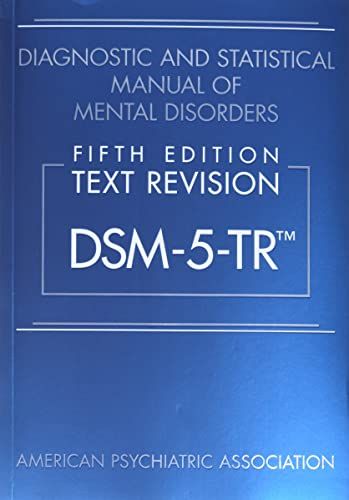
Diagnostic and Statistical Manual of Mental Disorders, Fifth Edition, Text Revision (DSM-5-TR(tm))
Diagnostic and Statistical Manual of Mental Disorders, Text Revision
The Unofficial Bible of the Mind
The Unofficial Bible of the Mind
Nova: Welcome to the show. Imagine a single book, bound in official colors, that dictates how millions of people worldwide understand their deepest emotional pain. It’s not scripture, it’s not law, but for mental health professionals, it’s the closest thing we have to an operating manual. We’re talking about the Diagnostic and Statistical Manual of Mental Disorders, or the DSM. And today, we’re dissecting the latest iteration: the DSM-5-TR, the Text Revision.
Nova: : That’s a mouthful. Nova, why should the average listener care about a highly technical revision of a manual published by the American Psychiatric Association? Isn't this just for doctors and insurance coders?
Nova: That’s the perfect entry point. It affects everything. It influences how research funding is allocated, how therapists are trained, and critically, whether your insurance company will cover your treatment for a specific condition. The DSM is the gatekeeper of legitimacy in mental health. When they issue a Text Revision, it signals a subtle but important shift in the landscape of what we consider 'disordered' versus 'human variation.'
Nova: : So, this isn't the massive overhaul we saw when they jumped from DSM-IV to DSM-5 a decade ago? This is more like a software patch?
Nova: Exactly. The DSM-5, released in 2013, was a seismic event—it dropped the multi-axial system, merged several disorders, and was incredibly controversial. The DSM-5-TR, released in 2022, is a refinement. It’s about updating the narrative text, correcting codes, and incorporating new findings that have solidified since 2013. But even a patch can change how the whole system runs. We’re diving into what those specific changes mean for diagnosis, treatment, and the ongoing debate about pathologizing life.
Nova: : I’m ready to see if this revision finally settled any of the dust kicked up by the last one. Let’s open the book.
The Evolution and Authority of the DSM
From Statistical Guide to Definitive Text
Nova: To understand the TR, we have to appreciate the manual’s journey. The very first DSM in 1952 was a slim volume, mostly for statistical tracking in hospitals. It was descriptive, not necessarily prescriptive. But over the decades, it morphed into what many critics now call 'psychiatry's bible.'
Nova: : 'Bible' is a strong word. It implies a single source of truth. I read that the DSM-5 revision in 2013 was perhaps the most controversial in its history. What made it so fraught?
Nova: The controversy stemmed from lowering thresholds and creating new categories where consensus was weak. For example, the criteria for Autism Spectrum Disorder were consolidated, which was a major structural change. But the core tension is this: is the DSM a descriptive tool reflecting observable patterns, or is it a prescriptive tool that the disorders by defining them?
Nova: : That’s the million-dollar question, isn't it? If you give a name to a constellation of suffering, does that name help the patient get treatment, or does it label them in a way that limits their understanding of their own experience?
Nova: Precisely. And the TR is an attempt to clean up the mess left by that last big structural change. The APA stated the TR includes fully revised text and references, updated diagnostic criteria, and new ICD-10-CM codes. They are trying to make the existing framework more precise, even if the framework itself is debated.
Nova: : So, if the DSM-5 was the earthquake, the DSM-5-TR is the engineering report detailing where the cracks are and how to temporarily shore up the foundation. What are the most significant structural updates they decided to shore up this time around?
Nova: The biggest structural addition, which we’ll explore next, is a completely new diagnosis. But beyond that, they focused heavily on clarifying language. For instance, they revised the criteria sets for several disorders, often to improve clinical utility and reduce ambiguity. They also added specific coding for suicidal and non-suicidal self-injurious behavior, which were previously handled less distinctly. It’s about tightening the screws on the existing definitions.
Nova: : It sounds like they are trying to address the feedback loop—clinicians used the DSM-5, found ambiguities, and the TR is the response to that field testing. But does simply revising the text truly address the fundamental philosophical critiques that have followed the DSM since its inception?
Nova: That’s the challenge. The philosophical critiques—that it pathologizes normal human responses, that it’s culturally biased, that it’s too reliant on consensus rather than hard biological markers—those critiques don't disappear with a text revision. They linger beneath the surface of every updated code. It’s a constant tension between scientific aspiration and clinical necessity.
Nova: : It’s fascinating how much power this book holds, given that it’s essentially a consensus document, not a peer-reviewed scientific journal. It’s the standard because it the standard, creating a self-fulfilling prophecy of authority.
Nova: Absolutely. It’s the lingua franca. Without it, research collaboration stalls, and insurance claims bounce. The TR is an acknowledgment that the language needs refinement to keep the system functioning smoothly, even if the system itself is imperfect. Let’s look at the most concrete addition to that language: Prolonged Grief Disorder.
When Sadness Becomes a Disorder
The New Diagnosis: Prolonged Grief Disorder
Nova: The headline change in the DSM-5-TR is the official inclusion of Prolonged Grief Disorder, or PGD. This was a diagnosis that was debated heavily for inclusion in the original DSM-5, but it was ultimately left out, categorized under Adjustment Disorders.
Nova: : So, what’s the line? When does intense, normal bereavement cross over into a diagnosable mental disorder? That feels like the most delicate distinction the manual has ever had to draw.
Nova: It is delicate, and the criteria are specific. For an adult diagnosis, the intense grief symptoms—which include intense yearning for the deceased and preoccupation with thoughts of them—must persist for at least 12 months following the loss. For children and adolescents, the threshold is six months. This is significantly longer than the typical bereavement period recognized previously.
Nova: : Twelve months feels long, but grief is complex. What distinguishes PGD from, say, Major Depressive Disorder or PTSD, which often co-occur after a significant loss?
Nova: That’s what the research focused on for the TR. The APA sought to make PGD distinct. The key feature is that the grief response is characterized by a persistent, maladaptive pattern where the grief is inescapable and intrudes on almost everything the griever does, often involving a persistent desire to die to be with the deceased. Crucially, the criteria aim to differentiate it from depression by focusing the core symptoms specifically on the yearning and preoccupation related to the, rather than generalized anhedonia or hopelessness.
Nova: : I’ve heard some critics argue that by formalizing PGD, the APA is essentially pathologizing one of the most universal human experiences—grief. Are they creating a disorder out of what should be a natural, albeit painful, process?
Nova: That is the central critique, and it’s powerful. Some experts argue that labeling this intense, prolonged reaction as a disorder might discourage natural coping mechanisms or imply that there is a 'correct' timeline for healing. However, the proponents argue that for a small subset of bereaved individuals, the grief becomes so debilitating and chronic that it meets the threshold for clinical impairment, requiring specific, targeted intervention that standard depression or anxiety treatments might miss.
Nova: : So, it’s a recognition that for some, the grieving process stalls completely, becoming a chronic state rather than a transition. What about other, smaller changes? Were there other criteria sets modified for clarification?
Nova: Yes, many. For instance, the criteria sets for several disorders were updated for clarity, and terminology was revised across the board. They also added a new category, Unspecified Mood Disorder, and refined the language around substance use disorders. But PGD is the one that required the creation of a whole new diagnostic block and code. It’s the most visible addition to the manual’s landscape.
Nova: : It’s a heavy responsibility to decide which human suffering gets a code and which remains in the realm of the 'normal but difficult.' It makes you wonder how many other intense, but currently uncoded, experiences are just waiting for the next Text Revision cycle.
Nova: It makes you wonder if the categorical approach itself—putting people into neat boxes—is the real limitation, regardless of the text inside the box. But for now, PGD is officially on the map, and clinicians must now navigate its criteria.
Examining the System's Core Flaws
The Controversy Crucible: Overdiagnosis and Bias
Nova: Let’s pivot to the persistent criticisms that follow the DSM like a shadow. The most common refrain is the fear of overdiagnosis—the idea that by lowering thresholds or expanding criteria, we are medicalizing normal human distress. Think about the shift to the spectrum approach for Autism, or the debate around ADHD prevalence.
Nova: : It feels like a slippery slope. If you define sadness lasting a year as a disorder, what about intense anxiety lasting six months? Where does the line between a difficult personality trait and a diagnosable illness get drawn?
Nova: That line is often drawn by external forces, which brings us to the second major criticism: cultural and social bias. Historically, the DSM has been criticized for reflecting a Western, often white, male-centric view of mental health, sometimes misinterpreting or pathologizing cultural expressions of distress that don't fit the dominant narrative.
Nova: : Have the revisions in the TR addressed those cultural blind spots? Or is the core structure still rooted in the same historical context?
Nova: The APA has made efforts to improve cultural sensitivity in the descriptive text, but fundamentally changing the to accommodate every cultural nuance is incredibly difficult within a standardized manual designed for global use. The challenge is that the manual must be both specific enough for rigorous research and broad enough for diverse clinical settings worldwide.
Nova: : And then there’s the elephant in the room: money. I recall reading about the significant financial conflicts of interest among the committees that drafted the DSM-5, with many members having ties to pharmaceutical companies.
Nova: That’s a critical point that has dogged the manual for years. Undisclosed or poorly managed financial conflicts of interest among the panel members raise serious questions about objectivity. When the people defining the disorders also stand to profit from the resulting treatments—medications—the integrity of the diagnostic process is naturally questioned. The TR attempts to move forward, but the legacy of those earlier conflicts remains a point of contention for critics.
Nova: : It forces us to ask: Who benefits most from this system? Is it the patient seeking relief, or the industry that profits from the prescription pad?
Nova: It’s a complex ecosystem. The manual is necessary for research standardization, but that standardization comes at the cost of nuance. The future outlook, which the APA itself has discussed, involves moving toward a more dimensional system—one that measures severity along a continuum rather than forcing a categorical yes/no diagnosis. That would be a radical departure from the current structure, which the TR is still firmly rooted in.
Nova: : So, the TR is a refinement of a flawed categorical system, rather than a leap toward a more nuanced, dimensional future. It’s an incremental step, not a revolution.
Nova: Precisely. It’s about making the current map legible for one more cycle, while the cartographers argue about whether they should be drawing maps based on topography or based on tectonic plates.
Where the Codes Become Currency
The Gatekeeper: Practice, Billing, and Research
Nova: Let’s bring this down to the ground level. For a practicing therapist or psychiatrist, the DSM-5-TR isn't an academic text; it’s the currency they use to get paid and to communicate with colleagues. Its impact on clinical practice and insurance is immediate and non-negotiable.
Nova: : Right. If a therapist treats a client for generalized anxiety but the insurance company only reimburses for Major Depressive Disorder, the diagnosis has to shift, even if the clinical picture isn't a perfect fit. How does the TR affect that billing reality?
Nova: The TR updates the ICD-10-CM codes that insurance companies rely on. When the TR was released, clinicians had to update their systems. If a clinician used an outdated code, the claim would be denied. Furthermore, the inclusion of PGD means that for the first time, a clinician can seek specific reimbursement for treating prolonged, complicated grief, which was previously often lumped into less specific or less reimbursed categories like Adjustment Disorder.
Nova: : That’s a tangible benefit for patients who need specialized care for that specific type of grief. It validates their suffering within the system.
Nova: It does. And it’s not just billing. Research hinges on these codes. If you are running a clinical trial on a new medication for Bipolar II Disorder, you need a universally accepted, precise definition of Bipolar II Disorder to recruit the right participants. The TR ensures that research conducted today uses the most current, agreed-upon definitions, making studies comparable across institutions.
Nova: : So, the TR is essential for maintaining the scientific infrastructure of psychiatry, even if the definitions themselves are imperfect consensus points. It’s the necessary evil for large-scale study.
Nova: That’s a great way to put it. It’s the infrastructure. Think about the new coding for suicidal behavior. By providing specific, distinct codes for suicidal ideation versus non-suicidal self-injury, it allows researchers and clinicians to track these critical risk factors with much greater specificity than before. This granularity is vital for risk assessment protocols.
Nova: : It sounds like the TR’s primary function, beyond adding PGD, is administrative hygiene—making sure the codes match the current understanding and that the system doesn't break down under the weight of a decade of new clinical experience.
Nova: Exactly. It’s about operationalizing the science. The APA views the TR as the most comprehensive, current resource available to clinicians. It’s the tool they must use to bridge the gap between the theoretical understanding of mental illness and the practical realities of healthcare delivery, where every diagnosis must translate into a billable service or a research metric.
Nova: : It’s a heavy burden for a textbook to carry—being both a guide for healing and a ledger for finance. It really underscores why the debate around its contents is so intense; the stakes are incredibly high.
Synthesis and the Road Ahead
Synthesis and the Road Ahead
Nova: We’ve covered a lot of ground today, from the subtle language tweaks in the DSM-5-TR to the massive philosophical debates it ignites. If we distill it down, what are the key takeaways about this Text Revision?
Nova: : The main takeaway for me is that the DSM-5-TR is less about revolution and more about refinement. The addition of Prolonged Grief Disorder is the most significant clinical change, offering a specific diagnostic pathway for chronic, debilitating bereavement. But it also forces us to confront the line between normal suffering and pathology head-on.
Nova: And that refinement is crucial for the system's survival. The TR updates the codes, clarifies the criteria, and ensures that the manual remains the standard for insurance reimbursement and clinical research for the foreseeable future. It’s the maintenance work that keeps the entire edifice standing.
Nova: : But the underlying tension remains. The manual is criticized for being too categorical, potentially leading to overdiagnosis, and for its historical lack of attention to cultural diversity. The TR cleans up the text, but it doesn't fundamentally alter the categorical structure that many experts feel is outdated.
Nova: Which leads us to the future. The APA is already looking beyond the TR, hinting at a roadmap that might embrace dimensional models—measuring severity and underlying constructs rather than just ticking boxes. That would be the true revolution, moving away from the 'bible' metaphor toward something more fluid and biologically informed.
Nova: : So, the DSM-5-TR is the final, polished edition of the categorical era. It’s the last great refinement before the potential paradigm shift. For our listeners, the actionable takeaway is simple: if you are seeking or providing care, know that the language and the codes have officially changed as of 2022.
Nova: Absolutely. Understanding the DSM-5-TR isn't just about knowing the latest labels; it’s about understanding the framework that shapes how society recognizes, funds, and treats mental distress. It’s a powerful document, and awareness of its contents and its limitations is the first step toward informed advocacy for better care.
Nova: : A fascinating deep dive into the architecture of modern mental health classification. Thank you, Nova.
Nova: My pleasure. This is Aibrary. Congratulations on your growth!