

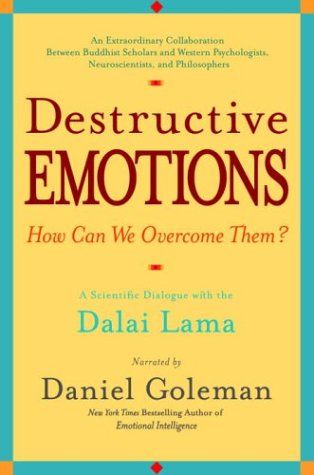
Destructive emotions
How Can We Overcome Them?
Introduction
Nova: Imagine for a second that you are high up in the Himalayas, in a room filled with some of the most brilliant neuroscientists on the planet. And sitting right in the middle of them is the Dalai Lama. They are not there to debate religion, though. They are there for a five-day intensive meeting to solve one of the most pressing problems in human history: why do we do things that hurt ourselves and others? Why do we have these massive emotional meltdowns that wreck our relationships and our peace of mind?
Nova: That is exactly what Daniel Goleman explores in his book, Destructive Emotions. It chronicles the eighth Mind and Life Institute meeting back in March 2000. Goleman, who basically put emotional intelligence on the map, acted as the bridge between these two worlds. He brings together the ancient psychological wisdom of Buddhism and the cutting-edge neuroscience of the West to answer a single question: can we actually train our brains to overcome destructive feelings like rage, jealousy, and fear?
Nova: That is the perfect place to start. Because as it turns out, the way a scientist defines a bad emotion and the way a monk defines it are worlds apart, and that gap changes everything about how we handle them.
Key Insight 1
Defining the Internal Enemy
Nova: In Western psychology, we usually define an emotion as destructive based on the outward result. If you get so angry that you hit someone or get fired, we call that a problem. But if you are just simmering with resentment inside and it does not affect your work performance, we might not even label it as destructive.
Nova: Exactly. But the Buddhist perspective offered in the book is much more radical. They use the term afflictive emotions. To them, an emotion is destructive the moment it disturbs your mental equilibrium. It does not matter if you act on it or not. If it distorts your perception of reality and makes you lose your inner peace, it is destructive.
Nova: Absolutely. Because in that moment, your mind is clouded. You are seeing the world through a lens of hostility. The book points out three main poisons in this framework: craving, hatred, and delusion. These are the roots of all destructive emotions. The idea is that these feelings act like a toxin in the mind, preventing us from seeing things as they really are.
Nova: Paul Ekman was actually one of the key participants. He pointed out that from an evolutionary standpoint, some of these emotions were actually survival tools. Fear keeps you from walking off a cliff. Anger can help you defend your family. But the Dalai Lama's response was fascinating. He argued that while those reactions might have been useful for a caveman, in our modern, complex world, they are often triggered by illusions or overreactions.
Nova: The book suggests it comes down to two things: the duration and the distortion. A healthy emotion is a brief response to a real situation. A destructive one lingers long after the threat is gone and blows the situation out of proportion. It creates a story in your head that keeps the fire burning. The scientists and the monks agreed that the real danger is when the emotion takes over the driver's seat and refuses to let go.
Key Insight 2
The Science of the Happiest Man
Nova: One of the most mind-blowing parts of the book involves a monk named Matthieu Ricard. He was a molecular biologist before he became a monk, so he understands both worlds. The scientists decided to put him in an fMRI machine to see what was happening in his brain during meditation.
Nova: That is the one! Richard Davidson, a leading neuroscientist, found that when Matthieu meditated on compassion, his brain showed activity in the left prefrontal cortex that was literally off the charts. It was way beyond anything they had ever seen in the thousands of subjects they had tested before.
Nova: Science has found that the left prefrontal cortex is the seat of positive emotions like joy, enthusiasm, and energy. The right side is more associated with negative affect, like depression, anxiety, and withdrawal. Most people have a baseline balance between the two. But Matthieu's brain was incredibly tilted toward the left side. He had essentially trained his brain to be in a state of high-level well-being as his default setting.
Nova: That was the exact challenge the scientists raised. But Davidson's research showed something called neuroplasticity. This was a relatively new concept at the time of the meeting. It means the brain is not a static organ; it is a muscle that can be reshaped. They found that even people who practiced mindfulness for just eight weeks showed a measurable shift in their brain activity from the right to the left side.
Nova: Exactly. Goleman describes it as mental gym work. Every time you catch a destructive thought and redirect it, you are strengthening the neural pathways that lead to emotional regulation. The book argues that happiness and emotional balance are not just things that happen to you; they are skills that you can cultivate through practice.
Key Insight 3
The Refractory Period and the Amygdala Hijack
Nova: Even if we are training our brains, we still get triggered. The book dives deep into a concept called the refractory period. This is the window of time right after an emotion is triggered where our brain becomes completely biased. We can only see information that supports that emotion.
Nova: That is the refractory period in action. Paul Ekman explained that during this time, we are literally incapable of processing contradictory evidence. If you are angry, your brain is looking for more reasons to be angry. The scary part is that for some people, this window lasts for minutes or even hours. For a highly trained meditator, it might only last for a few seconds.
Nova: Precisely. The book calls it narrowing the gap. Goleman also talks about the amygdala hijack, which is when that little almond-shaped part of your brain, the amygdala, senses a threat and shuts down the logical part of your brain, the prefrontal cortex. It is like the emergency broadcast system taking over the whole TV station.
Nova: The key is awareness. The book discusses how the Dalai Lama and the scientists looked at mindfulness as a way to create a tiny bit of space between the trigger and the reaction. If you can notice the physical sensation of anger, like your heart racing or your face getting hot, before you open your mouth, you have a chance to intervene. It is about catching the spark before it becomes a forest fire.
Nova: It is very hard. But the research in the book suggests that even a small amount of training improves your ability to detect micro-expressions, both in others and in yourself. Paul Ekman showed that by learning to recognize the very first flicker of an emotion, we can regain our footing much faster. It is about becoming an expert in your own internal signals.
Key Insight 4
Scaling Emotional Literacy
Nova: One of the final big themes of the book is how we take this out of the lab and the monastery and into the real world. Specifically, how do we teach this to kids? The Dalai Lama was very adamant that we cannot just rely on prayer or meditation for a few people; we need a secular way to teach emotional intelligence to everyone.
Nova: Goleman highlights several programs, like the Resolving Conflict Creatively Program in New York schools. They found that when kids were taught to identify their feelings and use techniques to calm down, violence dropped and academic scores actually went up. It turns out that when your brain is not constantly in a state of emotional hijack, you are much better at learning.
Nova: Not at all. It is about emotional literacy. It is teaching kids to name what they are feeling. Instead of just acting out, a child learns to say, I am feeling excluded and that makes me sad. The book suggests that by labeling the emotion, you actually engage the prefrontal cortex, which helps dampen the amygdala's response. Just the act of naming it gives you power over it.
Nova: Exactly. The dialogue in the book concludes with the idea of global compassion. The scientists and the Dalai Lama agreed that if we can reduce the power of destructive emotions in ourselves, we naturally become more empathetic toward others. It is not just about personal peace; it is about reducing the amount of aggression and conflict in the world at large.
Conclusion
Nova: As we wrap up our dive into Destructive Emotions, it is clear that the meeting in Dharamsala was a turning point. It proved that the ancient techniques for training the mind are not just spiritual fluff; they have a measurable, physical impact on the brain. We have learned that a destructive emotion is anything that clouds our judgment, that our brains are incredibly plastic and capable of change, and that the key to control is catching that refractory period before it catches us.
Nova: Goleman's book reminds us that while our emotions can be destructive, our capacity for awareness and compassion is even stronger. It is a journey of moving from being ruled by our impulses to being the masters of our own minds. If a molecular biologist turned monk can change his brain chemistry, there is hope for all of us.
Nova: This is Aibrary. Congratulations on your growth!