** The Code of Conflict: Learning from History to Escape the US-China Trap.
Golden Hook & Introduction
SECTION
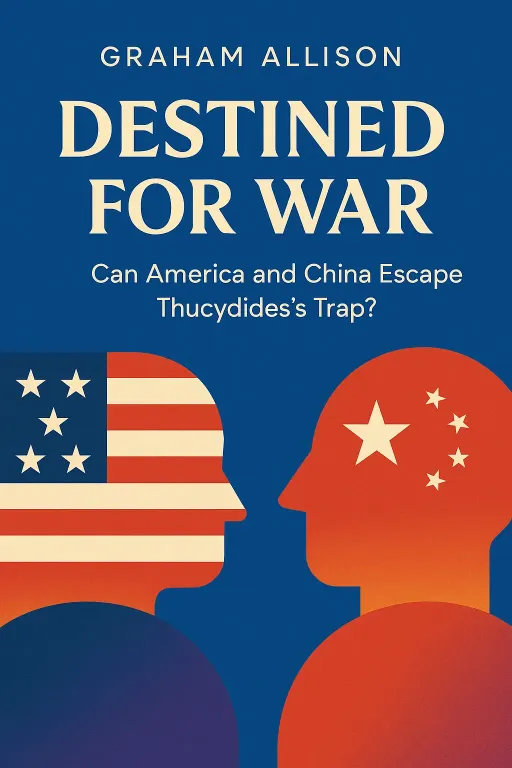
Nova: The ancient Greek historian Thucydides wrote, "It was the rise of Athens and the fear that this instilled in Sparta that made war inevitable." What if that wasn't just history, but a script? A dangerous piece of code that has run 16 times in the last 500 years, and resulted in war 12 of those times. Right now, many believe the world's two superpowers, the United States and China, are running that same script. Are we sleepwalking into a conflict that could define the 21st century?
Nova: Today, we're diving into Graham Allison's chilling book, 'Destined for War,' to find out. We'll tackle this from two angles. First, we'll explore the original 'source code' of this conflict: the Thucydides Trap between Athens and Sparta. Then, we'll see how that code ran with devastating results between Britain and Germany, and ask if it's running again right now. And we have the perfect person to help us decode all of this. Frank Wu is the cofounder of Aibrary, an AI platform that turns books into personalized learning, and he's a Harvard Master in Public Policy graduate. Frank, welcome. It’s fantastic to have you.
Frank Wu: Thanks for having me, Nova. It's a powerful and, frankly, unsettling topic. That idea of a historical script is something I think about a lot, both in my work and just as a citizen.
Deep Dive into Core Topic 1: The Thucydides Trap: History's Gravitational Pull
SECTION
Nova: It really is. That core idea from Thucydides is so powerful because it feels less like a choice and more like, well, a trap. A kind of gravitational pull. So let's go back to the original case study, to where this all began. Ancient Greece, 5th century BCE.
Frank Wu: The birthplace of the concept.
Nova: Exactly. After the Greeks heroically banded together to defeat the massive Persian invasion, Athens enters this incredible golden age. It becomes a hub of democracy, philosophy, art... and it builds a massive naval empire. They are, without a doubt, the rising power. And then you have Sparta.
Frank Wu: The established power. The old guard.
Nova: The old guard, precisely. Sparta is a rigid, land-based, militaristic society. They're the undisputed leaders of the Greek world, and they watch Athens's spectacular rise not with admiration, but with growing anxiety. The book is clear: this isn't about good guys and bad guys. It's about the structural stress that this power shift creates. Allison boils it down to three key drivers. First, clashing. Athens's empire starts to encroach on Sparta's allies. Second, and most importantly,. Sparta becomes terrified of being displaced, of losing its top spot. And third,. Athens is bursting with pride and self-confidence, while Sparta feels it has to act tough to maintain respect.
Frank Wu: So it's a psychological powder keg.
Nova: Completely. And it doesn't take much to light the fuse. A dispute over a distant colony here, a trade sanction there—the book mentions the Megarian Decree, basically a trade embargo Athens placed on a Spartan ally—and these small sparks escalate. The result? The Peloponnesian War. A brutal, thirty-year conflict that destroyed both city-states and ended the Golden Age of Greece. They were both ruined.
Frank Wu: It's a classic systems problem, isn't it? The very success of Athens creates the conditions for its potential downfall. It's a feedback loop. And that 'fear' component is so human. It reminds me of the cognitive biases we see in decision-making. Sparta isn't reacting to a spreadsheet of Athenian GDP; they're reacting to a of being overwhelmed, of their world changing too fast and becoming unrecognizable.
Nova: That's such a great point. It's emotion driving statecraft. And here's the truly scary part. Allison's team at Harvard found this isn't a one-off. They studied history and identified 16 cases where a rising power challenged a ruling one. Frank, as someone who builds learning tools and thinks about data, what does that number—12 out of 16 ending in war—say to you?
Frank Wu: It says the default setting is failure. It's a 75% failure rate. That's staggering. It means that avoiding war isn't the natural outcome; it requires an extraordinary, conscious effort to break the pattern. You can't just stumble into peace. You have to actively and build a different path, which is incredibly difficult when those primal emotions of fear and national pride are in the driver's seat.
Nova: You have to defy the gravity of the situation.
Frank Wu: Exactly. You have to be an astronaut of statecraft.
Deep Dive into Core Topic 2: Modern Echoes: Britain, Germany, and Today
SECTION
Nova: I love that. 'Astronaut of statecraft.' And that idea of a 'default setting' is the perfect bridge to our second point. Because if Athens and Sparta wrote the code for this trap, then Britain and Germany before World War I ran it with terrifying precision. It's the same trap, just with battleships instead of the ancient warships called triremes.
Frank Wu: And the stakes were so much higher.
Nova: Infinitely higher. So, picture the turn of the 20th century. Britain is the ruling power. The sun never sets on the British Empire. They rule the waves. But then, in 1871, Germany unifies and becomes an industrial monster. Their economy explodes. They're producing more steel than Britain. And, like Athens, they get that 'Rising Power Syndrome'—an enhanced sense of their own importance. They feel they deserve, in their words, "a place in the sun."
Frank Wu: And how do they decide to claim that place?
Nova: With a navy. Germany, a land power, starts a massive naval buildup. For Britain, an island nation, its navy isn't just for projecting power; it's for survival. It's an existential issue. So, this triggers a frantic, ruinously expensive arms race. The book points to a key document, the Crowe Memorandum, where a British diplomat basically argued: we can't trust Germany's stated are peaceful. We have to judge them on their to harm us. And their growing navy is a loaded gun pointed at our head.
Frank Wu: That's a critical shift in mindset. It's pre-emptive paranoia. You stop listening to what they say and focus only on what they do.
Nova: And that paranoia becomes a self-fulfilling prophecy. Britain, Germany, France, Russia... they all get tangled in this web of alliances and military plans. So when a Serbian nationalist assassinates an Austrian Archduke in the summer of 1914—a regional crisis—the whole system clicks into gear, and Europe sleepwalks into the catastrophe of World War I.
Frank Wu: A war that destroyed a generation and toppled four empires. It's horrifying.
Nova: It is. So Frank, let's connect the dots to today, as the book does so powerfully. We have China's incredible rise—Allison calls it "the biggest player in the history of the world." And we have the United States, the established power for 75 years, feeling its position is threatened. Do you see the parallels to Britain and Germany?
Frank Wu: Oh, absolutely. The parallels are chillingly precise. You can swap Germany's naval race with China's technological race in AI, 5G, and quantum computing. It's the same competition for the high ground of the future. You can swap Britain's anxiety about its global empire with American anxiety about its global leadership role. And the user's note on recent diplomacy fits right in here—a slogan like 'Make America Great Again' is a textbook symptom of the 'Ruling Power Syndrome,' a direct response to the feeling of being displaced.
Nova: And on the other side?
Frank Wu: On the other side, Xi Jinping's 'China Dream' of national rejuvenation is the 'Rising Power Syndrome' in its purest form. The language of restoring past glory and claiming a rightful place is almost identical to that of early 20th-century Germany.
Nova: That's a brilliant connection. The psychology is the same. The book mentions how leaders with strong nationalist visions—like Xi and, in his own way, Trump—can act as accelerants. They pour fuel on the fire of these national emotions.
Frank Wu: Exactly. They personify the national feelings of pride on one side and fear on the other. It makes compromise look like weakness and confrontation look like strength. It dramatically narrows the path to a peaceful outcome, because the leaders themselves become symbols of the struggle.
Synthesis & Takeaways
SECTION
Nova: So, we've seen this terrifying pattern, this historical script, playing out from ancient Greece to modern Europe. A rising power, a fearful ruling power, and a powerful, gravitational pull towards conflict. It feels so deterministic.
Frank Wu: It does, but the book—and history itself—shows it's not inevitable. Four of those 16 cases Allison studied managed to avoid war. It required incredible, almost heroic statecraft, a deep understanding of the other side's needs, and in some cases, like with the US and the Soviet Union, the terrifying but stabilizing logic of Mutually Assured Destruction. Peace is possible, but it's the harder path. It's the exception, not the rule.
Nova: So, as we wrap up, what's the key takeaway for us, for our listeners, from this powerful book?
Frank Wu: I think it comes down to a fundamental challenge of growth, whether you're talking about a person or a civilization. Can you manage your own fear, your own ego, to truly understand another's perspective? As a father of a three-year-old girl, I think about the world she's going to inherit. And the question this book leaves me with is, can our leaders—and can we as citizens—develop the 'civilizational empathy' needed to see the world through our rival's eyes? To see them not just as a threat, but as another major player with its own legitimate interests, its own history, and its own fears?
Nova: A profound and necessary question.
Frank Wu: It is. Because history suggests that failing to do so has a catastrophic price. And that's a bill none of us wants our children to have to pay.