

The Life Design Experiment: A Researcher's Guide to Building a Meaningful Career
Golden Hook & Introduction
SECTION
Nova: Alexander, as a scientist, you live in a world of hypotheses, experiments, and data. But what happens when the subject of the experiment... is your own life? We're often told to have a five-year plan, a single, perfect blueprint. But what if that very idea is a flawed hypothesis, destined to fail from the start?
Alexander: That's a powerful question, Nova. Because in science, we're trained to be skeptical of any "perfect" plan. We know that reality is messy and unpredictable. The idea of applying a rigorous, experimental framework to something as personal and chaotic as a career path is... well, it's incredibly appealing. It suggests there's a method to the madness.
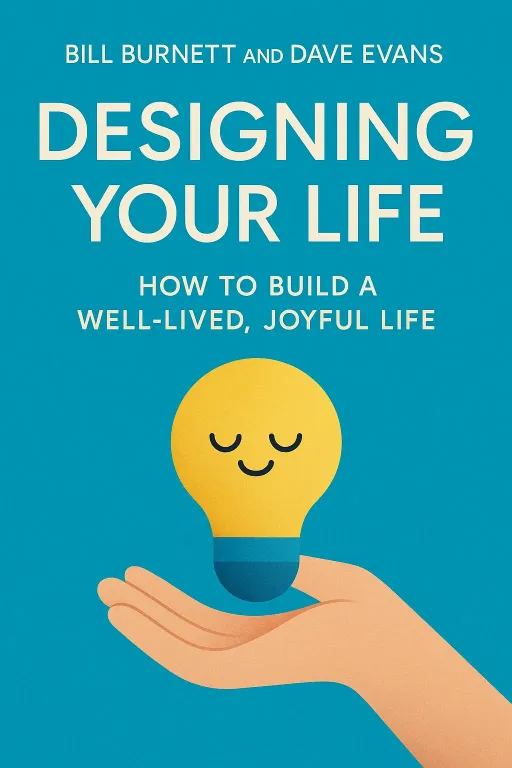
Nova: That's exactly it. And the method we're exploring today comes from the book "Designing Your Life" by Stanford's Bill Burnett and Dave Evans. It's less of a self-help book and more of a lab manual. Today, we're going to tackle it from two perspectives. First, we'll act as myth-busters, identifying the 'dysfunctional beliefs' or flawed hypotheses that hold us back.
Alexander: The assumptions we don't even realize we're making. I like it.
Nova: Exactly. Then, we'll step into the lab and explore the powerful concept of 'prototyping'—running small, data-driven experiments to design the life you actually want, not just the one you think you're supposed to have.
Deep Dive into Core Topic 1: Deconstructing 'Dysfunctional Beliefs'
SECTION
Nova: So let's start with those flawed hypotheses. The book calls them 'dysfunctional beliefs,' and they're the stories we tell ourselves about how the world works. For example: 'If you are successful, you will be happy.' It sounds logical, right?
Alexander: It's a very common cultural script.
Nova: It is. And the book shares the story of a woman named Janine. On paper, her life was a masterpiece of success. She went to top schools, became a lawyer at a prestigious firm, had a great marriage... she had meticulously planned and executed a perfect life. But there was a problem. She was profoundly, deeply unhappy. She'd find herself standing on her beautiful deck, looking at her perfect life, and just crying, with no idea why.
Alexander: That's fascinating, and it's a classic case of optimizing for the wrong variable. Janine defined 'success' by external metrics—prestige, income, status—but she never defined her own internal metrics for happiness or fulfillment. In research, if you're measuring the wrong outcome, your entire experiment is worthless, no matter how 'successful' it looks on paper. You get a statistically significant result that means absolutely nothing.
Nova: And it's so common. The book cites data that two-thirds of workers in America are unhappy with their jobs. Which brings us to another dysfunctional belief: 'Your degree determines your career.' We see this with a young woman named Ellen. She majored in geology because, as a kid, she liked rocks.
Alexander: A perfectly reasonable starting hypothesis for an 18-year-old.
Nova: Right? But after two years, she realized she wasn't actually interested in a in geology. But she finished the degree anyway. After graduation, she's living at home, babysitting and walking dogs, and her parents are baffled. They ask, "When are you going to go be a geologist?" And she's stuck, because she feels like she's failed her own plan.
Alexander: It sounds like she got caught in the sunk cost fallacy. She'd already invested so much time and money into the geology degree that she felt she to use it, even though her own internal data—her feelings of disinterest—was telling her to pivot. A good researcher has to be willing to abandon a hypothesis, even one they've spent months on, if the evidence points in a new direction. It's not failure; it's just a new finding.
Nova: And the data backs her up! The book points out that only 27% of college graduates end up in a career directly related to their major. So this idea that your major is your destiny is, for three-quarters of people, statistically false. It's a bad hypothesis from the start.
Alexander: So, we're starting with these flawed, unexamined beliefs. We're running our lives based on bad science, essentially. The question then becomes, how do you run a experiment?
Deep Dive into Core Topic 2: Life as a Laboratory: Prototyping
SECTION
Nova: Exactly! And that's the perfect segue. If our old beliefs are flawed hypotheses, how do we test new ones? The book's answer is brilliant and, I think, very familiar to you, Alexander: prototyping. The authors say, "Designers don't think their way forward. Designers build their way forward."
Alexander: I love that. It's the bias to action. You don't just sit in a room and theorize; you build something, test it, and see what happens. You generate data.
Nova: Precisely. And not prototyping can be catastrophic. The book tells this heartbreaking cautionary tale about a woman named Elise. She was in HR for years, but her dream was to open a romantic Italian deli and café. She imagined the smell of espresso, the happy customers, the beautiful decor. So, she did it. She quit her job, poured her life savings into it, renovated a space, and opened the doors.
Alexander: A full-scale, high-cost experiment. I'm already nervous.
Nova: You should be. The deli was a hit! But Elise was miserable. She discovered she didn't love the of the job, which was managing difficult staff, tracking inventory, ordering supplies at 5 a. m., and dealing with payroll. She loved the of the deli, but she hated the work. She ended up selling the business at a loss, completely burned out.
Alexander: That's just gut-wrenching. But it's a perfect illustration of the risk. She ran a massive, irreversible experiment with zero preliminary data. In the lab, that's unthinkable. It's why we have pilot studies. You test your methods on a small scale before you commit the multi-million dollar grant. So, what does a good life design 'pilot study' look like?
Nova: I'm so glad you asked. Let's look at the opposite case: a woman named Clara. She was a successful sales executive for 35 years and was ready for an "encore career." But she had no idea what to do. So she started prototyping. She was interested in helping women, so her first prototype was just attending a talk on mediation at her church. That's it. Low cost, low risk.
Alexander: A literature review, basically. Gathering initial information.
Nova: Exactly. She liked the talk, so her next prototype was a bit bigger: she took a mediation certification course. She still wasn't committed to a new life, just gathering more data. She enjoyed that, so she prototyped again, taking a part-time role mediating for kids in the juvenile justice system. Through that, she got connected to a women's foundation, where she learned about non-profits and grant writing.
Alexander: So each step was a small, self-contained experiment that generated new data and, crucially, opened up new questions and new avenues for the experiment. This is brilliant.
Nova: It is! And through the foundation, she discovered an interest in the issue of homelessness, joined the board of a shelter, and eventually became a major champion for the homeless in her city. She found this incredibly meaningful career, but she never once sat down and said, "My five-year plan is to become a champion for the homeless." She just ran the next small, interesting experiment.
Alexander: That's the key difference. Elise tried to guess the final answer. Clara built a. She let the data lead her. That's how breakthroughs happen, in the lab and, apparently, in life. She wasn't afraid of a null hypothesis; if she hated the mediation talk, she would have just learned something and moved on. That's the beauty of a low-stakes prototype.
Synthesis & Takeaways
SECTION
Nova: So when you put it all together, it really is a clear, two-step scientific process. First, you have to have the courage to look at your most fundamental assumptions about life—your 'dysfunctional beliefs'—and treat them not as facts, but as testable hypotheses.
Alexander: And be willing to find out they're wrong. That's where the real growth happens. And second, once you have a new question or a new idea, you don't commit your life savings to it. You design a small, cheap, fast experiment—a prototype—to gather some real-world data on what that path actually feels like.
Nova: It's about trading a life of "what ifs" for a life of "let's see." It's active, it's curious, and it's so much more empowering than just trying to follow a rigid, outdated map.
Alexander: It completely reframes the goal. The goal isn't to find the one, perfect "dream job." The goal is to become a good designer, a good experimenter in your own life. To build a system for continuous discovery.
Nova: Beautifully put. So, as we wrap up, what's the one takeaway you'd want our listeners to start with? What's the first step in their own life design experiment?
Alexander: I think we need to reframe the question we ask ourselves. We're so often told to ask, "What's my passion?" It's this huge, intimidating question that implies there's one right answer we have to find. A design thinker, or a scientist, would ask a much better question: "What's a small, interesting experiment I can run this week to learn something new about myself or the world?"
Nova: I love that.
Alexander: It could be having coffee with someone in a field you're curious about. It could be spending an hour volunteering. It could be trying a new hobby. Don't try to find your passion. Just run the next experiment. Gather the data. And trust that the process of discovery will lead you somewhere amazing. That's a question a designer—and a scientist—can really get behind.









