

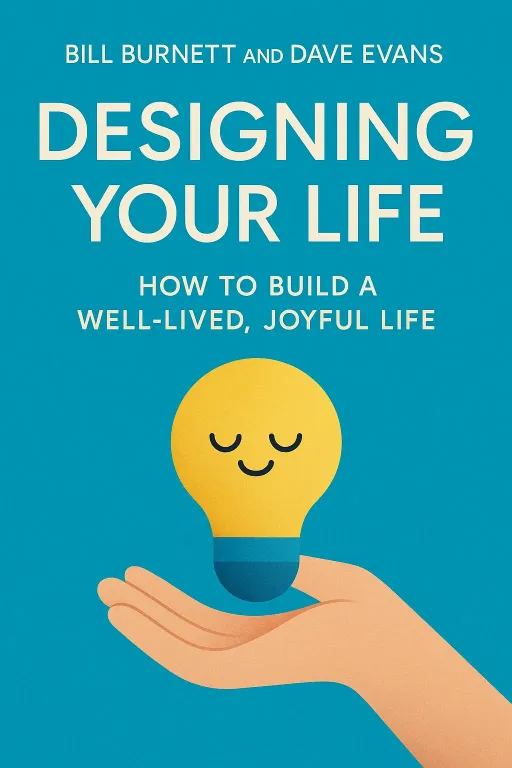
Unlocking Your Inner Architect: Designing Your Life Beyond Default Settings.
Golden Hook & Introduction
SECTION
Nova: Atlas, quick, what's the first thing that comes to mind when I say 'life planning'?
Atlas: Ugh. Spreadsheets, existential dread, and that one distant relative who always asks about your 'five-year plan' at Thanksgiving. It's basically a recipe for feeling inadequate, isn't it?
Nova: You've perfectly encapsulated the collective groan, my friend. But what if I told you that life planning doesn't have to be a rigid, fear-inducing exercise? What if it could be an exciting, creative process, more like designing a custom home than filling out tax forms?
Atlas: That sounds a lot more appealing than dread. I imagine a lot of our listeners, especially those who are always looking to master their craft and build something meaningful, are nodding along right now. We're often so focused on the external build, we forget to design the internal blueprint.
Nova: Absolutely. And that's precisely what we're diving into today, inspired by two incredibly impactful books. First, "Designing Your Life" by Bill Burnett and Dave Evans, who are design professors over at Stanford, taking design thinking out of product development and into personal fulfillment.
Atlas: Oh, I like that. Bringing the rigor of design into something as fluid as life.
Nova: Exactly. And we'll also be touching on the foundational wisdom of Stephen Covey's "The 7 Habits of Highly Effective People," a book that, decades after its release, continues to shape how people approach personal and professional effectiveness. These books, together, offer a powerful toolkit for anyone feeling they're living life on autopilot.
Atlas: So, it’s about moving from default settings to intentional design. I can see how that would resonate with anyone who considers themselves a 'growth architect.'
Nova: Precisely. And our first stop on this design journey is the liberating concept of prototyping your life.
Life Design as Prototyping: The Iterative Approach to Fulfillment
SECTION
Nova: Many people feel stuck in careers or life paths they've sort of 'fallen into.' They achieve what society deems 'success,' but there's this quiet hum of dissatisfaction. Burnett and Evans argue that this happens because we often treat life like a single, irreversible decision, rather than a design problem.
Atlas: Hold on. You’re saying we approach our lives with the same mindset we use to pick a college major or a first job, thinking it's a one-and-done choice?
Nova: That’s a great way to put it. We're taught to pick 'the one thing,' commit, and then just execute. But a product designer doesn't just build the final car or iPhone on day one. They prototype. They test. They iterate. They learn.
Atlas: Okay, so you’re saying we should apply that same iterative, experimental mindset to our careers, our relationships, our well-being? That sounds incredibly freeing, but also… a bit scary for someone who values certainty.
Nova: It is freeing! And it reframes failure not as a dead end, but as data. Let's take a common scenario: someone who's spent years climbing the corporate ladder, perhaps as a 'Strategic Persuader' excelling in sales or business development. They're good at it, but they wake up one day wondering if there's more.
Atlas: That sounds like a lot of people we know. They've built this impressive structure, but maybe they didn't design the interior.
Nova: Exactly! Instead of quitting their job and buying a one-way ticket to Bali – which is the dramatic, high-stakes version – the design thinking approach suggests prototyping. This could mean conducting 'life design interviews,' where you talk to people doing something you you might be interested in. Or it could involve 'side hustles' or short-term projects that let you dip your toes in a different pond.
Atlas: But wait, for someone in a demanding professional role, taking a 'low-stakes' detour still feels incredibly risky. How do you convince a 'Strategic Persuader' to try something that might not lead to a clear, immediate ROI? They're wired for results.
Nova: That's where the 'low-stakes' part is critical. It's not about making a full pivot. It's about gathering information, getting a taste. An 'odyssey plan' is a great example from the book. You sketch out three wildly different five-year plans for yourself. One is your current path, but amplified. Another is what you'd do if money or image were no object. And a third is what you'd do if your current path suddenly vanished.
Atlas: Three radically different lives? That's a fascinating thought experiment. It's like asking, "What if I pursued that crazy idea I had in college?" or "What if I actually followed that passion project?"
Nova: Precisely! The goal isn't to commit to any of them, but to generate options, to see the possibilities. Then, you might prototype small elements from those plans. If one plan involves becoming a chef, you don't open a restaurant tomorrow. You take a cooking class, volunteer at a soup kitchen, or interview a chef.
Atlas: So, it's about asking 'what if' and actually small versions of 'what if,' rather than just thinking about it or making a huge, terrifying leap. That makes a lot more sense. It feels less like a gamble and more like a calculated exploration.
Nova: It's about gathering data, not making commitments. It’s about building curiosity, not just certainty. And that naturally leads us to the second key idea we need to talk about, which often acts as a critical compass for all that prototyping.
The 'End in Mind' Blueprint: Aligning Values for Intentional Living
SECTION
Nova: While prototyping offers incredible flexibility, true fulfillment requires an inner compass, a North Star. That's where Stephen Covey’s timeless principle, 'Begin with the End in Mind,' becomes indispensable.
Atlas: I imagine a lot of our listeners, especially those driven by external achievements, might find it hard to define their 'end in mind' beyond 'success' or 'financial security.' How do these books help someone uncover deeper values when they're already so focused on external metrics?
Nova: That's a brilliant question, Atlas, because it cuts to the core of why so many 'successful' people still feel unfulfilled. Covey uses the powerful metaphor of building a house. You wouldn't start laying bricks without a blueprint, would you? That blueprint is your 'end in mind' – your values, your vision, your deepest principles.
Atlas: So, if you're just laying bricks because everyone else is, or because you're good at laying bricks, you might end up with a mansion you don't even want to live in.
Nova: Exactly! You could be incredibly efficient at climbing the wrong ladder. Covey challenges us to clarify our personal mission statement, to envision our own funeral and what we'd want people to say about us. Not just about our professional achievements, but about the kind of person we were, the impact we had.
Atlas: Wow, that's a pretty intense exercise, but I can see how it cuts through the noise of daily demands. It forces you to look beyond the immediate to the ultimate. For an 'Empathetic Closer' who builds trust with clients, this is about building trust with yourself, isn't it?
Nova: That’s a profound connection to make. It’s about ensuring your actions are in integrity with your deepest self. Burnett and Evans echo this with their concepts of 'workview' and 'lifeview.' What is work for? What is life about? Answering these questions helps you articulate your own unique blueprint.
Atlas: Okay, so prototyping is the exploration, but the 'end in mind' is the internal GPS that guides that exploration. Without that internal clarity, even successful prototypes can feel hollow or lead you down paths that aren't truly yours.
Nova: Precisely. It prevents you from designing a life that looks good on paper but feels empty in practice. It ensures that every step you take, every prototype you test, is aligned with who you authentically want to become, not just who you think you be.
Synthesis & Takeaways
SECTION
Nova: So, you need both – the iterative, curious prototyping to explore possibilities without fear, and the deep, values-driven blueprint to ensure those possibilities lead to genuine fulfillment. They work in tandem, constantly informing each other.
Atlas: For our listeners who are 'Growth Architects' looking to master their craft and build lasting client relationships, this isn't just about career. It's about designing a life where your professional growth is deeply aligned with who you are, making every action more impactful.
Nova: Exactly. It's about moving from being a passive recipient of your life to being its active, intentional creator. And a tiny step everyone can take right now, to start this process, is to spend just 15 minutes mind-mapping three radically different versions of your ideal next five years.
Atlas: Three different lives, just for exploration. That's a powerful exercise in curiosity and self-discovery. It's about giving yourself permission to explore beyond the default.
Nova: It's about realizing you're the architect of your own life, not just a resident. The tools are there; it's up to you to start designing.
Atlas: Absolutely. And that's a conversation worth building on.
Nova: This is Aibrary. Congratulations on your growth!









