

Navigating the Unknown: Strategies for Career Reinvention
Golden Hook & Introduction
SECTION
Nova: I was today years old when I realized that the advice "follow your passion" might actually be one of the most paralyzing things you can tell someone trying to figure out their career. It’s like telling a chef to 'just cook delicious food' without giving them ingredients or a kitchen.
Atlas: Oh man, I feel that in my bones. It’s the kind of advice that sounds profound on a motivational poster, but in real life, it often leads to analysis paralysis or chasing a mythical 'one true calling' that probably doesn't exist. It leaves you feeling guilty if you don't instantly know what your lifelong passion is.
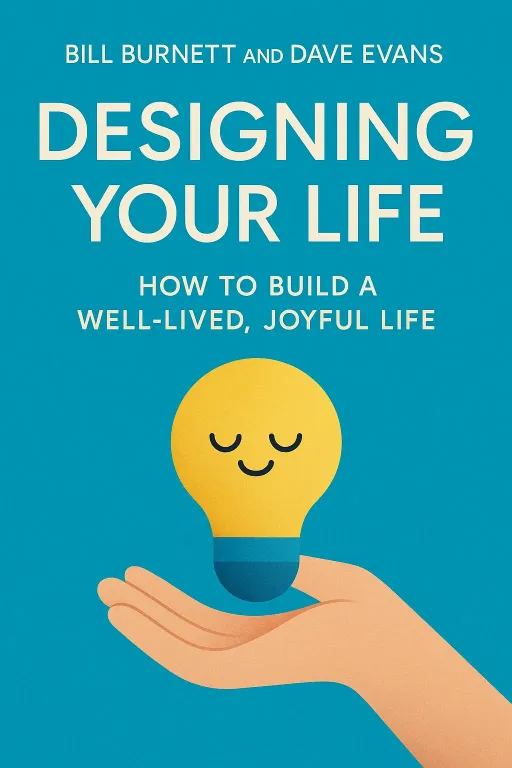
Nova: Exactly! And that's why we're diving into a couple of groundbreaking books today that challenge that very notion, offering a much more practical and frankly, less stressful approach to finding your professional path. Specifically, we'll be discussing insights from by Bill Burnett and Dave Evans, and by Steve Dalton. What's fascinating about Burnett and Evans is they're both Stanford professors who teach a wildly popular course applying design thinking to life planning. They're literally teaching engineers and artists how to design their lives, not just their products, making what could be an abstract concept incredibly actionable.
Atlas: That's brilliant. It's like they’re saying, "Stop waiting for inspiration to strike, start building." And I imagine a lot of our listeners, especially those feeling a bit lost or wanting a change, are nodding along right now, because that search for purpose, that innate drive for direction, is a powerful force. But how do you actually that? How do you go from 'I don't know what I want to be when I grow up' to actually a career?
Designing Your Life with Prototyping
SECTION
Nova: That’s where the magic of design thinking comes in. Burnett and Evans argue that career reinvention isn't about finding 'the one' perfect path, but about actively exploring, prototyping, and strategically navigating the job market. They want you to think like a designer. Designers don't just sit in a room, brainstorm the perfect product, and then build it. They prototype, they test, they iterate.
Atlas: So you're saying instead of having a grand five-year plan that feels like it’s set in stone, I should have... a rough sketch? A series of small experiments?
Nova: Precisely. They introduce this incredibly liberating concept called 'Odyssey Plans.' Instead of plan for your next five years, they challenge you to map out career paths you could pursue. Don't worry about feasibility yet, just brainstorm.
Atlas: Three paths? Like, one could be an astronaut, another a baker, and the third a deep-sea diver? Even if I have absolutely no experience in any of those?
Nova: Exactly the spirit! One plan could be the one you're currently on, just optimized. The second could be your 'plan B' if plan A suddenly disappeared. And the third could be your 'wild card'—the dream you've always pushed aside because it seemed unrealistic. The point isn't to pick one, but to visualize different futures. They emphasize that this isn't about finding the perfect plan, it's about exploring possibilities. It's about getting unstuck from the idea that there's only one right answer.
Atlas: That’s actually really inspiring. Because for someone who's seeking clarity, that need for purpose can feel like a heavy burden. This approach sounds like it lightens that load, turning it into an adventure rather than an existential crisis. But what happens after you've got these three 'Odyssey Plans'? Do you just... look at them?
Nova: No, that's where the prototyping comes in. Once you have these plans, even if they're just on paper, you start to 'prototype' elements of them. This doesn't mean quitting your job and moving to a remote island to test out being a hermit. It means conducting small, low-risk experiments. This could be a conversation with someone in that field, taking a relevant online course, volunteering, or even just reading extensively about it.
Atlas: Okay, so it’s like dipping your toe in the water before you jump in. I like that. For people who are practical, who value tangible progress, this sounds much more appealing than endless introspection. It gives you something concrete to.
Nova: Absolutely. And this iterative process helps you gather real-world data about what genuinely excites you, what you're good at, and what environments you thrive in. You're constantly learning and adjusting, rather than committing to a path based on assumptions. It's a continuous design process. They even encourage 'life design interviews' where you talk to people living the lives you're curious about. It’s not a job interview; it’s an information-gathering mission.
Atlas: That makes perfect sense. It’s about building self-confidence and stability by actively testing the waters, rather than just hoping for the best. And what about the flip side? What if you've done all this prototyping and you've got a pretty good idea of what you want, but you're now facing the daunting task of actually that job?
The Strategic Job Search: Data-Driven Reinvention
SECTION
Nova: That's where Steve Dalton's enters the picture. If Burnett and Evans give you the blueprint for to explore, Dalton gives you the hyper-efficient, data-driven methodology for to land that next role. He essentially turns the job search into a science experiment.
Atlas: Two hours for a job search? That sounds a bit out there, Nova. For anyone who's ever spent months sending out hundreds of resumes into the abyss, that claim might sound almost offensive.
Nova: I know, right? But the title is a bit of a misnomer – it's not saying you'll a job in two hours. It's about designing a job search that, once set up, can be maintained in about two hours a week. It's about precision over volume. Dalton worked at Duke's Fuqua School of Business and saw countless bright MBAs struggle with the job search. He realized the traditional methods were incredibly inefficient.
Atlas: So basically you're saying, stop blindly applying to every opening on LinkedIn?
Nova: Exactly. His core insight is that the vast majority of jobs are filled through networking, not online applications. And most people network inefficiently. Dalton provides a systematic approach, using spreadsheets and a disciplined process, to identify target companies, find insiders, and strategically connect with them.
Atlas: Okay, so how does someone who's looking for a secure future, someone who wants actionable steps, actually implement this without feeling like they're just cold-calling strangers?
Nova: It starts with creating a 'L. A. M. P. List' – that's List, Alumni, Motivations, Posting. You start by brainstorming a List of 40-60 target companies that genuinely interest you. Then, you filter them based on people you might know there, especially Alumni from your schools, or people connected to your network. This is where you leverage your existing connections.
Atlas: Ah, so it's not just about applying to companies, but applying to companies where you might already have a sliver of an 'in.' That makes sense. It's about reducing the 'cold' in cold outreach.
Nova: Precisely. And then you research your Motivations for each company – why do you genuinely want to work there? This isn't just about sounding good in an interview; it's about genuine alignment. Finally, you look at their Job Postings to understand the roles and required skills. This whole process is about being incredibly targeted. You're not spraying and praying; you're using a sniper rifle.
Atlas: I see. So it's about building a strong professional network, but doing it in a highly structured way, transforming what often feels like a haphazard, uncomfortable process into a strategic campaign. It sounds like it cultivates a positive mindset too, because you're taking control.
Nova: Completely. Instead of feeling like a victim of the job market, you become an active participant, almost a detective. Dalton emphasizes that you're looking for information, not just a job. You're trying to understand the landscape, build relationships, and get referred. Because a referral is exponentially more powerful than a resume sent into the void.
Atlas: That's such a powerful takeaway. Because when you're in the midst of career reinvention, it's easy to feel overwhelmed. But combining these two approaches – the design thinking for exploration and the strategic job search for execution – it really does create a comprehensive toolkit.
Synthesis & Takeaways
SECTION
Nova: It’s truly about empowering people. These books collectively tell us that career reinvention isn't a magical, singular event, but a continuous process of exploration and strategic action. It’s not about waiting for 'the one' perfect path to appear, but about actively exploring, prototyping, and then strategically navigating the job market with data and purpose.
Atlas: And for anyone out there seeking clarity, wanting actionable steps, and driven by a need for self-confidence and stability, this approach is a game-changer. It transforms the overwhelming unknown into a series of manageable, exciting experiments. It's about embracing this moment of exploration as a new beginning, not a lost one.
Nova: Absolutely. Start with those three 'Odyssey Plans' – don't worry about feasibility, just brainstorm. Then pick one tiny step, one small, consistent action towards a new skill or connection, and prototype it. If failure wasn't an option, what career reinvention would you be most excited to prototype in the next six months? That's your deep question for today.
Atlas: What a fantastic way to reframe the entire journey. It reminds us that our careers are living documents, not finished masterpieces. And we have the tools to be the designers.
Nova: This is Aibrary. Congratulations on your growth!









