

Designing Your Ideal Life and Career
Golden Hook & Introduction
SECTION
Nova: Forget "finding your passion" and "having a single, grand 5-year plan." What if the secret to a meaningful, satisfying life isn't a rigid blueprint, but a series of small, intentional experiments, a bit like a scientist in a labcoat, but for your own existence?
Atlas: Oh, I love that! Because honestly, the pressure to find that one true calling, that perfect path... it can feel paralyzing. It makes you feel like you're failing before you even start.
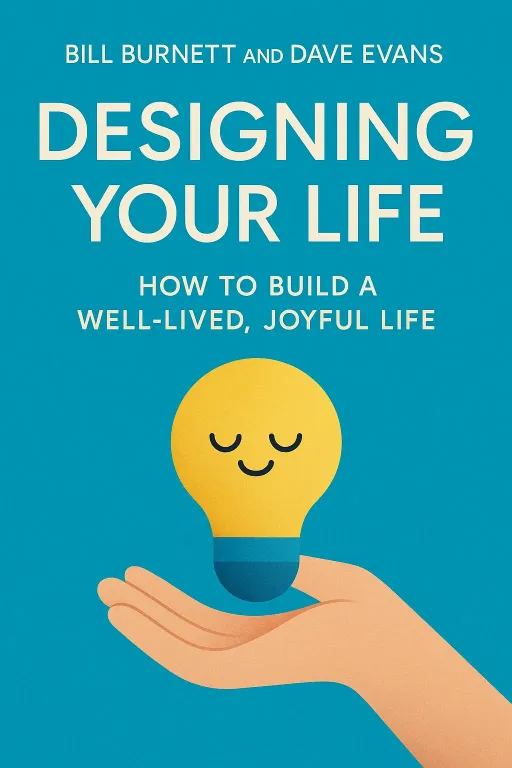
Nova: Exactly! And that's where the brilliance of "Designing Your Life" by William Burnett and David J. Evans comes in. These aren't some self-help gurus; they're design professors from Stanford University, and this book grew out of their wildly popular course, making sophisticated design principles accessible for everyday life challenges.
Atlas: That's fascinating. Taking something as abstract as "design thinking" and applying it to something as messy as life? And speaking of making big things less messy, that also perfectly sets up Robert Twigger's "Micromastery." Twigger, an acclaimed adventurer and polymath, has shown us that you don't need years to become proficient in a new skill, just focused bursts. He’s mastered everything from martial arts to obscure languages!
Nova: And that's what we're talking about today. How to stop waiting for life to happen you, and start actively designing it, not with a magic wand, but with a toolkit of iterative experiments and the confidence built from small, achievable skills.
Designing Your Life with Iteration & Prototyping
SECTION
Nova: So, let's dive into "Designing Your Life." The core idea here is that you don't your way; you your way forward. It's about applying the same principles that designers use to create products—iteration, prototyping, and reframing problems—to the biggest product of all: your own life and career.
Atlas: So you're saying we don't need a single "North Star" to guide us? That's a huge relief for many of us who feel stuck trying to find it, especially when time is scarce and every decision feels high-stakes. How does this "building" process actually work?
Nova: It starts with getting curious and trying things. They emphasize that instead of agonizing over a perfect plan, you should generate multiple "Odyssey Plans"—different versions of your next five years, each equally viable. This immediately reduces the pressure. But the real magic happens with prototyping.
Atlas: Okay, "prototyping" in a life context. What exactly does that mean? Are we talking about building a cardboard model of my future office? Because that sounds... inefficient.
Nova: Not quite a cardboard model, though the spirit is similar! A life prototype is a low-cost, low-risk experiment designed to test an assumption or explore an interest. Let's say you're in a demanding role, but you've always wondered about becoming a baker. The traditional advice might be "quit your job and go to culinary school." That's a huge, risky leap.
Atlas: Which for our pragmatic learners, who are focused on impact and progress, sounds like a recipe for disaster if it doesn't pan out. So, what's the design thinking alternative?
Nova: A prototype. Instead of quitting, you might volunteer at a local bakery on weekends for a month. You could take a single bread-making class. Or, crucially, you could conduct a "life design interview" – talk to three professional bakers about their daily lives, their challenges, their joys. What do you learn from those small, cheap experiments?
Atlas: That's brilliant. It feels like you're gathering real-world data without betting the farm. I imagine a lot of our listeners, especially those juggling demanding careers, might feel that pressure to make the 'right' big decision. This iterative approach feels less daunting and much more in line with maximizing learning.
Nova: Precisely. You're not committing; you're. And if you learn you actually hate the early mornings or the repetitive tasks of baking, you haven't wasted years or thousands of dollars. You've gained valuable insight and can pivot. This also ties into "reframing problems." Instead of "I hate my job," which is a stuck problem, you reframe it to "How can I improve my work experience?" or "How can I leverage my skills differently?" That immediately opens up new avenues for prototyping.
Atlas: So the goal isn't necessarily to find the job, but to find ways to make your job or jobs more satisfying through small, testable changes. That's a powerful shift in mindset. It's about agency, not just waiting for inspiration to strike.
Micromastery & Building Confidence through Small Wins
SECTION
Nova: And this idea of taking small, actionable steps, of experimenting and learning, connects beautifully to our second book, Robert Twigger's "Micromastery." While "Designing Your Life" gives you the framework, "Micromastery" gives you the engine to make those small steps feel achievable and even joyful.
Atlas: Ah, micromastery. I'm curious how this fits into the grander scheme of life design. Is it just about learning cool party tricks, or something more profound for someone deeply driven by progress and impactful knowledge?
Nova: It's far more profound. Twigger argues that by focusing on small, achievable skills—a "micromastery"—you can gain confidence, build a foundation for larger achievements, and make learning less daunting and more enjoyable. It's not about the skill itself, but the of acquiring it. Think about it: learning to juggle three balls, tie a specific knot, or master a basic calligraphy stroke. These are skills you can learn to a competent level in a focused burst, maybe 20 hours over a few weeks.
Atlas: So it's like learning the 'meta-skill' of learning itself, through a low-stakes activity? For our pragmatic learners, that 15 minutes a day for focused learning suddenly feels incredibly powerful if it's building more than just one tiny skill.
Nova: Exactly! Twigger’s own journey, from mastering martial arts to learning obscure languages, underscores that these small wins create a positive feedback loop. Each micromastery proves to you, "I learn new things. I overcome initial clumsiness. I achieve competence through consistent effort." This builds self-efficacy, which is crucial for tackling those bigger life design prototypes.
Atlas: I can see that. The sheer satisfaction of achieving something, even small, can be incredibly motivating. But how does mastering, say, basic origami, tangibly help me design my ideal career in leadership or finance? I mean, it sounds fun, but what's the direct impact for someone looking for significant shifts in their professional trajectory?
Nova: The impact is less about the specific skill, and more about the and you develop. Micromastery teaches you problem-solving, discipline, how to break down complex tasks into manageable chunks, and how to overcome frustration. It trains your brain to engage with new challenges productively. That confidence you gain from consistently achieving small goals fuels the courage to prototype those bigger life design ideas. It's the engine for iteration.
Atlas: So, the little victories from micromastery give you the resilience and the belief in your own learning capacity to tackle the bigger unknowns of life design. It's about building mental muscle.
Nova: Precisely. It's about creating a personal growth flywheel. The small wins from micromastery make you more confident to try life prototypes. The insights from those prototypes guide your next small steps, and so on. It’s a continuous loop of learning, growing, and designing.
Synthesis & Takeaways
SECTION
Nova: So, bringing these two powerful ideas together, "Designing Your Life" gives you the strategic framework and the permission to experiment with your future, to iterate and prototype. "Micromastery" then provides the practical, confidence-boosting engine to those experiments, especially the small prototypes.
Atlas: That's a really powerful synthesis. It means instead of being overwhelmed by the idea of 'designing my ideal life,' I can start with a tiny experiment, like that baking example, and then use micromastery to build the skills and confidence to iterate on it. It’s like a feedback loop of continuous, manageable growth.
Nova: Precisely. It's about empowering yourself through continuous, manageable progress, rather than waiting for a moment of grand inspiration or a perfect plan to materialize. It’s about being an active participant in the creation of your own future.
Atlas: That’s such a hopeful way to look at it. It makes the grand ambition of an 'ideal life' feel less like an insurmountable mountain and more like a path to explore, one small, intentional step at a time. It truly reframes the entire process.
Nova: And that brings us to our Tiny Step for today, directly from the design thinking playbook. We challenge you to identify one small area in your life or career where you feel stuck. Then, brainstorm 3-5 wild ideas for how to approach it differently. Pick just one, prototype it for a week—do a quick experiment—and then reflect on what you learned.
Atlas: And we'd love to hear about your micromastery experiments and life prototypes. Share your insights and journeys with us on social media. We're always eager to connect with our community.
Nova: This is Aibrary. Congratulations on your growth!









