

Crafting a Life of Purpose & Intelligent Achievement
Golden Hook & Introduction
SECTION
Nova: You know, Atlas, there’s this pervasive myth out there, this almost sacred mantra, that if you just work harder, push longer, grind more, success is inevitable. It’s the default advice for everything.
Atlas: Oh, I know that feeling. It’s like the universe's broken record, right? Just "lean in," "hustle harder," "rise and grind." And honestly, for a lot of our listeners, especially those trying to navigate a career shift or find more meaning, it often feels like leaning in just makes you fall over faster.
Nova: Exactly! And what if I told you that blindly working harder isn't just inefficient, it can actually be counterproductive? What if the secret to a truly fulfilling and impactful life isn't about effort, but about effort?
Atlas: Hold on, intelligent effort? That sounds a bit like saying "breathe smarter." I mean, how do you even quantify that? Is there a secret formula I’ve been missing while I’m busy trying to juggle all the things?
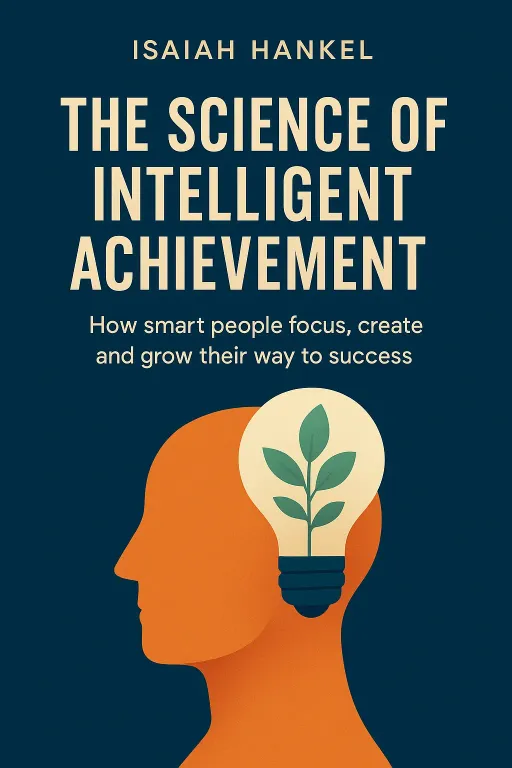
Nova: Well, it’s less of a secret formula and more of a strategic framework. Today, we're diving into two incredibly powerful books that challenge this conventional wisdom and offer a roadmap for building a life that's not just successful, but deeply purposeful. We're talking about Isaiah Hankel's "The Science of Intelligent Achievement" and William Burnett and David J. Evans' "Designing Your Life."
Atlas: Ah, "Designing Your Life"! I've heard whispers about that one. Coming from Stanford's renowned design school, right? That lends some serious credibility to applying creative problem-solving to, well, life itself.
Nova: Absolutely. Burnett and Evans brought their hugely popular Stanford course to the masses, showing that the same principles used to design products can be used to design a meaningful existence. And Hankel, with his background as a former scientist who pivoted into human performance and achievement, offers a perspective grounded in objective strategy rather than just motivational fluff. He really breaks down the mechanics of intentional success.
Atlas: That’s a great pairing. So, one is about to achieve intelligently, and the other is about to achieve and how to explore it. I imagine a lot of our listeners, especially those feeling a bit adrift or stuck in a career they’ve outgrown, are craving this kind of actionable wisdom. They want to make a meaningful impact, but the path isn't always clear.
Nova: Precisely. And that naturally leads us into our first core idea: the science of intelligent achievement.
The Science of Intelligent Achievement: Beyond Mere Effort
SECTION
Nova: So, let's start with Hankel. He argues that most people operate on what he calls "blind effort." They work incredibly hard, but without a clear understanding of their true passion, their unique strengths, or a strategic roadmap. It's like an archer shooting arrows in the dark, hoping to hit a target they can't even see. They might hit, but it's rarely the bullseye they truly desire.
Atlas: That resonates. I think many of us have been that archer at some point, right? Just firing away, exhausting ourselves, and then wondering why we feel unfulfilled even if we've technically "succeeded" by someone else's metrics. So, what's the intelligent alternative?
Nova: Intelligent achievement, as Hankel defines it, is about aligning your personal passion with strategic action. It’s about being incredibly intentional. It involves three key components: clarity of purpose, strategic focus, and consistent, aligned effort. It's less about the sheer volume of work and more about the precision and direction of that work.
Atlas: Okay, so it’s not just "work smarter, not harder" — it's "work smarter,, on the." That makes sense. But how does someone, especially in a demanding role or during a big life transition, actually that? It sounds great in theory, but the daily grind can make clarity feel like a luxury.
Nova: That's a critical point, and it’s where his framework really shines. Let me give you an example. Imagine Sarah, a marketing executive. She was incredibly successful by conventional standards: big title, good salary, long hours. But she felt utterly drained, a deep sense of 'is this all there is?' She was working hard, but it wasn't achievement because it wasn't aligned with her deeper values.
Atlas: I know that feeling. Honestly, that sounds like my Monday mornings sometimes. What did she do?
Nova: Instead of just pushing through, Hankel's approach would guide her to pause and gain clarity. Sarah realized her true passion was empowering women in STEM. Her strategic action wasn't to quit her job immediately, but to her current projects. She started volunteering for diversity initiatives within her company, using her marketing skills to highlight female engineers. She also began taking online courses in non-profit management, building skills that aligned with her emerging purpose.
Atlas: So she wasn't just working hard on her existing job; she was strategically redirecting some of that effort, or even her free time, towards something that fueled her.
Nova: Exactly. The process involved identifying her core values—impact, empowerment, learning—and then consciously seeking or creating opportunities that allowed her to express those values. The outcome wasn't just a new job; it was a profound shift in her daily experience. She found that the energy she put into her passion projects actually her for her day job, and eventually, her strategically built network and skills led her to a leadership role at a non-profit focused on women in tech.
Atlas: That’s a really powerful example. It illustrates that intelligent achievement isn't about escaping work, but about transforming it. It’s about finding the lever, not just pushing the cart harder. So, once you have that clarity of purpose and strategic focus, how do you actually figure out the to get there? Because for many, that’s the biggest hurdle.
Designing Your Life: Prototyping Your Future
SECTION
Nova: That's a perfect segue, Atlas, because once you know to achieve intelligently, the next question is to achieve, and how to explore those possibilities without feeling like you're making irreversible commitments. This is where "Designing Your Life" by Burnett and Evans comes in, applying the ingenious principles of design thinking to personal and career development.
Atlas: Design thinking for life? That’s intriguing. I always associate design thinking with creating products or solving business problems. How do you apply something like that to, say, figuring out if you want to be an entrepreneur or a therapist?
Nova: Well, it reframes your life as a design problem, which is inherently solvable and iterative. You wouldn't design a new smartphone and expect to get it perfect on the first try, right? You'd prototype, test, get feedback, and refine. Burnett and Evans suggest we treat our lives the same way. One of their most powerful tools is the "Odyssey Plan."
Atlas: Odyssey Plans? That sounds epic, like a journey. But for someone needing to make real choices and pay bills, isn’t that just a lot of daydreaming? How do you move from imagining to without risking everything?
Nova: That’s precisely where the "prototyping" aspect becomes crucial. An Odyssey Plan is about envisioning three completely different five-year versions of your life. Not just one ideal path, but three distinct, viable options. For example, one might be your current path extrapolated, another could be what you’d do if money were no object, and a third could be what you’d do if your current path suddenly disappeared. The goal isn't to pick one, but to generate possibilities and identify common themes.
Atlas: Okay, so it’s about expanding your imagination beyond the obvious. I can see the value in that for gaining mental clarity amidst the noise. But then what? You can't just pick one of those Odysseys and jump in blindly. That sounds incredibly risky.
Nova: And you absolutely shouldn't! That's where prototyping comes in. Once you have these Odyssey Plans, you don't commit to any of them. Instead, you design small, low-risk experiments—or "prototypes"—to test aspects of these potential futures. The goal is to gather data and insights about what truly energizes you, what challenges you, and what feels right, before making big, irreversible decisions.
Atlas: That’s actually really clever! So it's like A/B testing your life? Can you give me an example of a small prototype? I'm thinking about our pragmatic learners here, who want actionable steps they can take this week.
Nova: Definitely. Let's say someone is in a corporate job but is considering a complete career change to become a baker, a long-held dream. A non-prototyping approach would be to quit their job, enroll in culinary school, and open a bakery, only to discover they hate the early mornings and physical demands. That's a high-risk, high-cost failure.
Atlas: Yeah, that's the kind of irreversible commitment that paralyzes people.
Nova: Exactly. A prototype, on the other hand, might involve: spending a Saturday volunteering at a local bakery, talking to three professional bakers about their daily routines and challenges, taking a single bread-making class, or even just trying to bake and sell a few loaves to friends and family. These are all low-cost, low-commitment ways to "test drive" the experience. The cause: a curiosity about a new path. The process: small, directed experiments. The outcome: concrete, real-world data about whether that path truly aligns with their desires and capabilities, without jeopardizing their current livelihood.
Atlas: Wow, that's incredibly insightful. So it's about gathering intelligence on your potential futures before you make the leap. For someone trying to optimize their daily output or find focus amidst the noise of options, this provides a structured way to explore without the fear of failure. It feels much more empowering than just waiting for inspiration to strike.
Synthesis & Takeaways
SECTION
Nova: Absolutely. When you combine these two frameworks, you get an incredibly potent recipe for crafting a life of purpose and intelligent achievement. Hankel gives you the internal compass and strategic engine—how to align your passion with focused action. Burnett and Evans give you the external map and the test-driving tools—how to explore and validate those potential paths without fear.
Atlas: So it's not just about finding your purpose, it's about actively building it, testing it, and then strategically pursuing it. That sounds incredibly empowering for anyone feeling stuck or at a crossroads, especially if they're driven by purpose and want to make a meaningful impact. It moves them from passive acceptance to conscious navigation.
Nova: Exactly. It's about becoming the architect of your own life, not just a passenger. It’s about understanding that every step, even the small prototype, is progress towards a more deeply fulfilling existence.
Atlas: That's such a hopeful way to look at it. It gives people permission to experiment, to be curious, and to learn, rather than feeling like they have to have all the answers right now.
Nova: And that brings us back to our deep question for our listeners today: Considering this design thinking approach, what small "prototype" could run this week to test an idea about your ideal career or life path? And how would you measure its "intelligent achievement" – not just by effort, but by the clarity, alignment, and insight it brings you?
Atlas: I love that. It’s about taking one tiny, actionable step. No grand declarations, just a little experiment to gather data on your own life. That makes it feel achievable, not overwhelming.
Nova: Start small, learn fast, and build big. That's the intelligent way forward.
Atlas: This is Aibrary. Congratulations on your growth!









