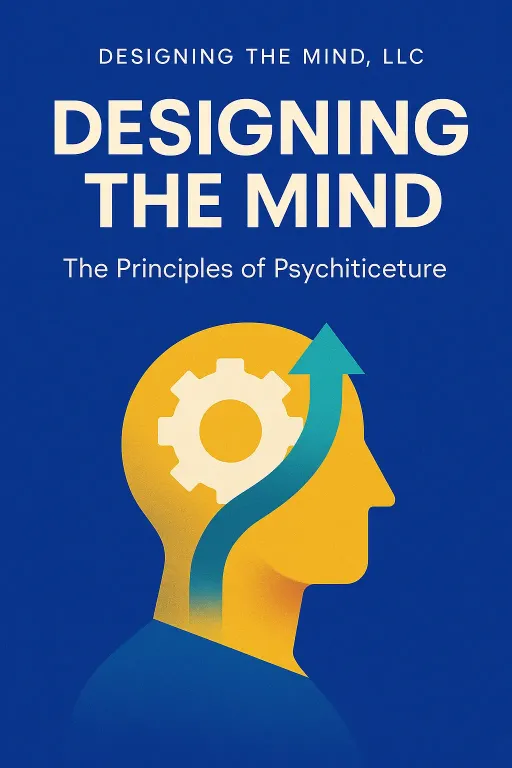
** The Psychitect's Blueprint: Reprogramming the Entrepreneurial Mind
Golden Hook & Introduction
SECTION
Nova: Imagine waking up tomorrow and realizing that your self-doubt, your anxiety, and even your deepest habits aren't permanent parts of who you are. They're just poorly written lines of code in your mental software. What if you could debug your own mind? Welcome to today's episode! We are diving into the fascinating world of. And we have a truly special guest with us today. Precious, the brilliant mind behind HOG Exotic Caps and the Forge Global Network, is here to help us unpack this. Precious, welcome!
Precious: Thanks, Nova! It is fantastic to be here. You know, as soon as I picked up this book, the concept of "psychitecture" clicked for me. As an entrepreneur, I spend my days building systems, optimizing supply chains, and scaling networks. The idea that we can apply that exact same engineering mindset to our own consciousness? That is a game-changer, especially for young leaders trying to find their footing in a chaotic world.
Nova: Oh, absolutely! We love that connection. Today, we're going to tackle this book from three different angles. First, we'll explore how to align our goals with our deepest values using a structured hierarchy. Then, we'll discuss how to reprogram our emotional algorithms to build unshakeable equanimity. And finally, we'll focus on how to design our environments and habits to automate self-control without relying on exhausting willpower. Ready to dive in, partner?
Precious: Let's do it. Let's look at the blueprint.
The Mind as an Operating System: Aligning the Goal Hierarchy
SECTION
Nova: So, let's start with this beautiful analogy the book uses: the mind as a computer. The brain is the hardware, but our thoughts, beliefs, and habits? That's the software. And the author makes this bold claim right out of the gate: the human condition, as we know it, is optional. We don't have to run on the default factory settings!
Precious: That is such a powerful starting point. In business, if you run a company on outdated, default software, you get disrupted. You fail. Yet, so many of us run our lives on default psychological software that was programmed by evolution thousands of years ago, or by social conditioning when we were kids. The book talks about how our belief systems are just "maps" of reality, not the actual territory. If your map is full of errors, you're going to make terrible strategic decisions.
Nova: Yes! And one of the biggest areas where our maps get warped is in what we choose to pursue. The book introduces this concept of the "Goal Hierarchy." Think of it like a tree. At the very bottom, you have your daily actions—like checking your emails or making a sales call. In the middle, you have your strategies. And at the very top, you have your ultimate, abstract values.
Precious: Right, and the problem is that most people have an incredibly incoherent goal hierarchy. They are taking actions every day without knowing what ultimate value those actions are serving. The book shares this brilliant, almost tragic story of a reporter interviewing a young shepherd. The reporter asks, "Why do you herd sheep?" The shepherd says, "To get rich." "Why do you want to get rich?" "To get married." "Why do you want to get married?" "To have a son." "And why do you need a son?" And the shepherd replies, "So he can herd the sheep when I'm old."
Nova: It's a complete loop! A closed, cyclical loop of survival with no actual destination. We're just herding sheep to herd more sheep.
Precious: Exactly! It's a system with zero ROI on happiness. In the entrepreneurial world, we see this all the time. People get caught in the "hustle" loop. "Why are you working eighty hours a week?" "To scale my business." "Why?" "To make more money." "Why?" "To buy a bigger house." But they never stop to ask if a bigger house actually aligns with their core value of, say, freedom or deep connection. They've mistaken the cultural "decoys" of success for their actual, intrinsic values.
Nova: That is so true, Precious. We get sold these "tourist traps of life" by culture and industry. "Buy this, achieve that, and then you'll be happy." But science shows us the "Dukkha Bias"—our desires are biochemically designed for survival and reproduction, not lasting satisfaction. Dopamine is the "promise chemical," not the pleasure chemical. It drives us to, but once we, the satisfaction evaporates almost instantly.
Precious: It's the hedonic treadmill. As an INTJ, I look at this and think: this is a design flaw! If we want to build impactful businesses and empower the next generation of leaders, we have to teach them to audit their goal hierarchies. We need to ask ourselves the "Why" questions until we hit rock bottom—our core, intrinsic values, like wisdom, compassion, or creativity. Once those are defined at the top, we use reason to design the strategies and actions that flow from them. That's how you build a frictionless life.
Nova: "A frictionless experience with desire." I love that phrasing from the book. It's not about having no desires; it's about making sure your desires are carrying you exactly where your highest self actually wants to go.
Emotional Alchemy: Reappraisal over Suppression
SECTION
Nova: Now, once we have our goals aligned, we inevitably run into obstacles. And that brings us to the emotional realm of psychitecture. Precious, as a sales manager and founder, I'm sure you've faced your fair share of rejections, setbacks, and stressful moments. How did you react to those before, and how does the book's approach change things?
Precious: Oh, early on, every rejection felt like a personal attack. If a client said no, or a project fell through, my default emotional algorithm would trigger anxiety, self-doubt, and frustration. But the book introduces the "Principle of Cognitive Mediation," which is the foundation of Cognitive Behavioral Therapy, or CBT. It says that external events don't actually cause our emotions. It's our of those events that does. As Epictetus famously said, "Men are disturbed not by things, but by the views which they take of things."
Nova: Yes! It's that classic psychological example of the "Snake and the Stick." You're walking in the woods, you see a curved shape on the ground, and your amygdala instantly triggers a massive fear response. You jump back! But then you look closer and realize... it's just a stick. The fear dissipates. The external reality didn't change—the stick was always a stick. What changed was your cognitive appraisal of it.
Precious: Exactly. And the book argues that we are constantly doing this with much more complex situations. We get a rejection email, and our default algorithm appraises it as: "I am a failure, I will never succeed." That appraisal triggers depression or anger. But as "psychitects," we have the power of "reappraisal" or reframing. We can pause, step outside of our automatic thoughts, and rewrite the algorithm.
Nova: And let's be clear, this isn't just "toxic positivity" or pretending everything is fine. It's about finding the most and adaptive interpretation.
Precious: Right. It's cognitive realism combined with emotional optimism. Instead of suppressing the anger or sadness—which the book notes actually increases painful emotions and depressive symptoms over time—we use Socratic questioning to challenge the distortion. We ask: "Is this setback really permanent? Is it really pervasive? Does this rejection actually define my worth as a leader?"
Nova: Hmm, that's a crucial distinction. Suppression is like trying to hold a beach ball underwater. It takes constant effort, and eventually, it's going to pop up and hit you in the face. Reappraisal is like letting the air out of the ball. You dismantle the belief that was fueling the emotion in the first place.
Precious: Yes! And when you do this consistently, you build what the book calls "emotional robustness" rather than just resilience. Resilience is about bouncing back after you've been knocked down. Robustness is about not getting knocked down in the first place because your mind is so well-fortified. You become like that headland of rock Marcus Aurelius talks about—the waves break against you incessantly, but you stand fast, and the seething waters sink to rest around you.
Nova: That is such a beautiful image. And it leads to "equanimity"—that unshakeable freedom of mind. Imagine leading a team or running a business from that state of inner equipoise. Praise, blame, gain, loss... they're just data points. They don't shake your core.
Precious: It's the ultimate competitive advantage, Nova. When you aren't wasting energy on emotional drama, you can focus entirely on strategic execution and helping others. It's how we empower young leaders to face global challenges without burning out.
Architecting Behavior: Systems over Willpower
SECTION
Nova: So, we've aligned our goals, we've stabilized our emotions, but now we have to actually the work. We have to execute. And this is where behavioral algorithms come in. Precious, let's talk about the elephant in the room: willpower. We've all been told that if we just had more willpower, we'd eat healthier, work harder, and achieve our dreams. But the book totally busts this myth, doesn't it?
Precious: It absolutely does, and honestly, it's a relief! The traditional view of willpower as this depletable muscle that we just need to squeeze harder is highly flawed. The research shows that people with the highest self-control don't actually spend their days fighting heroic battles against temptation. Instead, they design their lives and environments so they rarely have to use willpower in the first place.
Nova: It's all about "Ontological Design"—the idea that we design our world, and then our world acts back on us and designs us. If you want to stop eating junk food, don't buy it and put it on your counter hoping you'll resist it. Don't even bring it into the house! You modify the environmental input to automate the behavioral output.
Precious: Exactly. It's about building systems. In retail e-commerce, we don't rely on our sales team to just "remember" to follow up with every lead through sheer willpower. We build a CRM system that automates the reminders. We design the workflow so the correct action is the easiest one to take. We need to do the same thing with our personal habits. The book talks about "implementation intentions"—instead of saying "I want to read more," you program a specific algorithm: "If it is 8:00 PM and I am sitting on the couch, then I will open my book and read for twenty minutes."
Nova: Oh, I love that! It takes the decision-making out of the moment. You've pre-programmed the response. And speaking of pre-programming, the book also mentions "pre-commitment strategies." Like the classic story of Ulysses tying himself to the mast of his ship so he could hear the Sirens' song without throwing himself into the sea. We can use our existing drives—like our aversion to losing money or our desire for social approval—to lock ourselves into positive behaviors.
Precious: Yes! I love the example of using financial commitments or social accountability. For instance, the book mentions virtual coworking tools like Focusmate, where you pair up with a stranger, state your goals at the start of an hour, and work silently. You are leveraging your natural social drive for approval to keep your focus. Or, you can use "temptation bundling"—only allowing yourself to listen to your favorite podcast or play fantasy football while you're on the treadmill.
Nova: It's like rotating your existing drives so they stack onto your weaker habits. You're hacking your own biological reward system!
Precious: It's brilliant. And as you repeat these behaviors, they start to shape your identity. The book references James Clear's idea that "every action you take is a vote for the type of person you wish to become." If you practice consistently, you stop seeing yourself as "someone trying to learn the guitar" and start identifying as "a musician." Once that identity shifts, the behavior becomes natural. It's no longer a struggle; it's just who you are.
Synthesis & Takeaways
SECTION
Nova: This has been such an incredibly rich conversation, Precious. We've covered so much ground! From treating our minds as customizable software, to aligning our goal hierarchies with our true values, to using cognitive reappraisal for emotional robustness, and finally, designing our environments to automate our habits. If you had to synthesize all of this into one core message for our listeners, what would it be?
Precious: I would say: stop being a passive user of your mind, and start being its architect. You are not your thoughts. You are not your automatic emotions. You are the programmer. If there is a part of your life that isn't working—if you're feeling stuck, anxious, or unaligned—don't just try to change your external circumstances. Look at the software running in your head. Audit your goals, debug your cognitive biases, restructure your emotional reactions, and design your behavioral inputs.
Nova: That is a beautiful call to action. And for everyone listening, remember that this is a gradual, iterative process. It's about those "one-percent shifts," that daily Kaizen of the mind. You don't need to rewrite your entire operating system overnight. Just start beta-testing one new algorithm today. Precious, thank you so much for sharing your strategic brilliance and systems-thinking with us today. You are a true psychitect!
Precious: Thank you, Nova. It's been an absolute pleasure. To everyone listening, go download the Psychitect's Toolkit, start questioning your "why," and remember: the privilege of owning yourself is worth any price. Keep designing your mind!
Nova: Well said! And to our listeners, thank you for tuning in. Until next time, keep optimizing, keep growing, and keep shining!