

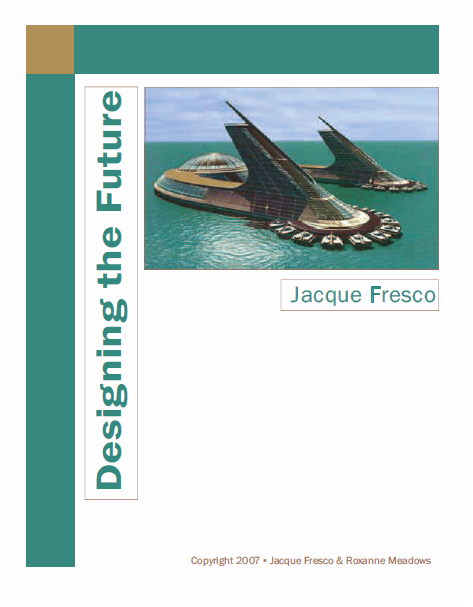
Designing the Future: From Utopian Blueprints to Aligned Systems
Golden Hook & Introduction
SECTION
Nova: What if our biggest global problems—poverty, pollution, even war—aren't inevitable facts of life? What if they aren't moral failures, but simply... design flaws? That's the provocative question at the heart of Jacque Fresco's book, 'Designing the Future.' He argues that the fundamental operating system of our society, the monetary system, is obsolete and is actively preventing us from creating a sustainable and equitable world.
Freddie Williams: And as someone who spends their days designing and evaluating systems, that framing—society as a system with a potential design flaw—is incredibly compelling. It moves the problem from something intractable and emotional to something that can be analyzed and, potentially, redesigned.
Nova: Exactly! And that’s why I’m so excited to have you here, Freddie. With your work at the intersection of governance, infrastructure, and human-centered design, you are the perfect person to explore these huge ideas with. Today we'll dive deep into this from two perspectives. First, we'll explore Fresco's diagnosis of our current world as a system that is 'scarcity by design,' driven by profit and planned waste.
Freddie Williams: A concept I see echoes of every day.
Nova: I bet. Then, we'll discuss his radical solution: a global 'Resource-Based Economy,' and what that could mean for how we build and govern our future. It’s a conversation about moving from a world of extraction to a world of alignment.
Deep Dive into Core Topic 1: Scarcity by Design
SECTION
Nova: So let's start with the diagnosis. Fresco's main target is what he calls the 'price system.' For him, this isn't just about money, it's the entire logic of our economy. What does he mean by that, and why does he see it as the root of the problem?
Freddie Williams: I think people hear 'price system' and just think of buying and selling. But it's deeper, right? It's the mechanism that assigns value.
Nova: Precisely. And Fresco's core insight is that this mechanism has a fatal flaw: it requires scarcity to function. If something is infinitely abundant, like the air we breathe, you can't put a price on it. Its economic value is zero. So, for value to exist, for profit to be made, there must be some level of scarcity, either natural or, and this is the key, artificial.
Freddie Williams: So the system has a built-in incentive to limit access or availability. That's a fundamental misalignment right at the core of the operating system.
Nova: You've hit the nail on the head. And the most tangible example he gives, one we all experience, is planned obsolescence. Let's just walk through it. Think about the smartphone in your pocket. It's a miracle of technology. But it's absolutely not designed to last as long as it could.
Freddie Williams: Oh, absolutely not.
Nova: Right? The manufacturer might use a proprietary screw so you can't open it easily. The battery is often glued into the casing, making it nearly impossible for a normal person to replace. After two or three years, you'll find that software updates for your model stop, and new apps start to run slowly or not at all, pushing you to buy the new version.
Freddie Williams: It's a forced upgrade cycle. The system isn't designed for the user's primary goal, which is to have a reliable communication device for as long as possible. It's designed for the manufacturer's goal, which is to sell another unit.
Nova: Exactly! And Fresco would say this isn't because the engineers are evil or the company is greedy, though that might be true. It's because they are playing by the rules of the price system. In a world where you need to keep selling things to stay in business, a product that lasts forever is a disaster. So we get a system that is, by design, incredibly wasteful. We're strip-mining the planet for rare earth metals to build phones that we're intentionally designing to be thrown away in three years.
Freddie Williams: That's a perfect example of what I would call an 'extractive' model. The design's purpose is to extract maximum value—in this case, money—from the user and the environment over the shortest possible time. It's the polar opposite of an 'aligned' system, where the goal would be to create durable, repairable, upgradable tools that serve human needs while minimizing resource use.
Nova: And you see this extractive logic in your work in infrastructure and governance?
Freddie Williams: All the time. You see it when a public infrastructure project is built by a private company whose contract incentivizes cutting corners on materials to maximize profit, leading to higher maintenance costs for the public down the line. The system is designed to extract profit during construction, not to provide value over a 50-year lifespan. It's the same logic as the smartphone, just on a massive, civic scale. Fresco's diagnosis feels spot on; it's a design flaw that replicates itself everywhere.
Deep Dive into Core Topic 2: The Re-Design: A Resource-Based Economy
SECTION
Nova: Exactly. It's a system designed for churn, not for stewardship. So if that's the problem, what's Fresco's solution? This is where it gets really ambitious, almost into the realm of science fiction for some. He proposes we eliminate money entirely and move to what he calls a 'Resource-Based Economy.'
Freddie Williams: Okay, so this is the big leap. How does that even work? What replaces the price system as a way to allocate things?
Nova: This is the core of his vision. He says we should replace it with science and technology. Imagine a global, interconnected computer system—a kind of benevolent, super-intelligent AI. This system's job is to conduct a continuous survey of the entire planet. It knows where all the copper is, how much fresh water is in every reservoir, what the real-time energy capacity of our solar and wind farms is. It's a dynamic, global inventory.
Freddie Williams: So it's a system of pure information and logistics, not value and exchange.
Nova: You got it. And on the other side, it knows what human needs are. Not wants, but needs: nutritious food, clean water, shelter, education, healthcare. The system's entire purpose is to solve the logistical problem of matching available resources to human needs in the most efficient and sustainable way possible.
Freddie Williams: So if I need a place to live...
Nova: You don't go get a mortgage. You submit a request. The system analyzes your needs, the local environment, and the available materials, and then it designs and 3D-prints a highly efficient, beautiful home for you. If you need to get across town, you don't own a car. You summon an autonomous electric vehicle from a shared public fleet. It’s a transition from a system of managing people through laws and money, to a system of intelligently managing resources and processes.
Freddie Williams: Hmm. That's a massive paradigm shift.
Nova: It is! But Freddie, from your perspective in governance and building lawful, scalable systems, this sounds like both a paradise and a potential nightmare. What does 'governance' even look like in a world without laws based on property and commerce? How do you ensure a system like this remains 'human-centered' and not just a cold, efficient machine?
Freddie Williams: That is the billion-dollar question, even in a world without dollars. You know, the 'lawful' part of my work isn't just about adhering to existing regulations; it's about embedding core principles into a system's logic. In Fresco's world, the 'laws' would be the ethical constraints and primary goals we program into that central AI. This is where it gets both exciting and dangerous.
Nova: How so?
Freddie Williams: Well, who decides on those ethics? This is where I think modern conversations can add to Fresco's vision. For example, many Indigenous-led institutional frameworks are built on principles like 'seven-generation thinking'—the idea that every decision must be considered in terms of its impact on our descendants seven generations into the future. Or the principle of reciprocity with the natural world.
Nova: So you could, theoretically, code those principles into the AI as its prime directives.
Freddie Williams: Exactly. The goal isn't just 'maximum efficiency.' The goal is 'maximum holistic well-being for humans and the biosphere, sustained over centuries.' That's a very different kind of lawful framework. The 'human-centered' part is the other side of that coin. It's about protecting us from the system itself. A system that provides for all your material needs could easily become a perfect, comfortable cage. It removes struggle, but does it also remove purpose?
Nova: The freedom to strive and fail.
Freddie Williams: Right. A truly human-centered design would have to ensure that once our basic needs are met, the system's next priority is to maximize opportunities for creativity, learning, community, and self-actualization. It has to serve our higher needs, not just keep us fed and housed. The biggest risk of a perfectly logical system is that it doesn't account for the beautiful, illogical parts of being human. It must be a tool for liberation, not just management.
Synthesis & Takeaways
SECTION
Nova: So we've journeyed from a diagnosis of a system based on artificial scarcity and planned waste, to a truly radical vision of a future based on intelligent resource management. It's a huge leap.
Freddie Williams: It is, but the core principle is something we can use today. We don't have to wait for a global supercomputer to start thinking this way. It's about shifting our design philosophy, in any project, from extraction to alignment. Even on a small scale, that shift is powerful.
Nova: I love that. It brings this giant idea right back down to earth. It’s a mindset, not just a blueprint.
Freddie Williams: It's a lens. A way of seeing the systems around us more clearly.
Nova: So for everyone listening, especially those who design or manage systems of any kind, from a household budget to a corporate workflow or a piece of public policy, here's the takeaway question from Fresco, filtered through our conversation today.
Freddie Williams: When you look at a process, a product, or an institution, ask yourself: Is this designed for the health of the system as a whole—for the user, the community, the environment? Or is it designed to extract value for one small part of it?
Nova: Is it aligned, or is it extractive? Just asking that question, and trying to lean toward alignment in your own choices, can be the first step in designing a better future. Freddie, thank you so much for helping us unpack these incredible ideas.
Freddie Williams: It was my pleasure. It’s given me a lot to think about.