

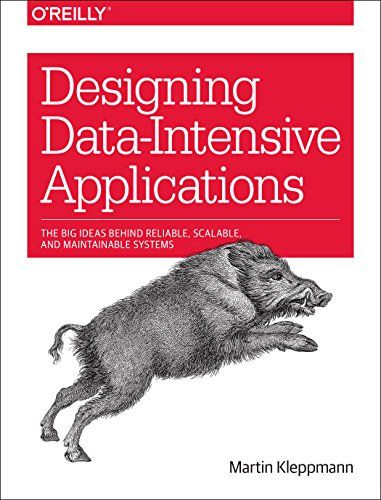
Designing Data-Intensive Applications
The Big Ideas Behind Reliable, Scalable, and Maintainable Systems
Introduction
Nova: If you have spent more than five minutes in a software engineering circle, you have probably seen a thick, white book with a wild boar on the cover. It is basically the holy grail of modern backend engineering. We are talking about Designing Data-Intensive Applications by Martin Kleppmann.
Atlas: Oh, the Boar Book. I have seen it on every senior engineer's desk, usually looking very intimidating and very well-read. But honestly, Nova, the title itself sounds like a mouthful. Data-intensive applications? Is not every app data-intensive these days?
Nova: That is a fair point, but Kleppmann makes a specific distinction. Most apps used to be compute-intensive, where the bottleneck was the CPU cycles. But today, the challenge is not how fast you can calculate something, but the sheer volume of data, the complexity of it, and the speed at which it changes. This book is the map for navigating that chaos.
Atlas: So it is not just a tutorial on how to use Postgres or MongoDB. It is more like the underlying physics of how all these systems actually work under the hood.
Nova: Exactly. It is about the trade-offs. Kleppmann’s whole philosophy is that there are no silver bullets in software, only trade-offs. And today, we are going to break down why this book changed the way we think about building systems that actually stay standing when the world tries to knock them down.
Key Insight 1
The Three Pillars of Data Systems
Nova: Kleppmann starts by defining what a good system even looks like. He breaks it down into three pillars: Reliability, Scalability, and Maintainability.
Atlas: Those sound like corporate buzzwords. I mean, everyone wants their app to be reliable. Does he actually give us a way to measure that?
Nova: He does. Reliability means the system continues to work correctly even when things go wrong. He calls these things faults. A fault is one component failing, but a failure is when the whole system stops providing service. The goal is to build fault-tolerant systems.
Atlas: So, like, if a hard drive dies in a data center, the user should not even notice?
Nova: Exactly. And then there is Scalability. This is where the book gets famous for its Twitter example. Think about how Twitter handles a tweet. When a normal person like me tweets, it only goes to a few hundred followers. But when someone like Taylor Swift tweets, it has to go to nearly a hundred million people instantly.
Atlas: Right, that is the fan-out problem. If you just write the tweet to a database and have every follower's home timeline query that database, you would crush the system every time a celebrity posts.
Nova: Precisely. Twitter actually had to move from a simple relational query to a system where they pre-compute every user's timeline. When a celebrity tweets, they have to merge that into millions of individual streams. It is a massive scalability challenge that shows there is no one-size-fits-all architecture.
Atlas: And the third pillar, Maintainability? That sounds like a problem for the people who inherit my code in three years.
Nova: Well, Kleppmann argues that most of the cost of software is in its ongoing maintenance. He focuses on operability, simplicity, and evolvability. If your system is so complex that no one understands how to change it without breaking it, it is not a successful design, no matter how fast it is.
Key Insight 2
Storage Engines and the Battle of the Trees
Nova: One of the most eye-opening parts of the book is when Kleppmann pulls back the curtain on how databases actually store data on a disk. He compares two main styles: B-Trees and LSM-Trees.
Atlas: Okay, I have heard of B-Trees. They are the classic ones used in relational databases like MySQL, right?
Nova: Right. B-Trees have been the standard since the 1970s. They break the database down into fixed-size pages and are very reliable for read-heavy workloads. But then you have LSM-Trees, or Log-Structured Merge-Trees, which are used in things like Cassandra or RocksDB.
Atlas: What is the big difference? Why do we need two ways to do the same thing?
Nova: It comes down to write speed. LSM-Trees are optimized for high-throughput writes. Instead of overwriting data in place, they just keep appending new data to a log. It is like a diary where you never erase anything; you just keep writing on the next line.
Atlas: But if you never erase anything, does not the diary get huge? How do you find anything?
Nova: That is the catch. They use a process called compaction in the background to merge and clean up old data. LSM-Trees are generally faster for writes, while B-Trees are often faster for reads. Again, it is that theme of trade-offs.
Atlas: It is wild to think that the choice of a data structure in the engine can dictate whether your entire application can handle a massive spike in traffic or not.
Nova: It really does. And Kleppmann explains that understanding these storage engines helps you choose the right tool for the job rather than just picking whatever is trending on Hacker News.
Key Insight 3
The Nightmare of Distributed Systems
Nova: Now we get to the part of the book that gives engineers nightmares: Distributed Systems. This is when you have data living on more than one machine.
Atlas: Which is basically every modern app. You cannot fit everything on one server anymore.
Nova: True, but once you have two servers, you have the problem of keeping them in sync. Kleppmann dives deep into replication and partitioning. Replication is having the same data on multiple nodes, usually for redundancy.
Atlas: But what happens if the network cuts out between those two nodes? If I update my profile on Node A, and Node B does not know about it yet, which one is the truth?
Nova: That is the classic CAP Theorem dilemma, though Kleppmann actually critiques the CAP theorem for being too simplistic. He talks about the reality of network partitions. In a distributed system, the network is unreliable. It will drop packets. It will have delays.
Atlas: So you have to choose between consistency, where everyone sees the same data at the same time, and availability, where the system stays up even if some parts are out of sync.
Nova: Exactly. He introduces the concept of Linearizability, which is the strongest consistency model. It makes the whole distributed system look like it is just one single copy of the data. But achieving that is incredibly expensive in terms of performance.
Atlas: I remember him talking about the split-brain problem too. That is when two different parts of your system both think they are the leader and start making conflicting decisions.
Nova: It is a disaster. Imagine two different servers both thinking they are the one in charge of processing payments. You could end up double-charging customers or losing data entirely. Kleppmann walks through consensus algorithms like Raft and Paxos that help machines agree on a single truth, even when the network is failing around them.
Key Insight 4
Unbundling the Database
Nova: In the final part of the book, Kleppmann looks toward the future. He talks about moving away from the idea of a single, giant database that does everything. He calls this unbundling the database.
Atlas: Unbundling? Like how people are unbundling cable TV into a dozen different streaming services?
Nova: Sort of! The idea is that a database is actually a collection of different functions: storage, indexing, caching, and query processing. In a complex system, you might want to use different tools for each of those.
Atlas: So instead of one giant Postgres instance, I might have a stream of data coming in through Kafka, which then feeds into a search index like Elasticsearch and a data warehouse like Snowflake simultaneously?
Nova: Exactly. He views data as a flow rather than a static state. This is the shift from Request-Response architecture to Event-Driven architecture. Instead of asking the database for the current state, you follow the log of everything that has ever happened.
Atlas: That sounds like it would make things way more complex to manage, though.
Nova: It can, but it also makes the system much more flexible. If you want to add a new feature, you just plug into the data stream. You do not have to migrate a massive, brittle database schema. It is about building systems that can evolve over time without a total rewrite.
Conclusion
Nova: We have covered a lot of ground, from the basic pillars of reliability to the complex world of distributed consensus and data streams. Designing Data-Intensive Applications is not just a book; it is a mindset shift. It teaches you to stop looking for the perfect tool and start looking for the right trade-offs.
Atlas: It definitely makes me realize that there is a lot more going on behind a simple Save button than I ever imagined. It is a bit humbling, honestly.
Nova: It really is. The biggest takeaway is that as an engineer, your job is to understand the guarantees your tools provide and, more importantly, the guarantees they do not provide. If you can do that, you can build systems that are truly resilient.
Atlas: So, if you are ready to move beyond just making things work and start making things that last, this is the book to dive into. Just be prepared for a few sleepless nights thinking about network partitions.
Nova: It is worth it, though. Understanding these fundamentals is what separates the juniors from the seniors.
Nova: This is Aibrary. Congratulations on your growth!