

Stop Guessing, Start Designing: The Art of Creative Problem-Solving
Golden Hook & Introduction
SECTION
Nova: What if I told you that the biggest obstacle to innovation isn't a lack of brilliant ideas, but a fear of looking foolish? That the very act of trying to be 'right' is what keeps us stuck in the wrong problems?
Atlas: Oh man, that hits home for so many people in high-stakes environments. It’s like we’re conditioned to present polished solutions, not raw, half-baked ideas. Is it really that simple? Just fear?
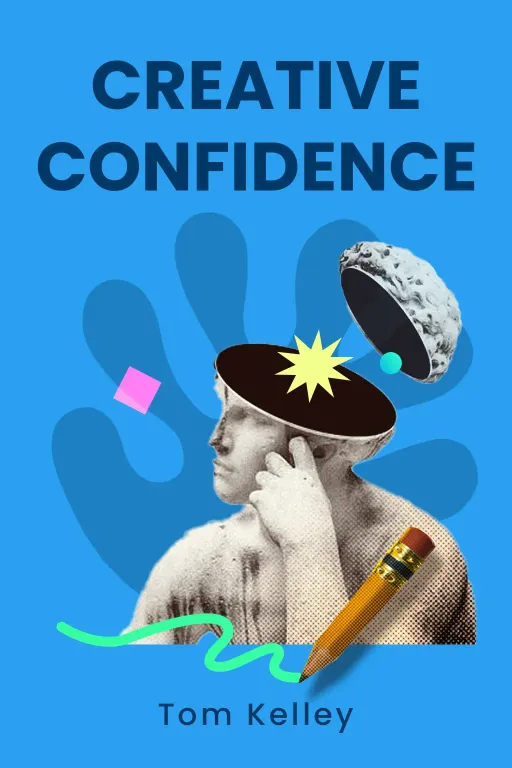
Nova: It's a huge part of it, Atlas. And that's exactly what we're diving into today. We're cracking open two seminal works that together form a powerful toolkit for systematic problem-solving: "Creative Confidence" by Tom and David Kelley, and "Design Thinking" by Nigel Cross. The Kelley brothers, founders of the legendary design firm IDEO and Stanford's d. school, have quite literally shaped how countless companies innovate. Their book became a massive hit for making creativity accessible to everyone, not just a select few.
Atlas: Right, so they're coming from the trenches of groundbreaking design, the real-world application.
Nova: Exactly. And then you have Nigel Cross, who comes from a deep academic background, articulating the fundamental principles of design as a way of thinking. His work influences how we approach complex systems, essentially defining the language of design thinking itself.
Atlas: So, one's from the world of practical, hands-on innovation, the other from the ivory tower defining its very language. Sounds like a powerful combination for anyone trying to move beyond just guessing and start actually designing solutions.
Nova: Absolutely. It's about transforming how we tackle challenges, moving from frustration to breakthrough.
Demystifying Creativity: From Innate Talent to Learnable Skill
SECTION
Nova: And that brings us to our first core idea: demystifying creativity. The Kelley brothers champion the idea that everyone is creative. It's not some innate, elusive talent reserved for artists or visionaries. It's a muscle that needs to be exercised. They argue that fear, not a lack of ability, often holds us back.
Atlas: But I mean, isn't it true that some people just creative? Like, we all know the "idea people" in a company, and then there are the rest of us, who are good at executing. It feels like a natural division.
Nova: That's a very common misconception, and it's precisely what "Creative Confidence" seeks to dismantle. The Kelleys, through their work at IDEO and the d. school, have seen countless people who initially label themselves "uncreative" blossom into innovative problem-solvers. They provide practical exercises designed to build this confidence, showing that creativity is a learnable skill. It's not about being an artist or a genius; it's about cultivating the courage to explore, to experiment, and to learn from failure.
Atlas: That's a huge mindset shift. For leaders trying to foster innovation in their teams, how do you even begin to build that kind of confidence in someone who’s convinced they’re not creative? What's a "tiny step" they could take to start flexing that muscle without feeling exposed or silly?
Nova: That's a brilliant question, and it's key to their approach. An exercise they might suggest is surprisingly simple: next time you're in a meeting and someone asks for ideas, even if you think your idea is ridiculous, just sketch it out. Or, try something completely unrelated to your work, like drawing your morning routine without judgment, or coming up with three radically different uses for a common object like a paperclip, beyond its obvious function. The point is not the quality of the output, but the act of generating, of trying, of engaging that part of your brain.
Atlas: So it’s about lowering the stakes, making it safe to fail, and building momentum through small, almost playful, wins. That makes sense for leaders trying to foster a culture of innovation. It's about removing the performance anxiety from the creative process.
Nova: Exactly. It's about recognizing that every "bad" idea is just a stepping stone to a better one. Creative confidence is the belief in your ability to create change, not necessarily to create a masterpiece on your first try.
Design Thinking: A Strategic Blueprint for Breakthroughs
SECTION
Nova: Once you have that burgeoning creative confidence, how do you channel it into solving, complex problems? That's where Nigel Cross's "Design Thinking" comes in. It provides a structured, human-centered methodology. Cross lays out the fundamental principles of design as a way of thinking, highlighting how designers approach problems. It's essentially a blueprint.
Atlas: Okay, so it’s a framework. We've got the confidence; now we need the map. What are the key stages of this design thinking blueprint? For strategists, we love a good framework.
Nova: The core principles are empathy, ideation, prototyping, and testing. Empathy is about deeply understanding the users or stakeholders you're designing for—their needs, their pain points, their desires. It means stepping into their shoes. Ideation is the expansive phase where you generate as many ideas as possible, building on that empathy.
Atlas: And that's where the creative confidence we just talked about really comes into play, I imagine. No bad ideas here, right?
Nova: Precisely. Then comes prototyping, which is about making your ideas tangible, even if they're rough. It could be a sketch, a role-play, a storyboard, or a very basic model. And finally, testing, where you put those prototypes in front of real users to get feedback, learn, and iterate. It’s a continuous loop.
Atlas: Okay, empathy makes sense, and ideation, but "prototyping"? For a strategic problem, like how to restructure a department to improve workflow, are we literally building a physical model of the office? Or is it more abstract? That's where it can feel a bit fuzzy for someone in a non-design field.
Nova: That's an excellent point, and it's where the "thinking" in "design thinking" truly shines. Prototyping in a strategic context doesn't always mean a physical object. For a department restructure, a prototype could be a detailed flowchart outlining new communication channels, a role-play simulation of new team interactions, or even a low-fidelity mock-up of a new digital tool. The goal is to make the abstract concrete enough so you can gather feedback and identify flaws you invest significant resources in full implementation. It's about reducing risk by learning quickly and cheaply.
Atlas: So it's not just for product designers, then. It's a method for anyone facing a complex, ill-defined problem, and it's about learning by doing, not just theorizing. That really resonates with the hands-on approach many innovators crave. It turns the often-daunting task of strategic planning into a series of manageable, iterative experiments.
Nova: Exactly. It moves you away from trying to get it perfect on the first try and embraces the idea that problems are best solved through continuous learning and refinement. It’s invaluable for product development, strategic planning, even optimizing outcomes in complex systems, which is a key aspiration for many of our listeners.
Synthesis & Takeaways
SECTION
Nova: So, what we've explored today is that creative confidence provides the mindset—the belief that you innovate—and design thinking provides the method—the structured approach to actually it. Combining them transforms problem-solving from a frustrating guessing game into a systematic, human-centered process of discovery and creation.
Atlas: It sounds like it turns uncertainty into a structured adventure, where every 'failure' is just data for the next iteration. That's a powerful shift for anyone trying to navigate complex systems, especially when the stakes are high. It reframes problems as opportunities to learn and refine.
Nova: Absolutely. It empowers you to approach innovation with a structured yet imaginative mindset, recognizing that creative problem-solving is a learnable skill, not an innate talent. It truly puts the power of design into everyone's hands.
Atlas: Which brings us back to that simple, yet profound, "tiny step" we can all take. Next time you face a complex problem, don't just stew over it. Try sketching out three radically different solutions, even if they seem silly at first. Just get them out there, make them tangible.
Nova: Embrace the playful experimentation. Allow new ideas to flourish without immediate judgment. That’s where the real breakthroughs happen. It’s about trusting your innate curiosity.
Atlas: And that's also where you start building that creative confidence, little by little. It’s an investment in your own capacity for innovation.
Nova: It is. And it’s an investment that pays dividends in every aspect of your work and life.
Nova: This is Aibrary. Congratulations on your growth!